
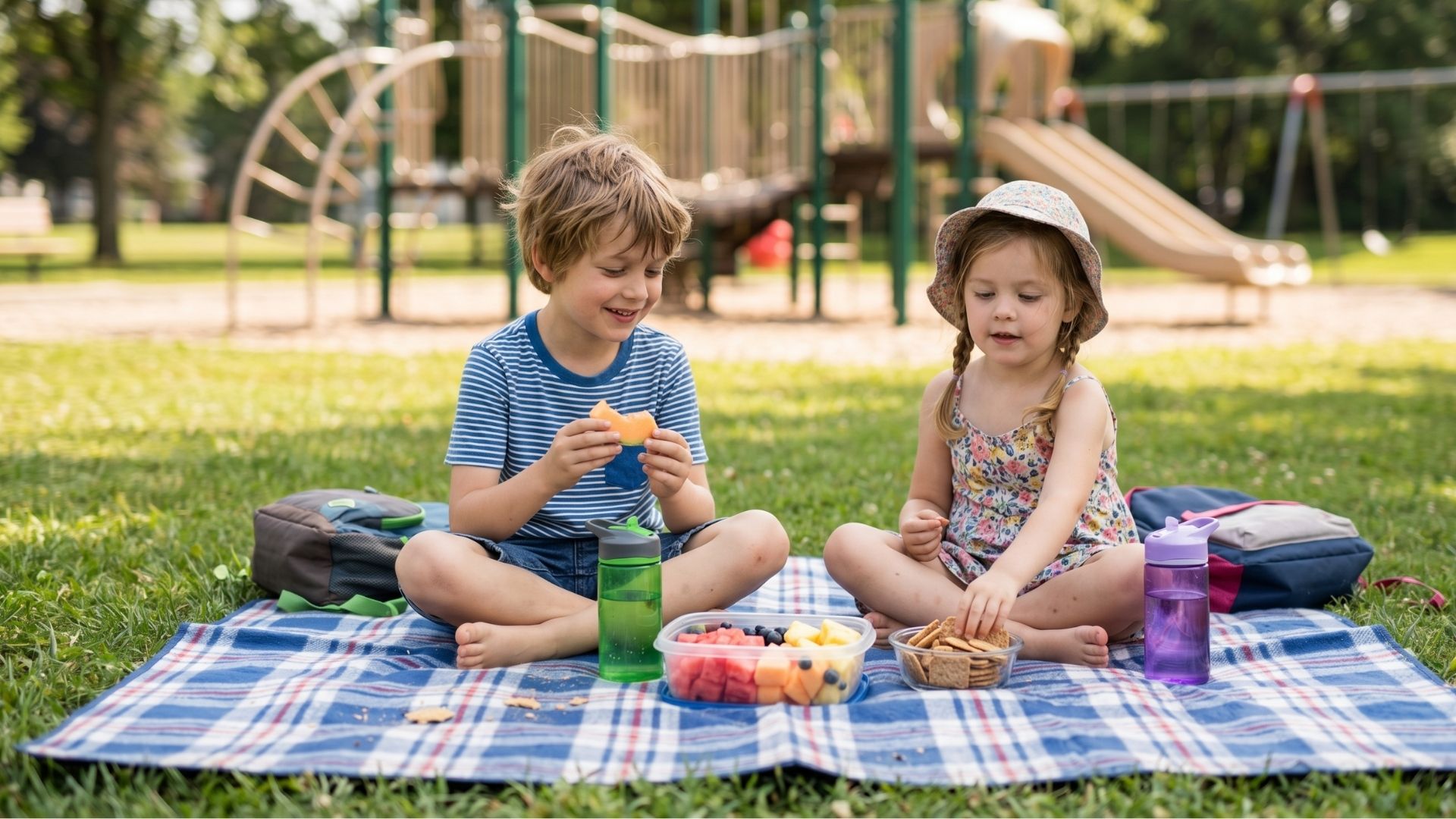
The park playdate is the most under-used playdate format. No host stress. No childproofing. No "sorry the house is a mess." The kids run themselves into the ground on the playground equipment, the parents drink coffee on a bench, and the cleanup is walking back to the car. For every age from 18 months to 12, the park is often the right answer. Here is the kit, the age-by-age tactics, and the 90-minute template that works.
Why park playdates are the easiest format
Three things make the park the lowest-effort playdate venue available.
- No host stress. Neutral ground. Nobody is judging your couch cushions or the state of your kitchen.
- The kids self-organise around the equipment. Swings, slides, climbing structures, sand, grass, room to run. You do not need to plan a single activity.
- Cleanup is the act of leaving. No vacuuming, no dishes, no sticky floors.
Park playdates also scale better than home playdates. Three families at home is a small party with a long cleanup; three families at the park is a normal Saturday morning. The format absorbs more kids without any extra work from you.
If you are still building out the broader playdate logistics, our complete guide to playdates covers the whole framework. This piece is the park-specific version.
Unstructured outdoor play gives kids room to move, explore, and work things out with other kids. The AAP's HealthyChildren article The Power of Play explains how free play helps build motor skills and emotional intelligence, and why it is worth protecting time for it.
The park playdate kit (10 items)
Keep these in a tote bag in the car or by the front door. Park day, you grab the bag and go.
- Water bottles, one per kid (filled at home).
- A snack box with the basics: cut fruit, crackers, cheese cubes, a small treat. See the next section on snack logistics.
- A picnic blanket or a folded outdoor mat. Saves you from sitting on damp grass or mulchy benches.
- Sunscreen, even if it looks cloudy. Reapply at the 60-minute mark.
- A small first-aid pouch: plasters, antiseptic wipes, antihistamine, paracetamol or ibuprofen, a couple of cool packs in summer.
- Wet wipes. Sticky hands, scraped knees, runny noses, snack cleanup.
- A change of clothes per kid for under-fives. Mud, water-feature spray, snack disasters.
- Hats and a small bottle of bug spray in summer; jackets and an extra layer in cooler weather.
- One toy or two: a frisbee, a ball, bubbles, sidewalk chalk. The park provides most of the entertainment, but a frisbee gets a school-age group through the lull between activities.
- A small bin bag (folded). For trash, wet clothes, anything you do not want loose in the car.
Total weight is about 4 to 5 kg packed. Easy to carry alongside a stroller or a kid on a scooter.
Park playdates by age
Toddlers (1 to 3).
Pick a fenced playground or one with clear boundaries. Toddlers run; you need to be able to see the exits. Stay within arm's reach for under-twos; within 10 feet for two-and-three-year-olds. Length: 45 to 60 minutes before the meltdown. Best activities: sand, swings, the smallest slides, walking on the path looking at things. Avoid: equipment designed for older kids; busy weekend morning slots when school-age kids dominate.
Preschoolers (3 to 5).
More autonomy, but still needs sight-line supervision. The kids can climb most of the equipment if it is sized for under-fives. Pretend play happens around the equipment (the slide is a spaceship, the climbing frame is a castle). Length: 75 to 100 minutes. Best activities: cooperative-play setups, sandbox, wide-open running, finding sticks and stones. Bring one small open-ended toy (a few small action figures, a small bucket and shovel).
School-age (6 to 9).
Self-directed play. You are within sight-line but mostly on a bench. Length: 90 to 120 minutes. They roam between equipment, organise games with kids they have just met, climb things you would not let them climb at home. Bring a frisbee, a ball, or chalk; build in a snack window halfway through.
Tweens (10 to 12).
The park is now a hangout. They prefer parks with skate ramps, basketball courts, or open fields rather than playground equipment. Length: 90 to 180 minutes. You can be at home if the park is walkable; otherwise, drop them and pick them up. Bring food (tweens eat) and a phone arrangement (you can reach them, they can reach you).
Mixed ages: pick the park that works for the youngest. The older kids will adapt; they almost always find something to do at any park.
Snack and meal logistics at the park
Park playdates run on snacks. Two principles.
Bring more than you think you need.
Park air, running, and the focused energy of the playground burns through the snack supply faster than a home playdate. Pack roughly 1.5x what you would prepare at home.
Plate it at the bench, not on the run.
Lay out the snacks on the picnic blanket or bench, call the kids over, give them 10 minutes to sit and eat. Eating-while-running produces choking risk and full snacks dropped in the mulch. The forced sit-down also gives everyone a 10-minute reset.
If the playdate spans a meal, two options:
- Pack a picnic lunch. A baguette, sandwich fillings, fruit, crackers, water. See our family picnics guide for the full kit.
- Pivot to a nearby coffee shop or food truck for a quick meal, then back to the park. Works best with school-age and older.
For the broader snack patterns that travel well outdoors, see our playdate snacks guide. For the picnic-format meal upgrade, our family picnics guide covers the 12-item kit.
Multiple-family park meets (the easy logistics)
Three or four families at a park is a great Saturday morning. The logistics are simpler than people think.
- Pick a specific meeting point within the park. "By the big slide at 10" beats "at Hyde Park around 10ish." Big parks have multiple playgrounds; designate one.
- First family arrives a bit early to claim a bench or a picnic-blanket spot near the chosen playground.
- Each family brings their own snacks and water. Optional sharing is fine; do not assume.
- Adults sit together or in a small cluster; kids move freely between adults. Anyone can flag any kid back if needed.
- End time is announced upfront. "We are here until 11:30." Some families leave earlier, some stay later; nobody is held to the group schedule.
Group park meets work best when one family is the loose anchor (always there, always brings extra snacks, always knows the meeting point). If you become that family for your friend group, you are doing them a favour and you also get a more reliable social rhythm out of it.
For the parent-friendship side of building these regular meets, see our guide to making mom and dad friends through playdates. For the text-script side of confirming park playdates, see our guide to texting another parent about a playdate.
When the playground gets crowded
Saturday mornings, school holidays, the post-school 4pm rush. Some park visits are simply busier than others; the busy ones change the playdate.
Three moves for crowded playgrounds.
- Pick a different time slot if you can. Mid-morning weekdays in school holidays, late afternoons on weekends, and rainy days are the quietest. The same park feels totally different at 10am Wednesday vs. 11am Saturday.
- Pick a different playground in the same park. Big parks usually have a fenced toddler area, a school-age playground, and a tween-friendly skate or sport court. The toddler area at 11am Saturday is often unbearable; the back-corner school-age area might be empty.
- Adjust the playdate format. If the playground is genuinely too crowded, switch to a kick-around in an open grass area, a walk through the park, or a snack on the blanket while you watch the kids run around without targeting equipment.
Rougher kids are more common in busy playgrounds because adult supervision per kid is lower. Stay closer to your kid; intervene more readily. Most rough kids back off when an adult addresses them calmly. If a kid is repeatedly aggressive, move your kid to a different part of the playground. You are not retreating; you are choosing your kid's playtime over a fight you cannot win.
Weather contingencies (when to commit, when to bail)
Park playdates depend on the weather. Decide your weather threshold in advance.
Light rain.
Often still good. Bring waterproofs. The playground will be quieter than usual; the kids will not notice the rain past the first 5 minutes. The post-rain hour is often the best playground time of the day.
Heavier rain or thunderstorms.
Skip. Pivot to an indoor playground or an at-home playdate. Send the cancel text by 8am if it is an 11am plan.
Cold (under 5C / 40F).
Doable with proper layers, hot drinks, and a shorter session (45-60 minutes). Bring hats, gloves, and a hot chocolate flask for the parents.
Hot (over 28C / 82F).
Shift the time slot. Mornings (8-10am) and late afternoons (5-7pm) are the workable windows. Avoid 11am to 4pm in summer; the playground equipment becomes too hot to touch (metal slides reach burning temperatures in direct sun) and dehydration risk rises fast for under-fives.
Wind.
Strong wind plus open park is unpleasant for everyone. Skip; it is the one weather condition that ruins a park visit faster than rain. Sand and grit blow into eyes, parents are cold even in summer, and the kids are miserable within 20 minutes.
When you cancel, send the text early and propose a specific reschedule date in the same message. "Looks like the rain is settling in. Skip today, same time next week?" Naming the next date keeps the playdate from drifting.
The 90-minute park playdate template
Most park playdates run 90 to 120 minutes. Here is roughly how the time shapes up.
Minutes 0 to 10. Arrival and warm-up.
Set up the picnic blanket or claim the bench. Apply sunscreen if not done. Kids start moving; usually heading straight for the swings or the slide. Adults catch up briefly.
Minutes 10 to 50. Free play on equipment.
Kids work through the playground. Pretend play, climbing, swinging, sand. You stay sight-line; intervene only if needed. Adults talk on the bench; one adult is mentally on "main eyes" duty even during conversation.
Minute 50. Snack break.
Call the kids over. 10 minutes at the picnic blanket or bench. Refuel; reset. This is also a useful moment to top up sunscreen or layer change.
Minutes 60 to 80. Second activity round.
Often a different part of the park: an open grass area for a kick-around, a path for a walk, the sandbox or water feature. Energy is back; this is often the deepest absorption window of the playdate.
Minutes 80 to 90. Wind-down.
Five-minute warning: "Five more minutes, then we go home for lunch." Last activity wraps. Pack the bag. Walk to the car or push the stroller home.
If the playdate is going well at 90 minutes, you can extend to 120; past that, especially with under-fives, you are heading toward a tired-kid meltdown that will follow you home.
Frequently asked questions
What time of day works best for a park playdate?
9 to 11am is the sweet spot for most ages. Cool enough in summer, after the school-run rush, before midday meal windows. For tweens, late afternoon (3 to 6pm after school) often works better. Avoid 11am-2pm in summer (heat) and the 4-5pm post-school rush at school-age playgrounds (very crowded).
Should I bring my own snacks or buy from the park kiosk?
Bring your own. Park kiosks are convenient but expensive, slow, and often offer mostly sweets and crisps. A packed snack box of fruit, crackers, cheese, and a small treat is healthier, cheaper, and ready instantly. Use the kiosk only for ice cream as a treat at the end.
What if there are no kids my kid's age there?
Often happens at off-peak times. Three options: stay anyway (your kid will likely find someone within 15 minutes; kids of similar enough ages naturally pair off), move to a different playground in the same park (size or age focus may differ), or try a different time tomorrow. Park demographics shift dramatically by hour and day.
How do I introduce myself to other parents at the park?
Light, no pressure. "Hi, your kid is so good at the climbing frame!" "Mine is 5 too, what year are you in?" Most park-parent conversations stay surface-level and that is fine; some grow into actual playdates. Do not over-engineer it. If you find a kid your kid clicks with and the parent seems open, swap numbers casually before leaving.
My kid only wants to be with me, not other kids. What do I do?
Common at ages 2 to 4 and during transitions. Sit on a bench, encourage the kid to explore one piece of equipment at a time, do not force interaction with other kids. Most kids drift toward other kids on their own within 20 minutes. If your kid genuinely will not separate after 30 minutes, stay close, do the playdate as a parent-and-child outing, and try a smaller setup (one other family) next time.
Are dog parks or skate parks ever good for a playdate?
Dog parks: skip with toddlers and preschoolers (unpredictable dogs and small kids do not mix); fine with older kids who are calm around dogs and you know the regulars. Skate parks: fine for tweens with their own boards or scooters; not for under-eights (collision risk with experienced skaters). Stick to the regular playground for under-tens.