
The first playdate with a new mom friend is not the goal. The second one is. The first is the audition; the second is when you find out if this is going to be a real friendship or just a polite text exchange. The texts you send between, before, and after each playdate decide which way it goes. Here is what to write at every stage, including the night-before reconfirm, the weather pivot, the post-playdate follow-up, and the second-playdate ask that makes it stick.
Why the first playdate is not the goal (it is the audition for the second)
Most new parent friendships die between playdate one and playdate two. Both moms had a fine time, the kids were sort-of-ok, both of you said "we should do this again" at pickup, and then six weeks pass and it just does not happen.
The reason is structural. The first playdate is high-effort: scheduling, weather check, snacks, conversation that does not flow yet. By the end of it, both of you are quietly relieved it is over, even if it was nice. Without a follow-up text within a few hours, the energy drains out fast. By day three, neither of you wants to be the one to text first.
The fix is not a better first playdate. It is the text that goes out 4 hours after the first one ends, suggesting a second. The scripts in this guide all serve one goal: get to playdate two, where the real friendship starts to build.
If you are still working out the broader playdate logistics (formats, frequency, what to do at one), see our complete guide to playdates. This piece is the messaging-by-messaging companion.
After the in-person plan: the 2-to-3-day-out reconfirm
Scenario: you and another parent agreed in person to "get the kids together next week, weather permitting." You exchanged numbers. Now what?
Send the reconfirm 2 to 3 days before the planned day. Sunday evening for a midweek plan, Monday or Tuesday for a Thursday or Friday plan. Late enough that you have a rough forecast, early enough that she has time to plan her week.
The script for a park plan after a shared class:
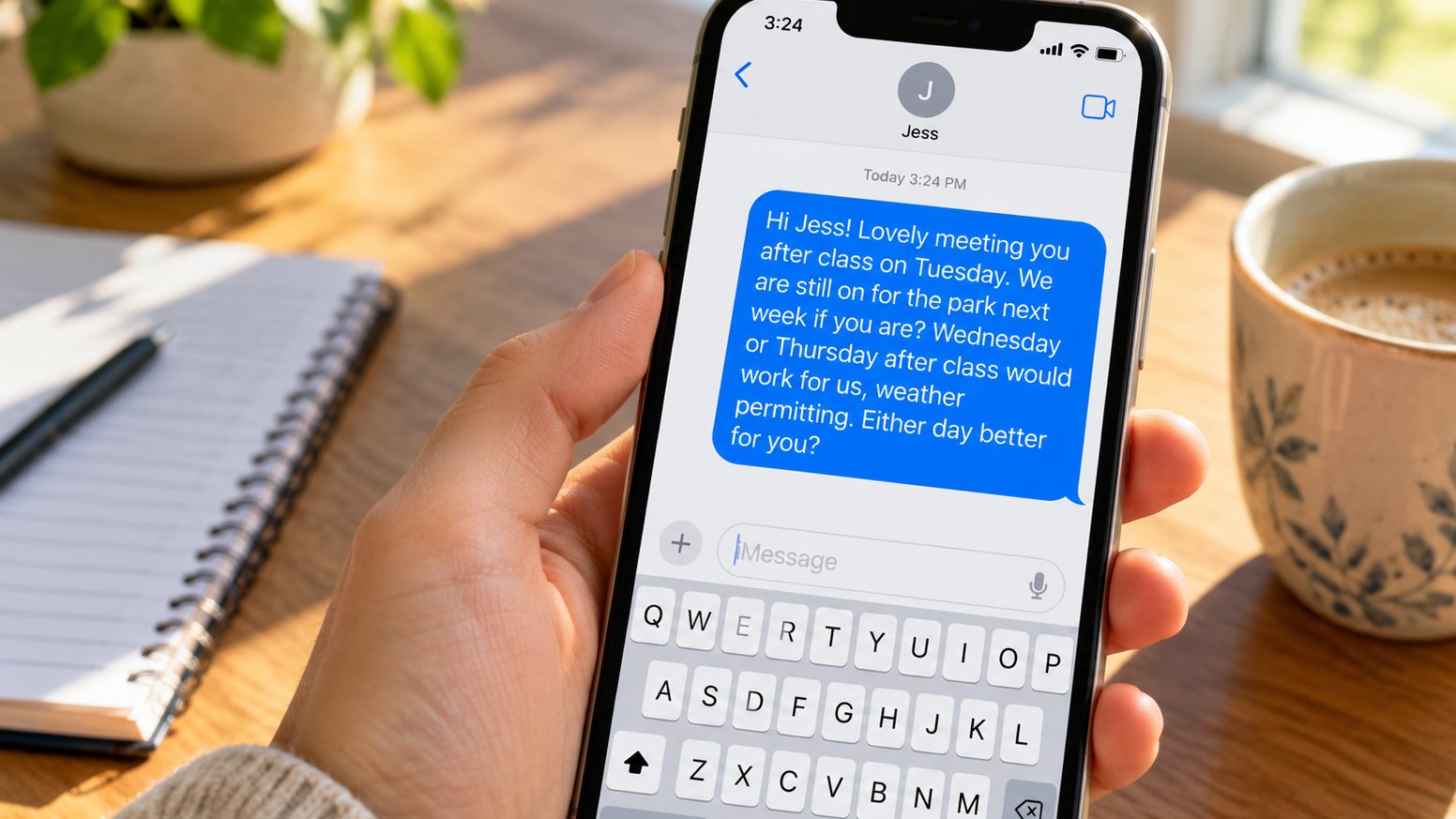
"Hi [Name]! Lovely meeting you after class on Tuesday. We are still on for the park next week if you are? Wednesday or Thursday after class would work for us, weather permitting. Either day better for you?"
Why this works: it names her by name, it anchors you to where you met (she may know multiple parents from class), it offers two specific days so she does not have to do the planning work, and "weather permitting" gives both of you a built-in escape.
What not to do: do not just text "Hey, still good for next week?" with no day. That makes her do the planning work. Do not over-apologize for the text or pre-emptively offer five reschedule options. Direct, short, friendly is the move.
If you are reconfirming a playdate at someone's home instead of a park, swap the location line: "We are still on for our place on Thursday at 3?"
If this is your very first ask (you have not even agreed to a playdate yet), our guide to asking another parent for a playdate without being awkward covers the opening text in detail. This piece picks up after the first ask is accepted.
The night-before text: weather scripts and indoor backups
By 7 to 8 pm the night before, you should know the next-day forecast. This is the moment to send the second text.
If the forecast looks good for a park playdate:
"Forecast looks good for tomorrow! Still on for the park after class? We can meet at the [playground name or main entrance] around [time]. Bringing snacks for [your kid's name]; let me know if [her kid's name] has any allergies and I will grab something extra."
The allergy line is a small thing that signals you are a thoughtful host, and it gives her a low-friction reason to text back, which moves the relationship forward.
If the forecast looks iffy:
"Hi! Tomorrow is looking a bit iffy weather-wise. Want to keep the park plan and play it by ear in the morning, or move to [Friday or next week]? Happy either way."
If you want to offer an indoor swap on the spot:
"Looks rainy tomorrow. Want to do our place instead? Same time, can do snacks, the kids can use the play room. Or we can push to next week if easier."
A few rules for the night-before text. One question, not three. Name a specific alternate day if you suggest moving. Do not send it after 9 pm; you will catch her in the wind-down hour and she will read it half-asleep.
For the food-allergy script if her kid has one, our guide to playdates and food allergies covers the questions to ask in detail.
The morning-of green light (and when to skip it)
A 9 am two-second confirm is often kind.
"All good for the park at [time]? See you there!"
Send this if the weather has shifted slightly overnight, if it is your first playdate with this family, if she has a young kid (under four) where mornings are unpredictable, or if you confirmed the night before and want one final lock.
Skip the morning-of text if you confirmed the night before and the forecast is solid, or if you have done several playdates with this family before and the rhythm is established. A morning-of text on top of a clean night-before lock can come across as anxious.
What about a 30-minute-out "leaving now" text? Useful for park meets where one person might arrive 15 minutes early and wonder if they were stood up. Skip for home playdates where the host is already there.
When the weather changes: 3 cancellation scripts that keep the door open
This is the hardest one. Canceling a new-friend playdate, especially a second-time cancel, is where most of these friendships fall apart. Three scripts for three scenarios.
The forecast is now bad and you want to move to next week.
"Hi! Looks like the rain is settling in for the afternoon. Want to push to [specific next day or next week, same time]? [Your kid's name] would love a rain check."
The single most important move: name the next date in the same text. Do not say "let's reschedule sometime." That is exactly where new-friend playdates die. Name a day.
Your kid is sick (last-minute, day-of).
"So sorry, [your kid's name] woke up with a fever and we have to skip today. Definitely want to do this soon. How does [next Tuesday or next week] look?"
Apologize once, not three times. Move directly to the next date. Most parents are sympathetic to a sick kid; over-apologizing makes it weird.
Something else came up (work, family thing).
"Hi! Something came up at work this afternoon and we have to bail on the park today. So sorry. Could we do [next Wednesday] instead?"
Brief explanation, no over-explaining. Move to the next date.
If you have to cancel two times in a row, send a slightly warmer follow-up the second time: "Truly sorry to do this twice. We are still very much in for a playdate, just hitting a rough week. Could we lock something in for [10 to 14 days out]?" The longer time horizon takes the pressure off and gives both of you breathing room.
The post-playdate text: send within 4 hours, lock in next time
This is the single most important text in the whole sequence. The post-playdate text within 4 hours of pickup turns a one-off into a developing friendship.
The script after a park or away-from-home playdate:
"Thank you so much for today, [her kid's name] is the sweetest! [Your kid's name] is asking when they can play again. Are you around [next Friday]? Same kind of plan?"
Three elements that all matter. A specific compliment about her kid (not a vague "they had so much fun"). Position your kid as the one initiating ("asking when they can play again"), which takes the social pressure off her. Name a specific next date.
If the playdate was at her place and she hosted:
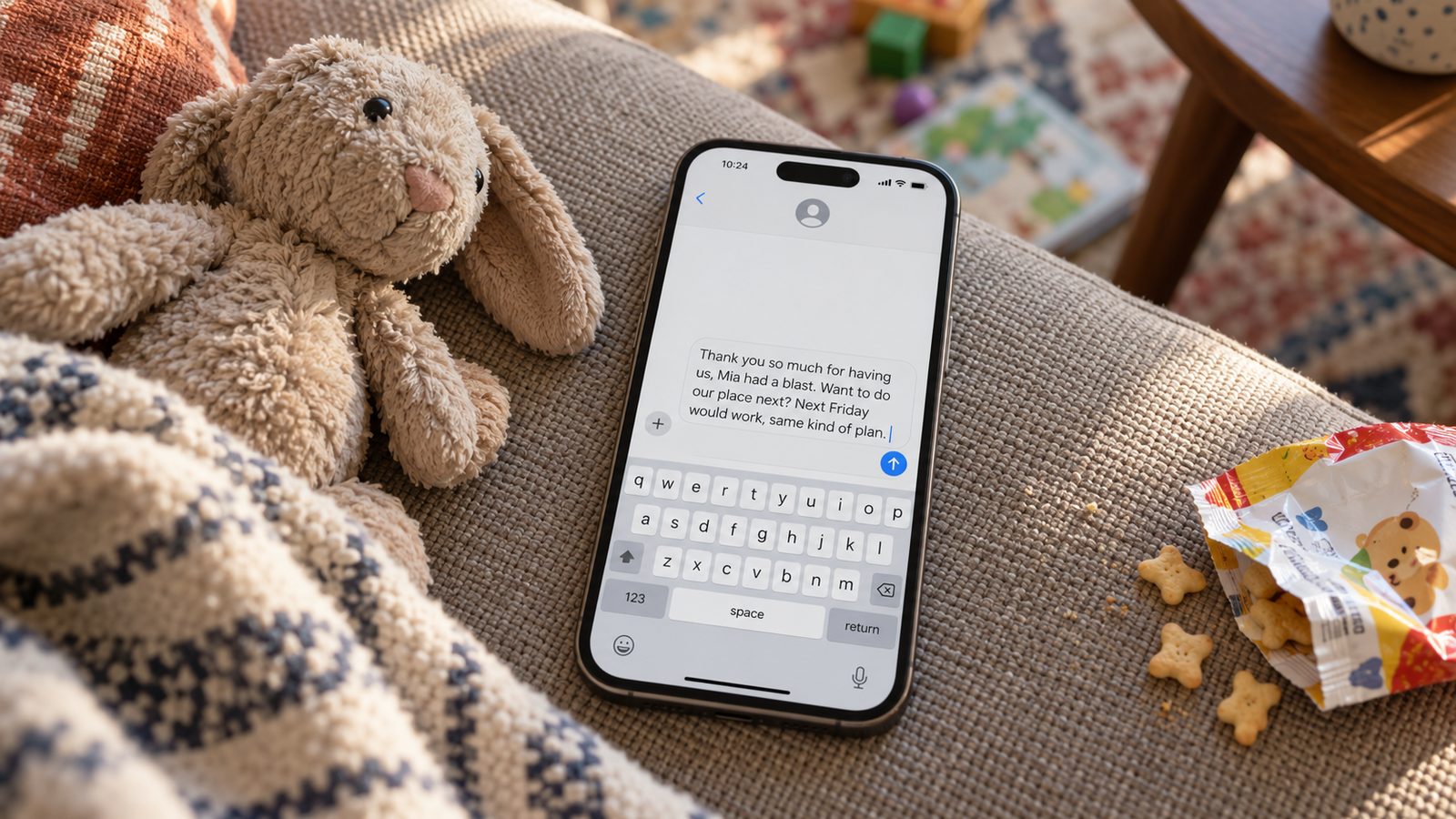
"Thank you so much for having us, [your kid's name] had a blast. Want to do our place next? [Next Friday] would work, same kind of plan."
Reciprocity matters. If she hosted, you offer to host next. The exception is if your home is genuinely not set up for it (very small apartment, a sick family member, a renovation in progress); then offer a park or library meet to balance the effort.
If you absolutely cannot name a specific next date in the text (your week is genuinely full):
"Thank you so much for today, [her kid's name] is the sweetest! [Your kid's name] has not stopped talking about her. Will text you Sunday to set up the next one."
Then text Sunday. This script only works if you actually do.
The second and third playdate: less effort, more rhythm
By playdate two, you can drop most of the formality. The reconfirm script can shrink to:
"Hi! Still on for Friday? Park or our place?"
By playdate three, even shorter:
"Park Friday at 3? Bringing the bubbles."
Each playdate should require less text-orchestration than the last. If you are still writing four-paragraph scripts by playdate three, the friendship has not deepened. It is fine; some friendships stay polite. But the ones that turn into real friendships are the ones where the texts get shorter.
What changes between playdate two and three. The length of texts drops by half each time. You start texting about non-playdate things (an article you saw, a question about a class, a complaint about a teacher). The kids start asking for each other by name (the real signal). You start running into each other casually (at the park, at school) and it is easy.
If your texts are still elaborate by playdate four, the friendship has plateaued. That is not a failure; some parent friendships stay at "we do a playdate every six weeks" and that is plenty. But if you want a closer friendship, the next move is texting about something other than a playdate.
The kid-friendship side runs on a similar arc. For more on what makes the kids actually click (vs. just play in parallel), see our piece on friendship-building playdates.
When things go quiet: how long to wait before reaching out again
The hardest scenario. You sent the post-playdate text. She replied warmly but did not commit to a next date. Two weeks pass. Now what?
Wait 10 to 14 days from the last contact, then send one low-stakes text:
"Hi [Name]! How is everyone doing? [Your kid's name] keeps asking about [her kid's name]. Any chance you are free [specific day, 1 to 2 weeks out] for the park or a playdate at our place?"
If she replies positively, great. If she replies vaguely ("oh we have been so busy"), send one more text 2 to 3 weeks later with a different specific date. If she still does not commit, take it as a soft no and stop initiating.
Some parents are bad at the texting part of friendship even when they like you. If you see her in person and the conversation is warm and easy, the friendship is real; the texting is the bottleneck. Try to catch her in person and pin a date there. If you need more places to meet other parents, our guide to making mom friends through playdates has them.
If she stops responding entirely after two unanswered initiations, take the hint. It is not personal; new parent friendships often fizzle for reasons that have nothing to do with you. The US Surgeon General's 2024 advisory on parents' mental health found that about 65% of parents and caregivers experienced loneliness, so you are far from the only one finding this hard. Accept it, move on, do not chase. Most parents try with several families before one turns into a real friendship.
Frequently asked questions
How soon after meeting in person should I text?
Within 24 to 48 hours, ideally the same day if you got a number. The longer you wait, the harder the first text gets to write. A simple "Hi, lovely meeting you today, would love to set up a playdate sometime" within the first day is the easiest version. By day three the message starts to feel weirder to send.
What if I do not have her number yet?
Ask in person next time. "Want to swap numbers so we can set up a playdate?" Almost no one says no. If you cannot ask directly, ask the class teacher or the school office to pass along a note (most will if it is a kid-related ask). Some classes also have a parent group chat or a class WhatsApp; joining that is the lowest-friction way to get her number.
What if my kid had a meltdown at the playdate?
Acknowledge it briefly in the post-playdate text and move on. "Thanks for being so chill about [kid's name]'s meltdown at the end, she was overtired. Definitely doing better now." Most parents are sympathetic; over-apologizing makes it bigger than it was. The other parent has had her own kid's meltdowns. She is not judging you the way you think.
Can I cancel a playdate twice in a row without it being weird?
Yes, if you reschedule with a specific date both times. Use slightly warmer language for the second cancel and a longer time horizon for the rescheduled date (10 to 14 days out). After the second cancel, you should be the one offering to host next, to balance the effort.
What if her kid was not nice to mine?
Watch how the parent handled it in the moment. If she addressed it (corrected her kid, apologized to yours), one more playdate is fine; kids have off days. If she ignored it, that is information about how she parents and whether this is the right friendship for your kid. Take the next playdate to a low-stakes setting (park) and watch how it goes a second time before deciding.
How do I keep momentum if our schedules do not line up?
Lower the stakes. A 30-minute park meet after pickup is easier to schedule than a 2-hour home playdate. Suggest meeting in transit: "We are at the playground every Friday after school, come find us if you are free." A standing recurring slot ("Tuesday after class, every other week") beats a one-off most weeks. The friendship survives schedules better when the bar is lower.