
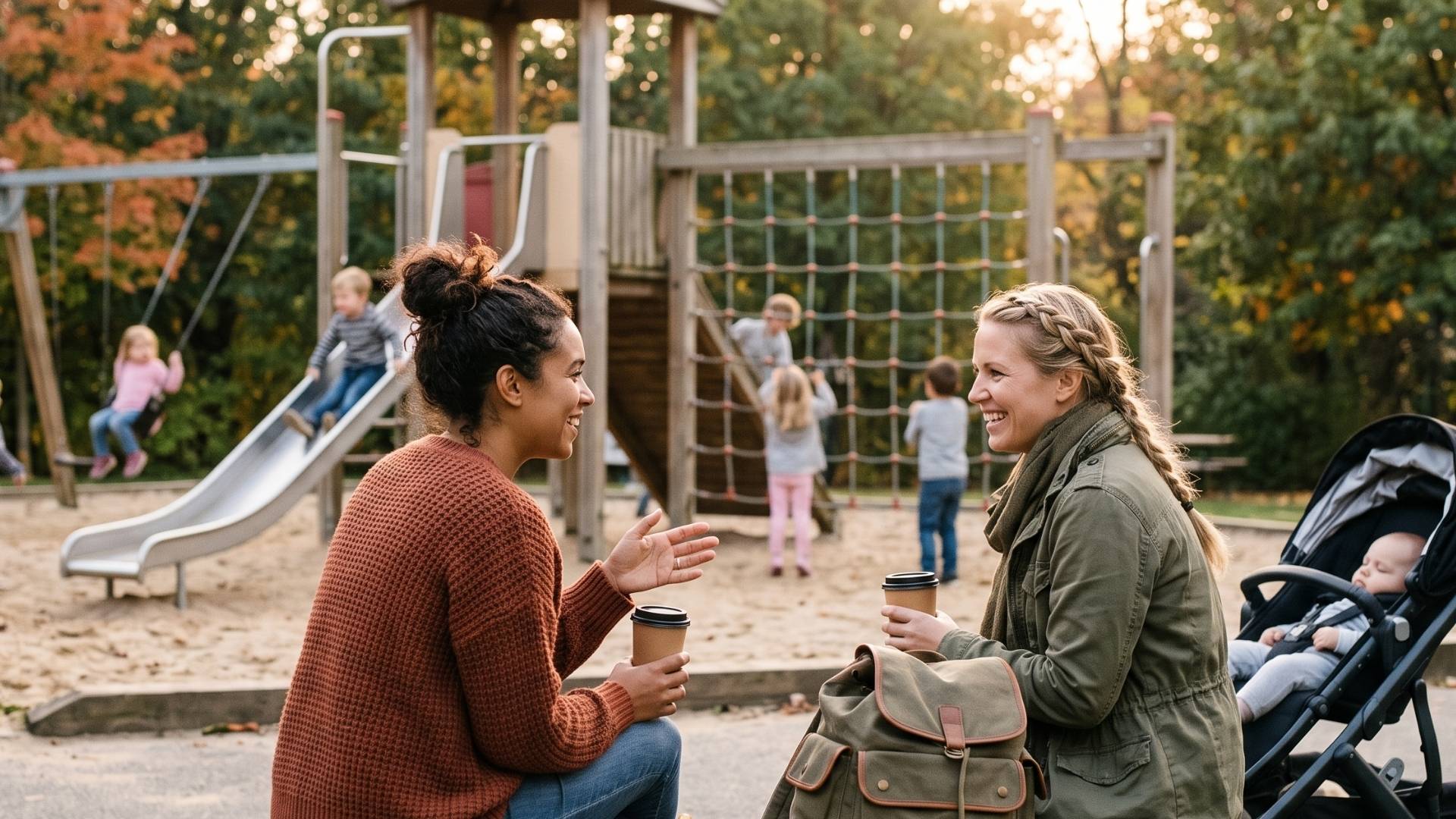
Most parent friendships start through the kids. School pickup, the same swimming class week after week, the playground bench on Saturday morning. The friendship begins as a small overlap and either grows into something real or stays at "hi, how are you." The growing-into-something-real part is the hard bit, and most adults forget how to do it once they leave their twenties. Here is where parent friendships actually start, the small moves that turn acquaintances into real friends, and what to do when the parent friendship and the kid friendship are not on the same trajectory.
Why parent friendships matter (more than the wellness articles let on)
Two reasons parent friendships matter, both well-supported by research.
Your mental health.
Friendship matters for parents, and loneliness is common at this stage. New parents lose touch with old friends, and busy parents of older kids can end up time-starved and isolated. The US Surgeon General's 2024 advisory on parents' mental health reports that about 65% of parents and guardians, and 77% of single parents, said they had experienced loneliness, compared with 55% of non-parents. It also notes that social connection can decrease the negative effects of stress.
Your kid's social opportunities.
Kids' friendships at age 4 to 9 are heavily mediated by parent friendships. The kids who get the most playdates are the kids whose parents have the easiest playdate-arranging social network. If you want your kid to have a steady social life, building your own parent network is one of the highest-yield investments you can make.
If you are still building out the broader playdate playbook, our complete guide to playdates covers the bigger picture. This piece is the parent-friendship layer.
Where parent friendships actually start (the 6 most common settings)
Adult friendship is no longer the casual proximity-based product of college dorms or new jobs. By the time you have kids, friendship needs structured opportunities to form. Six settings produce most parent friendships.
- School and daycare pickup. The most common setting. Repeated daily contact, kids as the obvious shared topic, low-stakes chats that compound across weeks.
- Kids' regular classes. Swimming, music, art, sport. Same parents in the waiting room week after week; structured proximity that pays off after 4-6 weeks.
- Local parks and playgrounds. Seasonal but real; the regulars at the same park at the same time of week become familiar.
- Toddler groups and library story times. The under-fives setting. Parents are often desperate for adult contact; the social barrier is low.
- Neighbours. The kids who live within walking distance produce the kids you see most often. Easy to organise spontaneous play; lower-stakes friendships.
- Friends-of-friends. The introduction your existing friend makes ("my friend Sarah just moved here, she has a 5-year-old too, you'd like her"). Pre-vouched-for friendships skip the awkward early stages.
What is missing from this list: most of the places adults imagine they will meet friends. Coffee shops. Through work (most parents do not socialise with colleagues outside of work, especially with kids). At the gym. These can produce friendships, but the kid-related settings produce them at much higher rates because the shared parenting context shortcuts so much of the early-friendship work.
The "we should hang out" → never happens trap
Most adult-acquaintance interactions end with some version of "we should hang out sometime" / "yes, definitely!" / [nothing happens]. Both people meant it; both people are busy; nobody followed up. The friendship never quite got going.
The trap is the vague intention. "We should" with no specifics produces no action. The friendship-builder skill is converting the vague intention into a specific commitment within 24 to 48 hours of the conversation that produced it.
The conversion script.
"That would be lovely. Are you free Saturday morning? We're going to the park around 10, you should come."
Three elements: confirms the interest ("that would be lovely"), names a specific time and place, gives them an easy yes-or-no without long planning. Most adults are starved for this kind of low-friction social invitation; the response rate is high.
If you cannot name a time on the spot:
"Yes, let's actually do this. I'll text you tomorrow with a couple of dates that work for us."
Then text the next day with two specific dates. The follow-up text is what separates the friendships that happen from the ones that get stuck at "we should."
Crossing from acquaintance to real friend (the specific moves)
Acquaintance and friend are different relationships. The crossing is gradual; specific moves accelerate it.
- From only-talking-about-the-kids to also-talking-about-other-things. After a few playdates, drop in a non-kid topic during the parent chat. "Did you watch [show]? It is excellent." "How was that holiday?" The shift signals you see them as a person, not just another parent.
- From only-meeting-with-the-kids to occasional adult-only time. A coffee, a walk without the kids, an evening drink. Even one adult-only outing per quarter dramatically deepens the friendship. The ratio matters less than the existence of the category.
- From scheduled playdates to spontaneous ones. "We are at the playground if you want to come" is a friendship-deepening text. It signals comfort; it normalises the friendship as part of regular life.
- From transactional reciprocity to fluid generosity. Early friendships balance scrupulously: you hosted last time, I host this time. Real friendships stop counting; whoever has the energy hosts. The shift takes 6-12 months and signals real friendship.
- From talking-about-kids to talking-about-actually-hard-things. The first friend you call when you have a parenting crisis, a marriage difficulty, a work problem. This is the deepest layer; most parent friendships do not reach it, and that is fine. The ones that do are the lifelong ones.
Each move requires one person to take a small risk first. Be the one who suggests the coffee, the one who texts the spontaneous park invitation, the one who introduces a non-kid topic. The risk almost always pays off; the cost of the rare miss is small.
Same-gender vs. cross-gender parent friendships
Most parent friendships are same-gender. The reasons are partly cultural (mom-friends and dad-friends socialising patterns differ) and partly logistical (the parent who does most of the school pickup tends to be the one who builds the school-pickup friendships).
Cross-gender parent friendships absolutely exist and are valuable. Three considerations.
- Match the existing social pattern of the families involved. If both families do mostly-couple socialising ("come over for dinner with your husband"), cross-gender friendships happen as part of couple-friendships. If one or both families do mostly-individual socialising, cross-gender single-parent friendships work less commonly because of partner-unease, real or perceived.
- Public-context friendships are easier than private-context. Parks, classes, school pickup, group dinners. Easier than coffee dates or evening drinks at someone's house, which can read differently to partners not in the picture.
- If your partner is uncomfortable with a specific cross-gender friendship, take that seriously without immediately deferring. Couples vary in what feels safe; talk it through, find a format that works for both of you. Killing the friendship to avoid the conversation is usually the wrong move; ignoring the partner's discomfort is also the wrong move.
Single-parent considerations. Single parents who want close cross-gender friendships face fewer partner-considerations but sometimes face more romantic-context assumptions. Some single parents enjoy the freedom; some find it complicated. Like all the friendship-formation moves, take it case by case.
The parent-friendship-but-kids-do-not-click problem
Common situation. You really like the other parent; the kids do not particularly enjoy each other. You feel stuck because the kid-friendship was the originating context.
Three workable arrangements.
- Adult-only socialising. Coffees, dinners, walks, weekend brunches without the kids. The friendship runs on its own track. Many adult friendships work this way long-term.
- Group settings where the kids do not have to interact intensely. Big family barbecues, group park meets, museum visits with multiple families. The kids have other kids to interact with; your two are not forced into a one-on-one dynamic.
- Occasional low-stakes kid contact. Birthday parties, once-a-quarter park meets, school-event overlap. Enough to maintain familiarity without forcing a regular playdate.
What does not work: forcing monthly two-kid playdates because you like the parent. The kids resent it; the friendship starts to feel like an obligation for everyone. For the longer treatment of when kids do not click, see our guide to when kids do not click.
The reverse situation also exists: your kids are best friends; you and the other parent never quite click as adults. Less common but real. Honour the kids' friendship; keep your interactions with the parent warm and brief; do not force the adult relationship just because the kids' relationship is working.
When the parent friendship outlasts the kid friendship
Kids' friendships shift; parents' friendships are more stable. By the time your kid is in middle school or beyond, many of the playdate friendships from age 4 to 9 will have faded for the kids while the parent friendships persist and deepen.
Some of the most lasting adult friendships of your parenting decades start with a 5-year-old's playdate and outlive the kids' friendship by 30 years. The original playdate context becomes irrelevant; the friendship is its own thing.
Three signs your parent friendship is the kind that will outlast the kid friendship.
- You text or call about non-kid things at least once a month.
- You see each other in adult-only contexts (dinners, walks, weekend trips).
- You can imagine being friends with this person if you had never met through your kids.
If all three are true, do not let the kids' friendship-fade affect the parent friendship. Continue to invest. The friendship that started in the school pickup line at age 5 may be the one you are still calling weekly when your kids are in college.
Single parents and non-traditional family situations
Some realities of parent-friendship-building are different for single parents, blended families, and other configurations. Few things that are worth naming.
Single parents.
Often have less time and more need for parent friends than coupled parents. The trade-off: harder to find the bandwidth to invest, but the friendships often go deeper because the social need is more acute. Lean into structured weekly settings (kids' classes, school events, neighbourhood gatherings) where the friendship-building work happens by attendance, not by extra effort.
Blended and step-families.
Have specific complications with kid-friendship logistics (kids only at this house every other weekend, schedules that do not align with other families). Be transparent about the schedule when arranging playdates; most other parents are accommodating once they understand the constraints. Online groups for blended families can also help find other families with similar schedules.
If you are looking for the practical first-ask scripts, see our guide to how to ask another parent for a playdate without being awkward. For the venues to find friends in the first place, see our guide to where to find playdate friends when you do not know anyone.
Frequently asked questions
How long does it take to make a real parent friend?
Most parent friendships take 6 to 12 months to deepen from acquaintance to real friend. The first 4-6 weeks are the introduction phase (recognising each other, light chat). The next few months are the testing phase (a few playdates, a coffee, the first non-kid conversation). By month 9-12, you know whether this is going to be a real friendship or stay at acquaintance level. Both are fine outcomes.
What if my kid is younger than the other parents' kids in my circle?
Often a non-issue for the parent friendship. Many of the closest parent friendships span a few years' age gap on the kids; the parents bond through shared parenting questions even when the kids' developmental stages differ. The kids may not become best friends; the adults still can. Be open about the age difference when arranging playdates and adjust the format accordingly.
Is it weird to ask another parent on a one-on-one coffee date?
Not at all. "Do you want to grab a coffee Saturday morning while the kids are at swim?" is a normal sentence; most parents say yes. The asking can feel like a high-school move, but it is the move that turns acquaintances into friends. Most parents are pleasantly surprised to be asked; almost no one is offended.
What if I have nothing in common with the other parents at school?
You do not need shared hobbies; you need shared parenting context. Most school-based parent friendships start with the surface-level overlap (kids the same age, same teacher, same morning routine) and find deeper connection over time. If after a year or so you genuinely cannot find a single family you click with at school, look elsewhere (kids' classes, neighbourhood, online groups). One school is not the whole social pool.
How do I make parent friends as a SAHM/SAHD vs. as a working parent?
Working parents have less time for the slow-warmth structured-class friendship-building; SAH parents have less access to the school-age weekday-pickup network. Compensate accordingly. Working parents: lean into evenings, weekends, and high-yield events (neighbourhood gatherings, school nights) where one event compounds. SAH parents: lean into the daytime classes, library times, park-mornings where you build through repeated low-key proximity. Different paths to the same destination.
Are online mom/dad friend groups worth the effort?
Often yes, especially in the early years and after a move. Apps (Peanut, Mom-Coms in the UK), Facebook groups, Nextdoor, local subreddits. Treat the online platform as an introduction service; the real friendship still needs in-person time to develop. Many parents have made one or two of their closest local friends through an online intro that turned into a coffee date that turned into a years-long friendship.