
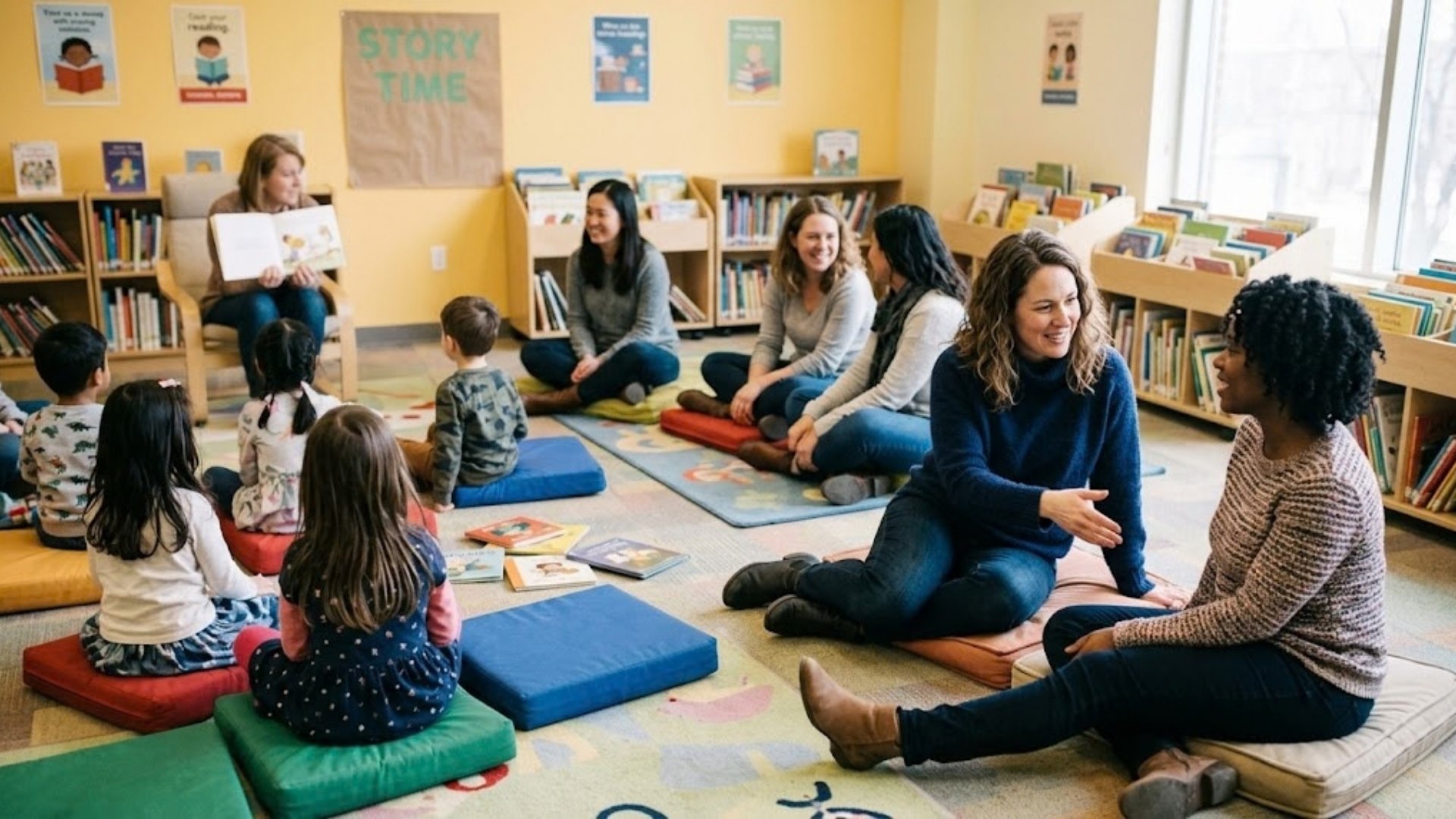
Building a playdate network from zero feels impossible. New parent, new town, no time, no obvious starting point. It is not actually impossible; it is just slow at first and faster than you expect after the first 6 to 8 weeks. The key is going to specific places where parent friendships form, going repeatedly, and taking the small social risks that the first few months of network-building require. Here are the 10 settings that consistently produce friendships, the online communities that genuinely help, and the strategy that works when you have just moved and need to start completely fresh.
Why finding playdate friends from zero feels harder than it is
Two patterns make new-network building feel impossible when it is actually just slow.
The momentum problem.
Existing networks compound; new ones do not. A parent with 4 friend families gets weekly invitations naturally; a parent starting from zero has to manufacture every interaction. The first 8 weeks feel like grinding without payoff; the next 8 weeks accelerate as the early connections start producing introductions to other families.
The visibility problem.
When you do not know anyone, every other parent looks like they already have their established friend group. They mostly do; they were also new once. Most parent friend groups are more permeable than they look from the outside; new families who consistently show up are absorbed within a few months at most settings.
The effort is worth it for you, not just your kid. Zero to Three points to research linking trusted social support with greater parental confidence and better access to parenting information, and suggests playgroups, classes, and online communities as starting points.
For the full picture of how playdates work at every age, start with our complete guide to playdates. If you are still building out the broader parent-friendship picture, see our guide to making mom and dad friends through playdates. This piece is the where-to-start layer; once you have met someone, our guide to asking another parent for a playdate covers the first ask.
The 10 specific places parent friendships form

Sorted roughly by yield and accessibility. Pick 3-4 to invest in regularly; trying to be everywhere at once produces shallow contact at every setting.
- School and daycare. The single biggest source of parent friendships for kids ages 3 and up. Pickup conversations, parent-teacher events, school volunteering. Show up; be friendly; introduce yourself.
- Kids' regular classes. Swim, music, art, sport. Same parents in the waiting room week after week. After 4-6 weeks, the recognition turns into friendly chat; after 12 weeks, into possible playdate exchanges.
- Local parks and playgrounds. The same park at the same time of day produces regulars; regulars become familiar; familiar becomes friendly. Saturday morning at 10 is an especially regular slot in most areas.
- Library story times and toddler groups. The under-fives setting where parents are often most open to new contact. Story time is structured social proximity; the chats happen during free-play after the reading. Our guide to what makes a great children's library helps you pick a good one, and library, museum, and coffee shop playdates covers turning a library chat into a first meetup.
- Your neighborhood. The kids who live within walking distance produce the easiest playdates of any age. Block parties, neighborhood walks, the front-yard chat with the family two doors down.
- Through work. Less common than in pre-kid life, but not nothing; colleagues with kids the same age sometimes become close family friends, especially if your families overlap on values.
- Family and pre-existing networks. Cousins, your old college friends with kids, friends-of-your-parents with grandchildren. Pre-existing connections are the fastest path to a playdate network because trust is already established.
- Online communities. Local Facebook groups, Nextdoor, Peanut, regional subreddits, Mom-Coms. Treat these as introduction services; the friendship still forms in person.
- Recreational leagues and youth sports. The team-parent context produces some of the most durable parent friendships, often lasting years past the kid's involvement in the sport.
- Religious or community organizations. Churches, synagogues, mosques, community centers, secular family groups. Many run dedicated family events specifically designed to build parent network.
Most established parent friend networks are built across 3-5 of these settings simultaneously, not concentrated in one. The crossover (a parent you know from school who also turns out to be at your kid's swim class) is what densifies the network into something that produces regular invitations.
How to read a room for who is open to friendship
Not every parent at a setting is looking for new friends; some have full networks and are not actively expanding. Reading the social signals saves you from spending energy on unlikely matches.
Signs a parent is open to new friendship.
- Talks to multiple other parents at the setting (not just one tight cluster).
- Makes eye contact and smiles at strangers.
- Initiates small talk ("how old is yours?") rather than waiting to be approached.
- Stays after the structured part of the activity (lingers in the cafe after class, on the benches at pickup) instead of rushing out.
- References shared experiences ("the homework this week was insane") that invite response.
Signs a parent is not actively looking.
- Always with the same one or two other parents; cluster is closed.
- Heads down on the phone during waiting moments.
- Brief, polite, ends conversations quickly.
- Rushes out of every setting without lingering.
- Body language is closed (turned away, no eye contact).
What looks like "not open" is sometimes "shy" or "stressed" or "introverted-but-friendly-with-warm-up." If you are unsure, a low-effort smile and brief greeting over a few weeks tells you more than one big approach. Adults read repeated low-stakes friendliness as safe; one big effort can read as intense.
The frequent-the-same-places strategy
The single highest-yield strategy for building a parent network from zero is consistent presence at a small number of settings. Repetition produces recognition; recognition produces familiarity; familiarity produces friendship.
Three rules for the frequent-the-same-places approach.
- Pick 3-4 settings and commit. Saturday morning at the closest park, weekday class with the same other parents, school pickup line on Tuesdays and Thursdays, library story time on Wednesdays. Pick a small number; show up consistently for 8-12 weeks before evaluating.
- Show up at the same time each week. Variability dilutes the recognition effect; if you go to the park at 10am one week and 3pm the next, the same regulars will not be there both times.
- Linger for the social-window minutes. Do not rush in and out. Stay for the chat after class. Sit on the bench for 10 minutes before leaving the park. The actual friendship-formation work happens in the unstructured minutes around the structured event.
After 8-12 weeks of consistent presence at 3-4 settings, you will have 5-15 acquaintance-level relationships and probably 1-2 budding friendships. After 6 months, the pattern is established and one or two of those friendships will likely be solid.
Online communities that actually work
Online platforms have become a real source of parent friendships, especially in the early years and after a move. Five categories of platform and what each is good for.
Local Facebook groups.
The single most consistent source of online-to-offline parent friendships. Search for "[city] moms" or "[city] parents" or your specific neighborhood. Most large cities have multiple groups; pick one or two that have visible recent activity and friendly tone, not just commercial posts.
Nextdoor and neighborhood-specific apps.
Useful for finding families in your immediate radius. Lower-yield for friendship-formation than Facebook groups but higher-yield for the kid-walks-to-friend's-house geographic match.
Peanut, Mom-Coms, and dedicated mom-friend apps.
Operate like dating apps for parent friendships. Profile-based matching, in-app messaging, eventually in-person meetings. Useful especially in the first year of being new to an area; some parents have made multiple close friends through these. Be patient with the matching; it takes a few rounds to find the right fit.
Reddit local subreddits and parenting subreddits.
Less direct friendship-formation, more useful for getting local information (best parks, pediatricians, classes) which then produces the in-person settings where friendships happen. Some city subreddits have parent-meetup posts; worth scanning monthly.
WhatsApp parent groups.
Class WhatsApp groups, school-year groups, neighborhood family groups. Often the most active day-to-day communication channel; ask the school office or check with another parent how to join. Once in, the casual conversation produces the in-person meeting opportunities.
Treat all of these as introduction services, not friendship destinations. The real friendship still forms in person; the online platform just removes the cold-start friction of finding people in the first place.
When you have just moved (specific advice)

Building a network in a new city or town is the hardest version of this work. The first 3-6 months in a new place are typically lonely; the year-1 mark is when most movers report having one or two real local friends.
Five moves that accelerate the new-area network.
- Sign up for the kid's structured activities in the first month, not the third. The waiting-room friendships start at week 1; if you wait 3 months to enroll, you have lost a quarter of the friendship-formation window.
- Join 2-3 local online groups within the first two weeks. Get the lay of the land; introduce yourself in one welcoming-new-families post; lurk on the others.
- Walk the neighborhood at standard times. Mornings before work, weekends, after-school hours. The repetition produces recognition with neighbors within a few weeks.
- Say yes to invitations even when tired. The first few weeks of any new social setting feel exhausting; the payoff is steeper than the effort. Skip the ones that feel actively wrong; default-yes to most others until your network is established.
- Initiate one specific outreach per week. To a parent at school, a neighbor, an online contact. One per week is sustainable; ten per week is overwhelming and produces shallow contact. Over six months, the one-per-week rhythm produces 24 attempts and probably 5-10 actual friendships.
What does not help: trying to recreate your old social network from your previous city. Different city, different culture, different people. The new network will be its own thing; do not measure it against the one you left.
Single parents and chosen-family situations
Single parents often need a parent network more acutely than coupled parents and have less time to build it. Specific approaches that help.
Lean into the structured weekly settings.
Kids' classes, school events, library times, neighborhood events. The friendship-building work happens by attendance, not by extra effort; that is exactly the right format for a time-strapped single parent.
Find other single parents.
Australia's Raising Children Network suggests parents groups, playgroups, preschools, schools, and sporting clubs as places single parents can connect with other parents.
Single-parent meetups, online groups, friend-of-friend introductions. Single-parent friendships are often deeper because the social need is more acute and the schedules align (evenings and weekends are when you have the kid; coupled friends are with their partners). Most cities have at least one active single-parent network; ask at the school office, the library, or in the local Facebook group.
Build chosen-family connections deliberately.
If you have biological family nearby, lean on them; if you do not, build chosen-family relationships intentionally. The friend who watches your kid in an emergency, the family that includes you in their holiday celebrations, the parent who picks up your kid from school when you are stuck at work. These relationships do not appear by accident; they form when you and another family decide to step in for each other repeatedly. Be the one who offers first; most chosen-family relationships start with one person taking that risk.
For more on the broader parent-friendship picture, including single-parent and non-traditional family considerations, see our guide to making mom and dad friends through playdates.
When your kid is the bridge
Sometimes the parent friendship runs through the kid's preferences, not yours. Your kid is best friends with a particular kid; you barely know that kid's parent. Building the parent friendship at that point is partly your work and partly your kid doing the work for you.
Three moves to convert a kid friendship into a parent friendship.
- Stay for drop-off and pickup. Even five minutes of in-person chat at each end of the playdate produces gradual familiarity. Over 5-6 playdates, the chat extends naturally.
- Suggest meeting the kids at a venue where parents stay. Park instead of drop-off. Library story time instead of separate visits. The shared-time format converts kid-friendship into parent-friendship faster than drop-off-only.
- Invite the family for a meal or a casual hangout. "Want to bring everyone over for pizza on Friday?" The whole-family format normalizes the parent friendship as part of the kids' friendship, not a separate effort.
Some kid friendships do not produce parent friendships, even with effort, because the parents do not click despite the kids loving each other. That is fine; you can support the kids' friendship without the parent friendship being close. Maintain warm logistics, do not force more, and let it be what it is.
Frequently asked questions
How long does it usually take to build a playdate circle from scratch?
6 to 12 months for a circle of 3-5 friend families; 18-24 months for a deeper network with overlapping connections. The first 8 weeks feel slow; the next 8 weeks accelerate as early connections produce introductions. By month 12 you should have at least one or two real friends and several friendly acquaintances; if not, the settings or strategies need adjustment, not your effort level.
What if the local parents seem cliquey?
Some are; many seem cliquey but are not. Established parent groups can look closed from the outside while being permeable from the inside. Show up consistently for 8-12 weeks at the same setting before deciding the group is closed. If after that genuine effort the cliquishness is real, try a different setting (different class, different park, different school event). One closed group does not represent the whole local parent population.
Are mom-friend apps actually worth using?
Often yes, especially after a move or in the early years. Treat them like dating apps: low expectations per match, patient with the matching process, follow-through on the in-person meet. Many parents have made one or two of their closest friends through these apps; many others have used them for a few weeks and moved on. The cost of trying is low.
What if I don't have time for "friend dating"?
Lean entirely on settings you are already going to. School pickup, kids' classes, the park you already visit. The friendship-formation work happens during attendance you are already doing; do not add new commitments just for friend-finding. Five minutes of chat at each pickup, over 12 weeks, is enough to build acquaintance with 5-10 other parents without adding any time to your week.
How do I find diverse playdate friends?
Cross-cultural and cross-class parent friendships often need more deliberate effort to form because the natural settings (your specific school, your specific class, your specific neighborhood) tend to be demographically clustered. Three moves: pick activities and venues that draw broader populations (community centers, public library, citywide events); join online groups that span demographics; be the one who initiates with families who look different from yours. The richness of the network depends on the deliberate diversity of the settings you choose.
When should I give up on a setting and try a different one?
After 12-16 weeks of consistent presence with no acquaintance-level relationships emerging. Some settings genuinely do not produce friendships (commuter classes where everyone rushes out, schools with closed parent cliques, parks dominated by older kids). Better to redirect that energy to a different setting than to keep grinding at one that is not yielding. Drop the unproductive setting; add a new one; give the new one the same 12-16 weeks before judging.