
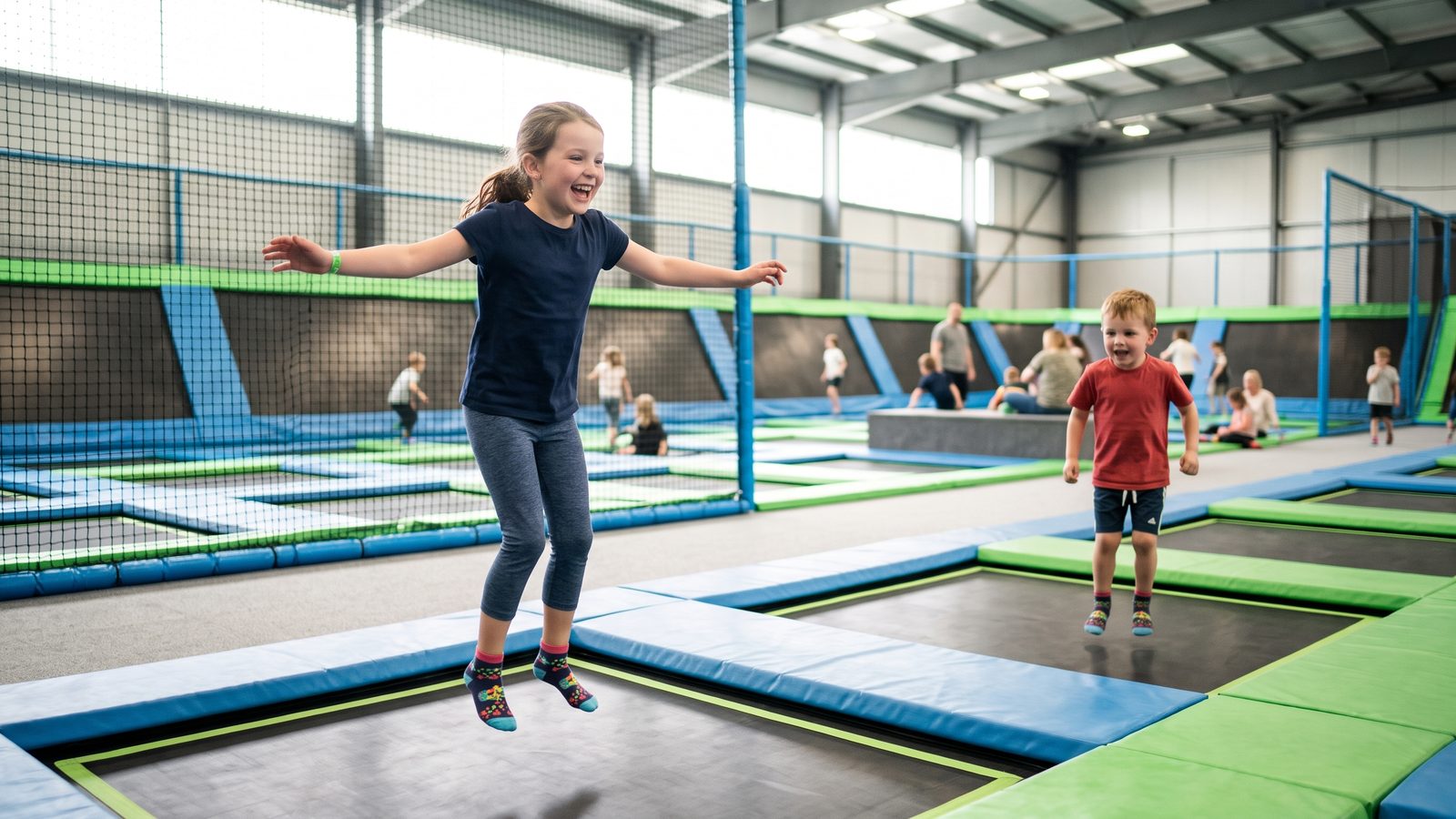
A trampoline park is one of the best ways to burn off energy on a cold or rainy day. Book a timed session online, sign the waiver before you go, bring or buy grip socks, and pick a quieter time. Rules vary by park, so check the minimum age, toddler sessions and whether parents can watch for free.
What happens at a trampoline park?
If you have never been, here is how a typical visit goes, so you and your kids know what to expect.
- Book a session. Most parks sell timed sessions, often 60, 90 or 120 minutes. Popular times can sell out, so booking online ahead is safer than walking in.
- Sign the waiver. Every jumper needs one, and for kids it is signed by a parent or legal guardian. Many parks let you do it online before you arrive, which saves waiting at the desk.
- Get grip socks. Almost every park requires its own grip socks (also called trampoline or jump socks). You buy them at the desk, and you usually keep them.
- Check in and watch the safety briefing. Many parks show a short video or give a talk about the rules, then give jumpers a wristband for their session.
- Jump. Staff (often called court monitors) watch each area and blow a whistle if someone breaks a rule.
- Take a break. Most parks have a cafe or seating area for water, snacks and tired legs.
What areas do trampoline parks have?
- Open jump courts: big grids of connected trampolines, usually split by size or age.
- Foam pits or air bags for jumping into.
- Dodgeball courts with trampolines.
- Basketball dunk lanes.
- Ninja or obstacle courses, climbing walls and balance beams at many newer parks.
- A toddler or little kids' area at some parks, with smaller trampolines and soft play.
What age can kids go to a trampoline park?
There is no single rule. Each park sets its own minimum ages, and they vary a lot. Here is what to check before you book.
- Toddler sessions. Many parks run sessions only for little ones, usually on weekday mornings, with quieter courts and a parent on hand. The age range depends on the park: one chain's toddler sessions run from walking age to 5, another's are for ages 1 to 2.
- Minimum age for general sessions. Some parks let any child who can walk join open sessions with an adult; others set a minimum age or height for certain areas, like foam pits or ninja courses.
- Age to jump without a parent. This varies widely. Among large operators, the age at which kids can be dropped off or jump without an adult on site ranges from about 9 to 13.
- Adult and teen sessions. Many parks run evening sessions for older teens and adults, sometimes with music and lights.
Pediatricians are more cautious than most parks. The American Academy of Pediatrics' parent site advises that children under 6 should not jump on trampolines, and suggests waiting until at least 6 for a trampoline park, then going at quieter times and staying close by. If you go with a younger child, a toddler-only session is the safer choice, because little jumpers are not sharing the court with big kids.
Pro tip: check the rules for each area
A park may let a 4-year-old on the main court but not into the foam pit or onto the ninja course. Look at the park's rules page before you go, so no one is disappointed at the edge of the pit.
Trampoline park rules parents should know
Rules differ by park, but these show up almost everywhere, and they are worth explaining to kids in the car on the way.
- One person per trampoline. This is the most important rule. When two people bounce on the same mat, the bigger jumper can throw the smaller one off balance.
- No flips or somersaults unless the park allows them in a coached area.
- Jump in the middle of the mat, not on the pads or springs between trampolines.
- Stay in your size or age zone. Many parks separate little kids from teens and adults.
- Empty your pockets and take off jewelry. Phones, keys and hair clips can fall onto the court and hurt someone.
- No food, drinks or gum on the courts.
- Do not sit or lie on the trampolines, and keep off the court while others are jumping in a foam pit lane.
- Listen to the staff. A whistle means stop and look.
These rules match the advice in the American Academy of Pediatrics' policy statement on trampoline safety: a single jumper on the mat at a time, no somersaults or flips for recreational jumping, and active adult supervision, not just an adult somewhere in the building.
Grip socks, waivers and what to wear
Do you need special socks for a trampoline park?
Almost always, yes. Parks require grip socks with rubber patterns on the sole, and most sell their own at the desk. You keep them, and many parks let you reuse them on later visits as long as they are in good condition. Put them in the car or bag after the visit, so you are not buying a new pair every time. Some parks only accept their own branded socks, so check before you bring a pair from somewhere else.
How do trampoline park waivers work?
Every jumper needs a waiver. For anyone under 18, a parent or legal guardian signs it. Signing online before you go is the easiest option: it is often valid for a set time (sometimes a year), and it saves time at the desk. If your child is going with another family or a friend's birthday party, you may need to sign the waiver yourself in advance, because another adult usually cannot sign it for your child.
What should kids wear?
- Comfortable sportswear: leggings, joggers or shorts and a T-shirt. Avoid jeans, belts and anything with zips or buckles.
- No jewelry, hair clips or anything in pockets.
- Long hair tied back.
- Glasses: ask the park. Some recommend a sports strap or leaving them in the locker if your child can manage without.
- A water bottle (refillable, if the park allows it), and a layer for afterward, since kids get sweaty fast.
- Coins or a card for lockers, which many parks have near the entrance.
Are trampoline parks safe for kids?
Trampoline parks are a fun, active outing, but they are not risk-free, and it helps to know where the risks are. A study in the journal Pediatrics found that emergency room visits for trampoline park injuries in the US rose sharply as parks spread, from an estimated 581 in 2010 to 6,932 in 2014. Most injuries were to the legs, mostly sprains and fractures, and park injuries were more likely than home trampoline injuries to need a hospital stay.
That does not mean you should never go. It means the rules matter, and so does the park you choose. Most serious injuries come from collisions, flips and landing badly, which the rules above are designed to prevent.
How to judge a trampoline park
- Staff on every court, watching and stepping in when rules are broken.
- Separate areas or times for little kids, with size zones on busy courts.
- Pads covering all springs and frames, with no gaps, rips or exposed metal.
- A clear safety briefing before you jump.
- A park that is not overcrowded. If the courts look packed, it is fine to wait or come back another time.
- Ask whether the park follows a recognized safety standard, such as ASTM F2970 for trampoline courts or ISO 23659 for trampoline parks, and whether it is inspected regularly.
"The safest trampoline park visit is a quiet one: fewer jumpers, staff watching, and one child per trampoline."
Can parents watch or jump at a trampoline park?
Yes, but the rules for parents vary. Some parks let non-jumpers in for free, while others charge a small spectator fee. Spectators usually stay in a viewing area or cafe and are not allowed on the courts without socks and a jump ticket.
If you want to jump with your kids, check whether the park allows adults in the same session, and stick to the one-jumper-per-trampoline rule. Bounce next to your child, not on the same mat. Some parks offer parent-and-toddler sessions where a grown-up is expected to join in, which is a great way for little ones to try it.
Watching closely matters most for younger kids. The AAP's advice is to stay close and keep watching, which is easier from the edge of the court than from a table across the room.
The best times to go to a trampoline park with kids
- Weekday mornings are usually quietest, and the time most toddler sessions run.
- After school and weekend afternoons are busy, especially on cold or rainy days.
- School breaks, including winter break, are peak times. Book early and pick the first session of the day.
- Opening sessions tend to be calmer, with fresh staff and fewer jumpers.
- Check for themed sessions like glow nights, fitness classes or sensory sessions, so you know what you are booking.
How long should you book? For most kids under 8, an hour is plenty; they tire faster than you expect. Older kids and teens often enjoy 90 minutes, especially with dodgeball or a ninja course to try.
Looking for more ways to burn off energy indoors? See our guide to indoor activities for high-energy kids and our tips for indoor playground playdates.
Trampoline parks for toddlers and kids with sensory needs
Busy trampoline parks are loud, bright and fast. For toddlers and kids who get overwhelmed, the right session makes a big difference.
- Book a toddler session, not a general session. Courts are quieter, big kids are not around, and staff expect parents to help.
- Look for sensory-friendly or quieter sessions. Some parks run them with lower music, fewer jumpers and softer lighting.
- Visit the park first, or show your child photos and videos from the park's website, so they know what to expect.
- Bring ear defenders for a loud park, and agree on a quiet spot to take breaks.
- Start with the easiest area (a small trampoline or soft play) before the main court.
For calm ideas at home after a big outing, see our sensory and calming activities.
Trampoline park birthday parties: what to know
Trampoline parks are a popular birthday party choice, especially for ages 5 to 12. Most packages include jump time, a party room or table, food, and a host who handles the jumping part.
- Book early, especially for weekends. Party slots fill weeks ahead.
- Send the waiver link with the invite, and ask every family to sign it before the party. This saves a long line at check-in.
- Tell guests about grip socks: whether they are included, and whether kids can bring their own from a previous visit.
- Check how many adults can come in for free and whether siblings can jump.
- Ask about a quieter time slot or a private court if your guests include younger kids.
Pro tip: put the waiver link in the invite
Add a line to the invitation with the park's waiver link and the words: please sign before the party. You will start the party on time instead of waiting at the desk.
Planning on a budget? Our guide to a 5th birthday party on a real budget has ideas that work at any age.
How to find a good trampoline park near you
Start with trampoline parks on Funday. Each place page has the address, what the park offers, which ages it suits and tips from parents, so you can compare a few before you book. Tap the heart to keep your favorites in your Saved list for the next rainy day.
Before you book, check these on the park's own website:
- Minimum ages and toddler session times.
- Grip sock rules, and if socks from a previous visit can be reused.
- Waiver: can you sign online, and for how long is it valid?
- Spectator rules and fees.
- The age at which kids can jump without an adult.
- Session lengths and the quietest times.
- Lockers, cafe, parking and the water bottle policy.
Your next step: pick a weekday or the first session of the weekend, find a trampoline park near you on Funday, and sign the waiver tonight so you can walk straight in.
Frequently asked questions
What age is a trampoline park for?
It depends on the park. Many welcome toddlers in special toddler sessions and older kids in general sessions, with some areas limited by age or height. The American Academy of Pediatrics' parent site advises no trampoline jumping for children under 6, and for older kids suggests quieter times and staying close.
Do you need special socks for a trampoline park?
Yes, at almost every park. Grip socks are required and usually sold at the desk. You keep them, and many parks let you reuse them if they are in good condition.
Can parents watch at a trampoline park for free?
Often, but not always. Some parks let non-jumping adults in for free; others charge a small spectator fee. Check the park's website before you go.
Can I drop my child off at a trampoline park?
Only above a certain age, which varies by park. Among large operators, the age at which kids can jump without an adult on site ranges from about 9 to 13. Younger kids need a parent or guardian on site.
Is a trampoline park good exercise for kids?
Yes. Jumping is vigorous, whole-body exercise that builds balance and coordination, and most kids are tired after an hour. Follow the rules, especially one jumper per trampoline, to keep it safe.
Who can sign a trampoline park waiver for a child?
A parent or legal guardian. For parties or outings with another family, sign the waiver online before the day, since another adult usually cannot sign it for your child.