
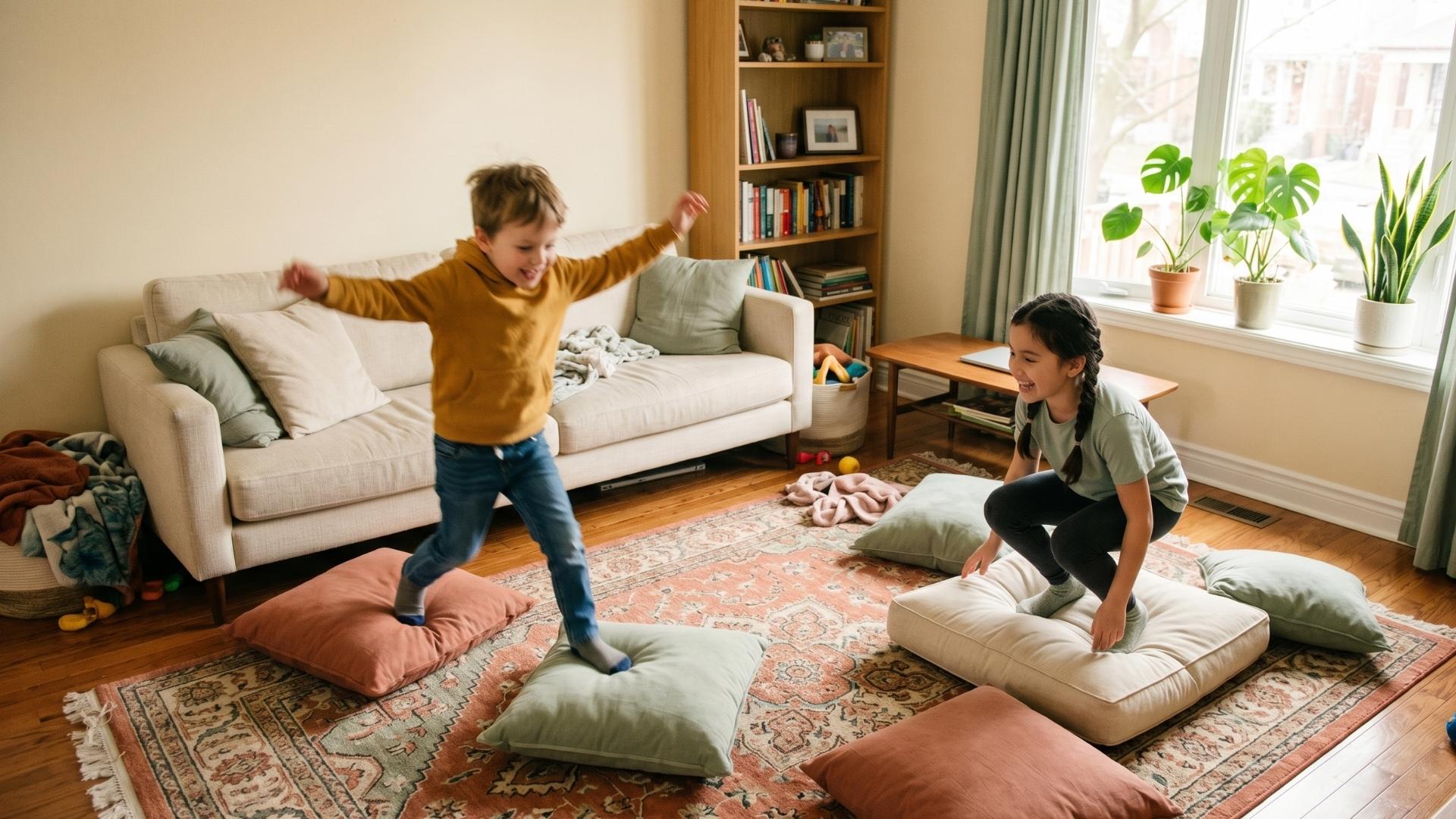
Some kids need to move. By 9am, a high-energy 5-year-old has used up their second breakfast and is bouncing off the walls. When you cannot get outside (rain, sick day, evening, apartment building, the kid is too small to walk far), you need indoor activities that actually burn the energy, not the calmer stuff that keeps them occupied. Here are the 12 activities that work, plus a 7-minute reset for the urgent moments and what to do when you cannot make any noise at all.
Why tiring them out actually matters
A kid with unspent energy is not a behaviour problem; they are a body that has not done what bodies need to do. Most kids ages 3 to 10 need at least an hour of moderate-to-vigorous physical activity a day, and many high-energy kids need closer to two.
When that activity does not happen, the energy comes out as the things parents call "behaviour": jumping on the couch, picking fights with siblings, refusing to sit down for dinner, the meltdown at 5pm. The fix is rarely more discipline; it is usually more movement. The CDC's physical activity guidance for kids covers the daily targets and why they matter.
On a day stuck inside, the goal is to find that hour anyway. Not all at once; a few 15-minute energy bursts spread through the day works better than a single long session. The activities below are sorted to make those bursts easy.
If you are looking for the broader menu of indoor activities (art, pretend play, science, quiet wind-down), our 30 indoor playdate activities guide covers everything. This piece is the high-energy subset only.
The 7-minute energy reset
When the bouncing-off-the-walls is acute and you need a quick fix, the 7-minute reset is the move. Set a timer, run the routine, then let them choose what is next.
- 60 seconds of jumping jacks (or just jumping in place for under-fives).
- 60 seconds of bear crawls across the room and back.
- 60 seconds of dance party with one loud song you both like.
- 60 seconds of animal moves: frog jumps, snake slithers, cheetah sprints.
- 60 seconds of "freeze dance" (music on, music off, freeze).
- 60 seconds of cooldown stretches: reach for the sky, touch the floor, big breath in, big breath out.
- 60 seconds of water break and a sit-down on the couch.
Most kids come out of this either ready to focus on something quieter or asking to do it again. If they ask to do it again, do it again; you have just bought yourself another seven minutes.
This routine works for ages 3 through about 9. Older kids need longer bursts (15 to 20 minutes) and more challenge (a real workout, a YouTube dance video, an actual obstacle course).
12 indoor activities that burn energy fast
All of these get heart rate up, recruit the big muscle groups, and can be set up in under five minutes with stuff you already have.
- Floor is lava. Couch cushions on the floor as islands; the kids hop between them. Add a complication every 90 seconds (no left foot, only crawling, eyes closed for one jump).
- Indoor obstacle course. Crawl under the dining chair, jump over a pillow, balance along masking tape on the floor, do five jumping jacks, run back. Time them. Let them re-design it once they know how it goes.
- Dance freeze. Loud music, dance, pause every 20 seconds, freeze. Add a difficulty: freeze in animal poses, freeze with eyes closed, freeze in slow motion.
- Wall sits and races. Sit against the wall, knees bent like sitting in a chair, hold for 30 seconds. Or race from one end of the hall to the other on hands and feet (bear crawl race).
- The cardboard box challenge. Stack boxes; jump over them; climb through the biggest one as a tunnel; flatten one and use it as a slide on the carpeted stairs (if your stairs allow).
- Pillow fort with a movement requirement. Build a fort, then a rule: every five minutes, everyone has to do five jumping jacks before going back inside.
- Living-room volleyball with a balloon. A balloon, a yarn or couch as the net. Volley back and forth without it touching the ground. Wear out shockingly fast for how silly it looks.
- Animal yoga. Cat stretch, frog jumps, bear crawls, snake slithers, downward dog. A yoga-cards deck (Yoga Pretzels or similar) makes it a 20-minute activity. Looks calm; is not calm.
- Hide and seek with a twist. Hider has to count to 30 doing five jumping jacks each round of 10. Seeker has to do bear-crawl back to base after finding the hider.
- Hallway bowling. Plastic cups or empty water bottles at one end of a hall, soft ball rolled from the other. Reset, rebowl, rinse. Add a rule: hop on one foot to retrieve the ball.
- Stair workouts (if you have stairs). Walk up and down five times; then crab-walk up; then take two at a time. Set a timer for two minutes and let them go.
- Just Dance / GoNoodle / kid YouTube workout videos. Yes, screens, but the screen is doing the work of being a coach. Pick a 15-minute high-energy session and let them follow.
Pick three to five for any given day. Cycle through; do not try to do all 12 in one afternoon (you will all be exhausted in a non-fun way).
Pent-up energy: what is actually happening
If your kid is melting down for what feels like no reason, ask yourself: when did they last move their body for 20+ minutes? If the answer is more than 3 hours ago and they have been awake the whole time, the meltdown is probably energy, not discipline.
The signs that energy is the issue: jumping on furniture, picking at a sibling, refusing to settle for a snack, talking very fast and loud, getting frustrated by tiny things. These are all symptoms of a body that needs to do what bodies do.
What does not work in those moments: telling them to calm down, sending them to their room, taking away a screen. What does work: 10 to 15 minutes of active movement, then offer the snack or the quiet activity.
Counterintuitively, a tired kid is not a kid who has run themselves into the ground; it is a kid whose nervous system has rebalanced. The reset is what gets them there. Try the 7-minute routine first; if they are still wired, try one more high-energy activity from the list above. Most kids come down within 20 minutes of solid movement.
The cardboard-and-couch-cushion zone
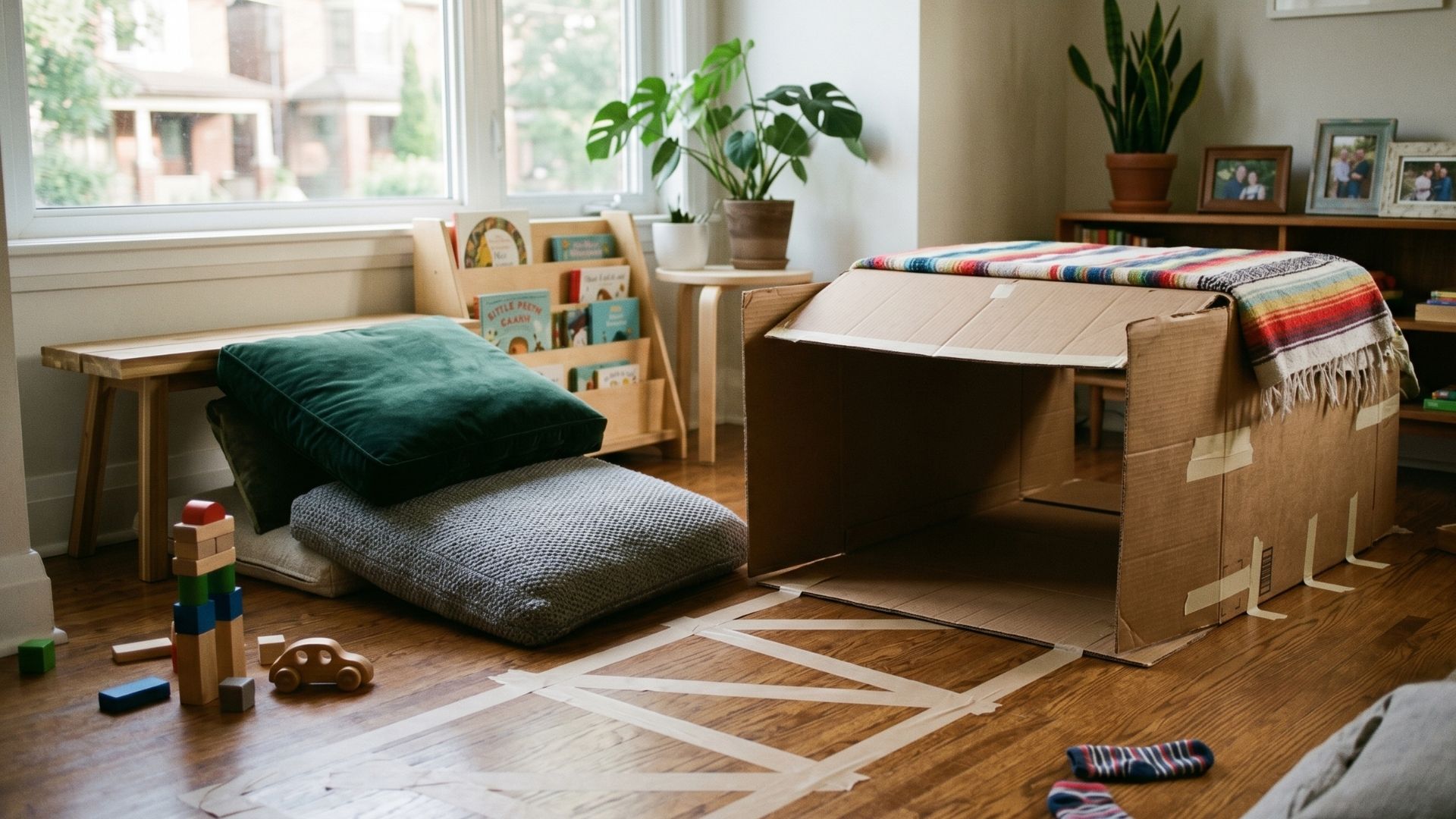
If you want a one-time setup that produces hours of activity over weeks, build a play zone. Two ingredients: couch cushions you are willing to let live on the floor, and a stack of cardboard boxes.
Push furniture back to clear a 4-by-6-foot area in the living room or playroom. The cushions become islands, ramps, fort walls. The boxes become tunnels, racing barriers, climbing structures. Add a roll of masking tape for floor lines (balance beams, bowling lanes, racing lanes), and you have a built-in indoor playground.
Reset the zone every Sunday evening. Put the cushions back. Recycle the most beat-up boxes; save the good ones. The zone refreshes every weekend so the kid does not get bored of the same setup.
This works best for kids ages 3 to 8; older kids need more elaborate setups or actual gear (climbing wall, mini-trampoline). For the bigger physical-play setups, see the next section.
Energy-burners by age
Ages three to five.
Big movement, low complexity. Floor is lava, dance freeze, animal yoga, indoor obstacle course (simple), pillow fort with the jumping-jacks rule, balloon volleyball, hallway bowling. They tire out in 20 to 30 minutes of solid play; expect the meltdown if you go past 45.
Ages six to eight.
More elaborate courses, more rules, more competition. Time the obstacle course and try to beat the time. Level up the freeze dance with frozen poses. Add a wall-sit challenge or a plank-hold challenge. Outdoor exercise videos (GoNoodle, Cosmic Kids Yoga) work well at this age. Expect 30 to 45 minutes per energy burst before they self-organise into something quieter.
Ages nine to twelve.
Real workouts, even brief ones. A 20-minute kids' HIIT video on YouTube. A push-up and sit-up challenge. Yoga apps. Just Dance with multiple rounds and a scoring system. Kids this age can do 45 minutes of moderate-to-high movement and feel actually tired after; under-fives cannot, no matter what you do.
Across all ages: outside is always better than inside if you can do it. Even 20 minutes of running around the block does what 60 minutes of indoor activity does. The indoor stuff is the backup, not the goal.
When you live in an apartment (the quieter version)
If you have a downstairs neighbour, hopping and jumping is a problem. The quieter alternatives still burn energy; they just do it without the thuds.
- Yoga and stretching. Cosmic Kids Yoga on YouTube is a hit at most ages. Builds strength and burns energy without bouncing.
- Wall sits, planks, push-ups. All silent and surprisingly tiring. Make it a game: how long can you hold the wall sit, can you beat your time tomorrow.
- Resistance band tug-of-war. Cheap resistance band, two kids (or kid and adult) pulling against each other. Burns the arms and core. Quiet.
- Slow-motion races. Cross the room as slowly as possible. Sounds easy; is not. Burns leg muscles and concentrates focus.
- The animal walk circuit. Bear crawl across the room. Crab walk back. Snake slither across again. Over and over. All low to the ground, all quiet.
- Balloon volleyball but with a rule: you must catch and release with no jump. Slows it down, keeps it quiet, still cardio.
- Slow yoga flows for older kids. Vinyasa to a relaxing playlist; a 15-minute flow burns more than it looks.
Keep a rug down for any of the floor-based ones. Save the floor-is-lava and dance freeze for outdoor or weekend daytime when the neighbours are out.
When the energy is actually anxiety
Sometimes what looks like high energy is actually a stressed nervous system. The signs that move-it-out is the right approach: kid is bouncy, loud, picking fights, hungry, has not been outside today. Movement helps; they come down within 20 minutes.
The signs that something else is going on: kid is bouncy AND has trouble sleeping, AND seems jumpy at small noises, AND has started melting down at smaller things, AND the high energy persists even after a long park day. That pattern is more like anxiety than physical energy, and it does not respond to obstacle courses the same way.
If the pattern fits anxiety more than "needs to move," a different toolkit applies: more sleep, more calm input, less novelty. The Child Mind Institute on anxiety in young kids is the right next read. Movement still helps but is not the whole answer.
If you are not sure which pattern your kid fits, run a one-week experiment. Make sure they get 60+ minutes of vigorous activity every day for a week. If the bouncing-off-walls calms down, it was energy. If it does not, talk to your pediatrician. Either way, you have useful data.
Frequently asked questions
How long should an energy-burning session be?
10 to 15 minutes for kids ages 3 to 5. 20 to 30 minutes for ages 6 to 8. 30 to 45 minutes for older kids. The point is to raise heart rate enough that they breathe heavy, not to exhaust them; an exhausted kid often has a second meltdown. End sessions while there is still some gas in the tank.
Are screen-based movement programs (Just Dance, GoNoodle, Cosmic Kids Yoga) good or bad?
Good when the screen is doing the coaching, not the entertainment. The kid is moving the whole time; the screen is just leading. Limit to once or twice a day so it does not become the only way they exercise, and pair it with non-screen movement when you can. For most families, these tools are a net win on rainy days.
My kid runs around for 20 minutes and then immediately wants more. Is this normal?
Yes, especially for kids ages 3 to 6 with naturally high energy. They have not yet calibrated when their body is tired; the brain says "more!" even when the legs are getting heavy. Offer a snack and a sit-down activity after a session; if they bounce up after 5 minutes, do another 10. Most days the second session is the one that lands.
How do I deal with downstairs neighbours during indoor energy time?
Move the high-thud activities (jumping, dance freeze, floor-is-lava) to weekend daytime when most neighbours are out. Stick to the silent alternatives in the apartment section above during evenings and weekday work hours. A rug helps. So does a friendly hello to the neighbour; most are sympathetic to families with kids and forgiving of occasional noise if you are otherwise a considerate neighbour.
Is my kid actually high-energy or is something else going on?
Most kids who feel "too much" to their parents are within the normal range for their age and temperament; the issue is the gap between their needs and the indoor adult environment. If you have done the one-week experiment above and your kid is still bouncy after 60+ minutes of vigorous daily activity, talk to your pediatrician about ADHD, sensory differences, or other patterns worth understanding. The conversation is not scary; it just gets you better tools.
Can you really tire out a 4-year-old enough that they will sit still?
Sometimes, briefly. A 4-year-old's natural state is moving; expecting them to sit still for more than 15 minutes is asking the wrong thing. A better goal is energy that flows in cycles: 20 minutes of movement, 15 minutes of quieter activity, repeat. Trying to grind them into stillness usually backfires; trying to flow with their natural rhythm works.