
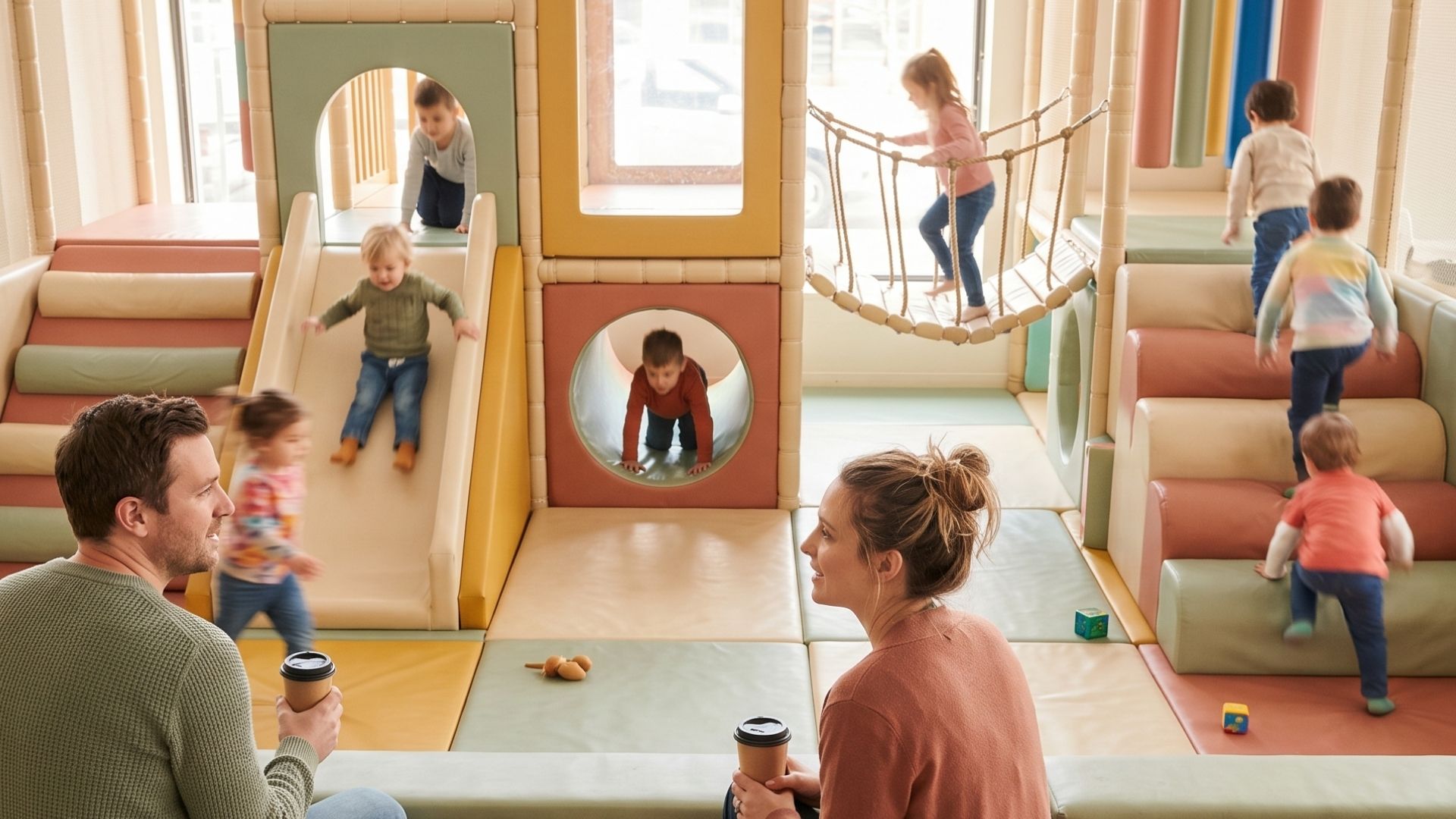
Indoor playgrounds are the rainy-Saturday salvation and the post-school energy-burner of choice. They are also loud, chaotic, expensive, and easy to misjudge. The right venue, the right age, and the right two-hour window produces a tired, happy kid; the wrong combination produces a meltdown in the lobby and a parent vowing never to come back. Here is how to pick the right one, when to step in, and the moves that make an indoor-playground playdate genuinely work.
When indoor playgrounds are the right call (and when they are not)
Indoor playgrounds are the right answer when: it is raining or freezing outside, your kid has a backed-up tank of physical energy, you need a low-prep playdate option (no host work, no childproofing), or the playdate is two-plus hours and you need somewhere that absorbs the kids without your involvement.
They are not the right answer when: the kids would do better with quieter time together (one-on-one bonding, conversation, calmer activities), you are short on cash (drop-in fees add up fast), the visiting kid is sensory-sensitive (most indoor playgrounds are loud beyond comfort), or your kid is already overstimulated (more stimulation will not help).
The format works best for: kids ages 2 to 9 with at least one playmate they already know. Tweens find most indoor playgrounds babyish (trampoline parks are the exception). Toddlers under 2 do better in a quieter venue or at home.
If you are still building out the broader playdate logistics, our complete guide to playdates covers the bigger picture. This piece is the indoor-playground-specific layer.
Choosing the right venue (the 5-point checklist)
Indoor playgrounds vary wildly. Here are the five things that separate a good one from a regrettable one.
- Age zones. The best venues have a separate fenced area for under-threes, with smaller equipment and softer landings. If toddlers and 9-year-olds share the same play structure, the toddlers will get knocked over, full stop.
- Cleanliness. Walk in and look. Floors should be visibly cleaned daily; equipment should not have visible food residue or staining; the toilets should be the basic test (if those are clean, the rest usually is). Stale-air smell or an obvious mold smell is a dealbreaker.
- Sight-lines. You should be able to sit in one spot and see most of the play area. Venues with mazey climbing structures where kids disappear from view for 5 to 10 minutes are stressful and harder to supervise; pick the ones where the parent zone has clear views.
- Food policy. Some venues let you bring outside food; some require buying onsite. The bring-your-own venues are usually cheaper overall and let you control what your kid eats. Onsite food is convenient but pricey and often limited.
- Pricing structure. Drop-in vs. multi-pass vs. membership. The math is different for each family; see the cost section below.
Visit a new venue once on a quiet weekday afternoon before committing to a weekend playdate there. The trial run tells you everything you need to know in 90 minutes.
The age question: when each format works
Soft play centres (ages 1 to 8).
The padded multi-level structures with ball pits, slides, climbing tunnels. Best for ages 2 to 6. Most have a separate toddler zone for under-twos. By age 8, kids find soft play repetitive; by 10, it is babyish. Length: 90 to 120 minutes is the sweet spot.
Trampoline parks (ages 5 to 14).
Best for kids 5+ who can follow rules around staying in their lane. Under-fives are at higher injury risk; many parks have separate toddler hours but supervision is critical. Tweens love trampoline parks; this is the venue that works best for the 10-12 age group. Length: 60 to 90 minutes; trampoline parks are physically draining and over-90-minutes is when injuries spike.
Indoor adventure parks (ages 4 to 12).
The bigger-budget venues with rope courses, ninja obstacle courses, climbing walls. Best for ages 5 to 12. The challenge level grows with the kid, so they tend to stay engaging across a wider age range. Length: 90 to 120 minutes.
Indoor swimming venues (all ages).
Pools with toddler areas and slides. Different format (you are in the water with under-fives, watching from poolside with school-age and up). Length: 60 to 90 minutes; longer sessions risk hypothermia for under-fives even in warm pools.
Bowling and laser tag (ages 6+).
Less aerobic, more structured. Best for ages 7 to 12 and up. One game (60-90 minutes) is the right format. Cheaper than the soft play options for school-age kids.
The supervision dose (how much, how often)
Indoor playground supervision is different from park supervision. The space is loud, the kids are out of sight more often, and the venue's staff are not technically watching your kid (despite what the marketing implies).
Under-threes.
You go in with them. Period. Most toddler zones require a parent in the play area. Stay within arm's reach for the first 20 minutes; once your kid is comfortable, you can sit at the edge and watch but stay close enough to intervene in 5 seconds.
Ages 3 to 5.
Sight-line supervision. You sit at a vantage point with eyes on the play area; you do not need to be inside it. Check in visually every 60 to 90 seconds; intervene if your kid asks for help, gets stuck, or starts to look upset.
Ages 6 to 9.
Loose sight-line. You can be on your phone, drinking coffee, talking to another parent. Look up every couple of minutes. Your kid knows where you are; they will come find you if needed.
Ages 10 and up.
Drop-off-feasible at most venues that allow it (check the policy). Be reachable by phone; agree on a pickup time and a meeting spot. Tween indoor-playground visits work as drop-off because the kids are old enough to handle disputes and self-regulate.
What to skip: hovering on the edge of the toddler zone narrating every move; reading a book and missing entire stretches; ducking out of the venue for a quick errand. Indoor playgrounds need an adult-on-call presence, not a chaperone and not an absentee.
Snacks and meals: the venue rules and your real options
Most indoor playgrounds have one of three food policies.
- Outside food allowed. Bring your own snack box, drinks, even a small lunch. Cheapest option; healthiest option. Look for these venues if you visit weekly.
- Outside food allowed in designated areas only. Common at trampoline parks and adventure parks. You eat in the cafe area; you cannot bring snacks into the play zone. Workable; just plan a snack window halfway through.
- Outside food not allowed. The venue wants you buying their cafe food. The cafe is usually overpriced and limited. If you have to use these venues, eat a real meal before you arrive and budget for one round of cafe drinks for the kids.
Drinks: water bottles in the venue regardless of food policy. Indoor playgrounds are warm and the kids are working hard; dehydration sneaks up on under-fives within 90 minutes. Refill at the water fountain or bring two bottles per kid.
For the broader snack patterns, our playdate snacks guide covers options that travel well in a venue setting. For allergy-safe options at a venue, see playdates and food allergies.
When other kids are rougher than yours
Indoor playgrounds attract kids of every temperament, and the chaos amplifies the rougher ones. Three things will happen at almost every visit.
- A bigger kid will land hard on a smaller kid in the ball pit. Usually accidental; usually fine after a hug. If it is not fine, intervene calmly and remove your kid for a few minutes' break.
- Some kids will play roughly without parent supervision. The parent is on their phone in the cafe; the kid is shoving on the slide. You can address the kid directly: "Hey, please wait your turn, the slide is one at a time." Most rough kids back off when an adult speaks calmly. If they do not, move your kid to a different part of the venue.
- Your kid will occasionally be the rough one. Eyes on them across the visit; if you see your kid pushing or grabbing, intervene immediately and consider a break. Indoor playgrounds bring out a particular over-stimulated energy that can flip into rough play; a 10-minute reset on the cafe couch usually fixes it.
When the venue is genuinely too rough (a Saturday afternoon when school-age kids dominate every space and your toddler keeps getting bowled over), leave. The visit is not worth the bruises. Find a quieter time slot or a different venue.
For the broader playground-conflict toolkit (sharing, hitting, when to step in), see our guide to playground boundaries. The principles travel from outdoor parks to indoor playgrounds.
Cost: drop-in vs. membership vs. birthday packages
Indoor playgrounds are not cheap. Drop-in fees per kid run roughly the cost of a takeout lunch for one. For a family of three or four, a single visit costs the equivalent of a sit-down meal out.
Drop-in.
Right for: occasional visits (once a month or less), trying a new venue, school-holiday treats. Most expensive per-visit option but no commitment.
Multi-pass / 5-pack / 10-pack.
Right for: regular but not weekly visits. Most venues offer a 10-15% discount on a multi-pack. Worth it if you know you will visit at least 5-6 times within the validity window (usually 6-12 months).
Membership.
Right for: weekly visitors, especially during a long winter or with multiple kids. Membership pays for itself at around 4 visits per month for most venues. Look for memberships that include a guest pass per visit (so a friend can join free or discounted).
Birthday party packages.
Convenient and expensive. The venue handles setup, food, party room, and entertainment for a flat per-kid fee. Cost is roughly 2-3x what an at-home party costs. Worth it if you want to outsource the whole thing; over-budget if you can host at home. For the budget alternative, see our 5th birthday on a budget guide.
If you are visiting more than twice a month, the membership math almost always wins. If you are visiting once a month or less, drop-in is fine and avoids the gym-membership psychology where you feel obligated to go to justify the cost.
Knowing when to leave (the meltdown signal)
Indoor playgrounds are exhausting in a way that sneaks up on kids. Most kids hit the wall at the 90 to 120 minute mark; some hit it at 60. The signs your kid is done.
- Sudden refusal to participate. They were happily climbing 10 minutes ago and now they will not get on the slide. They are tired.
- Hunger that ignores the snack box. They want to eat but they will not actually eat what is in front of them. Blood sugar is bottoming out.
- Crying over small things. The kid who fell down twice and bounced back up is now crying because they cannot find their shoe. Reserve depleted.
- Whining at you. They are following you around the cafe asking for things, fighting you on small decisions. Indoor-playground social bandwidth is gone.
- Aggression toward another kid. Pushed someone, grabbed a toy, snapped at a sibling. Time to leave 5 minutes ago.
When you see the signal, move quickly. Five-minute warning, snack and water, shoes back on, out the door. Do not negotiate ("just one more turn on the trampoline"); the negotiation extends the meltdown by 15 minutes.
The drive home from an indoor playground is often the meltdown zone for under-fives. Pre-empt with a small snack in the car, the favourite playlist, and a calm narration: "You did so much today. You are going to be tired. We will have a snack, then a quiet hour at home." Most kids fall asleep in the car within 10 minutes of leaving an over-stimulated venue.
Frequently asked questions
What is a reasonable cost per visit?
Highly venue-dependent. As a rough benchmark across most markets: drop-in for one kid runs roughly the cost of a coffee shop lunch for one adult; for a family of three or four it adds up fast. Memberships that pay for themselves at 4 visits per month usually mean drop-in equates to about a quarter of monthly membership. If you are unsure, ask the venue for the math.
Are indoor playgrounds clean? How do I judge?
Variable. The signs to watch for: visible food residue on play equipment, sticky floor in the cafe, dirty or smelly bathrooms, stale-air smell. The signs that say it is well-run: cleaning staff visibly working between sessions, hand-sanitiser stations in use, shoe-removal policy enforced, equipment that has been recently wiped. Trust your nose and your eyes; if it looks dirty, it is.
What about height and age limits?
Most venues have minimum age (often 12 or 18 months) and maximum age or height for specific equipment. Check the website before you go. Common limits: trampoline parks restrict under-5s to specific zones; rope courses have height minimums (typically 110-120cm); ball pits sometimes have age caps. The limits are for safety, not gatekeeping; respect them even when they feel inconvenient.
My kid is overstimulated within 30 minutes. What do I do?
Some kids do not handle indoor playgrounds well. Possible adjustments: visit during the quietest times (weekday late mornings, just-after-opening), pick a smaller venue with better sight-lines and less noise, limit visits to 45 minutes, bring noise-cancelling headphones for the kid who is sensory-sensitive. If none of these help, accept that this format is not for your kid; not every venue type works for every kid.
Are trampoline parks safe for under-fives?
Higher injury risk than older kids. Most parks now have a separate toddler hour or zone with cushioned surrounds and adult supervision required. If your venue does not have this, skip trampoline parks until age 5. The CPSC reports trampoline injuries spike sharply in the under-5 age group; the toddler-zone restriction exists for a reason. Stick to soft play under 5; switch to trampoline parks at 5 or 6.
Can I bring multiple kids and one adult?
Depends on the kids' ages. One adult can manage two school-age kids easily, two preschoolers if they pair well, or one toddler plus one school-age kid. Skip trying to manage two toddlers solo; you cannot keep eyes on both in a multi-level venue. Bring a friend, a partner, or a teen helper if you have multiple under-fives.