
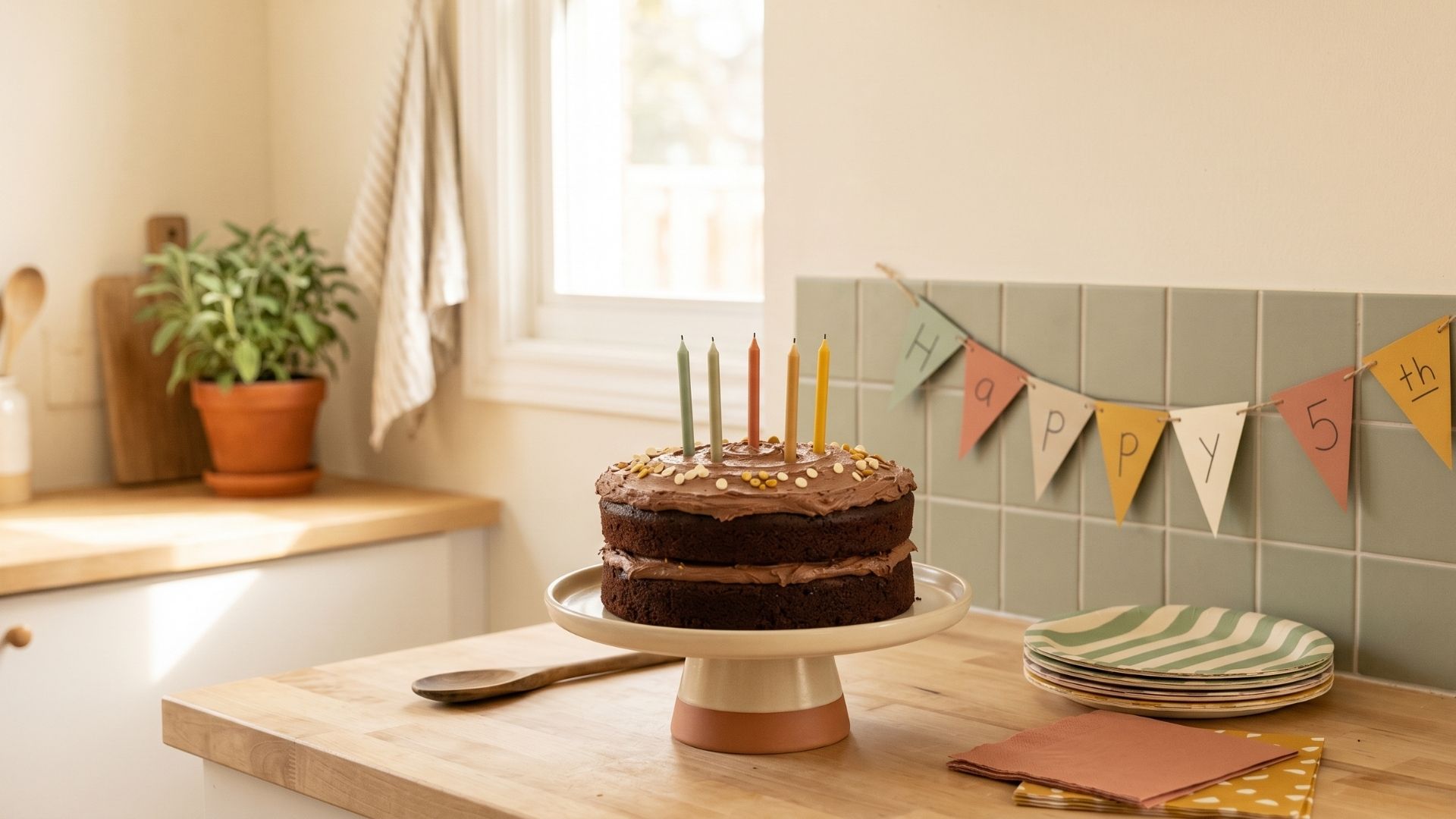
Turning five is a real milestone. It is the bridge between toddlerhood and the start of formal schooling, and the first birthday where your kid will have specific opinions about their own party. The pressure to deliver something Pinterest-perfect is real, but the rule of thumb that has held up across hundreds of parents we have asked is simple: the kid remembers the cake, the friends, and one or two specific moments. Everything else is for the photos. Here is how to throw a great 5th birthday for less than the cost of a single restaurant meal for the family.
Why 5 is a different birthday than the ones before
The 1st, 2nd, and 3rd birthdays are mostly for the adults. The kid is too young to remember the day; the party is for grandparents, family friends, and the parents' own milestone. By the 5th birthday, the kid is the audience. They know it is their day. They have specific friends. They have a wishlist. They will remember some of it.
This changes the whole shape of the party. You are no longer hosting an adult event with a kid theme; you are throwing a kid event the kid is the centre of. The implication: cut the things adults notice and put the budget into the things kids actually engage with. Streamers go on an Instagram grid; kids do not see them. A treasure hunt or a craft station is the day for them.
Five is also the last birthday before school changes everything. By 6 and 7, parties get bigger, more expectations attach, the friend group is the whole class. Five is the last sweet spot where 6 to 8 close friends in your living room is genuinely enough.
The Rule of Three: pick three things, ignore the rest
Most kids' parties try to be excellent on 12 fronts (decorations, theme, activities, food, cake, party bags, music, photos, invitations, venue, dress code, favours). They end up mediocre on all 12 because the budget and time are spread too thin.
Pick three. One hero activity, one signature snack, one memorable decoration. Concentrate the budget and time there. Everything else can be cheap, easy, or skipped.
"A child's joy is found in the connection and the play, not the price tag of the streamers."
Examples of three-thing combinations that work:
- Hero activity: backyard treasure hunt with hand-drawn map. Signature snack: a homemade chocolate cake. Memorable decoration: a single arch of balloons over the doorway.
- Hero activity: cupcake decorating station. Signature snack: pizza slices and a fruit platter. Memorable decoration: a happy-birthday banner the kid helped paint.
- Hero activity: a backyard movie projector with sleeping bags. Signature snack: popcorn and lemonade. Memorable decoration: fairy lights around the trees.
Pick the three before you make any other decision. Once they are chosen, every other decision flows from them and gets simpler.
The 2pm timing trick (slashes food cost ~60%)
Pro Planner Move: The 2 PM Start
Schedule your party from 2:00 PM to 4:00 PM. This avoids lunch and dinner windows entirely. You only need to provide light snacks, cake, and juice, which can slash your food budget by up to 60%.
The single biggest budget lever for a kids' birthday party is when you start it. Schedule it for 2:00 to 4:00pm. Two hours is plenty for ages 4 to 6. And critically, it falls between meal windows: not lunch, not dinner.
What this means: you do not need to provide a meal. You need a snack, a cake, and a drink. That is it. A 2pm party for 8 kids costs roughly a third of a 12pm party for the same group, because you are not feeding them lunch.
What goes on the table for a 2pm party: one platter of cucumber, carrot, cheese cubes, and crackers. A bowl of pretzels and a bowl of grapes. Cake. A pitcher of water and a pitcher of diluted juice or lemonade. That is the entire menu.
Adults who drop kids off can be told upfront: "Drop-off at 2, pickup at 4. We will have snacks for the kids; no need to send food." The drop-off format also takes some social labour off you (no need to entertain other parents).
The strategic guest list (smaller is better at five)
The classic rule of "age plus one" still holds for a 5th birthday. That means around 6 guests. The next rule of thumb is even better: 6 to 8 close friends produce a genuinely better party than 15 acquaintances.
Why smaller works at this age. Kids ages 4 and 5 cannot meaningfully engage with 15 peers in two hours; they bond in pairs and small clusters. A bigger group fragments into pairs and creates the kid-on-the-edge problem (the one who knows nobody, the one who is bored). Six kids is the largest group where everyone is included for the whole party.
Smaller also means: you can host at home. You do not need a venue. The food bill stays small. The party bag bill stays small. Cleanup is manageable. The whole event scales down to something one parent can run.
If your kid's preschool has a strong friend group of 12, and inviting only 6 feels exclusionary, a workable rule: invite the whole class for an in-class small celebration (cupcakes at school, the teachers handle the logistics) and host the home party for the closer 6. Most schools have a no-individual-invites-in-class policy that supports this exactly.
DIY entertainment that actually works for 5-year-olds
Hiring a professional magician or princess can cost upwards of an entire weekend's grocery budget. You do not need one. Five-year-olds are absorbing, curious, and short-attention-span; they do not need a paid performer. They need something to do.
Six DIY hero-activities that consistently work for the 4-to-6 age group:
- Treasure hunt with a map. Hand-drawn map, 5 to 6 hidden clues around the house and garden, a small "treasure" at the end (a bag of stickers, a small toy each, a basket of fruit). 30 to 45 minutes of focused play.
- Dinosaur dig (or fossil hunt). A sandbox or large plastic tub of sand. Bury small plastic dinosaurs or seashells. Hand each kid a paintbrush. They dig for 45 minutes.
- Cupcake decorating station. Plain cupcakes (homemade or store-bought), bowls of frosting in three colours, sprinkles, small candies. Each kid decorates one to eat now and one to take home.
- Obstacle course made from cardboard boxes and pool noodles. Set it up in advance; let them race through. Add a difficulty (no left foot, eyes closed) every 10 minutes.
- Mini-disco. One playlist of 8 to 10 kid-favourite songs, dimmed lights or a string of fairy lights, dance freeze. 30 minutes is plenty.
- Bubble station. A bowl of bubble solution, several wands of different sizes, outdoors. Kids ages 4 to 6 will play with bubbles for 45 minutes if you do not interrupt them.
Pick one as the hero, with one or two backups in your pocket if the kids burn through the hero faster than expected. Do not try to do all six in one party; the kids will be exhausted and you will be too.
"A child's joy is found in the connection and the play, not the price tag of the streamers."
The decoration shortcut: one thing, big
Most party decorations get glanced at and forgotten. Save the decoration budget for one thing, done well.
- A balloon arch over the front door or the cake table. About 15 to 20 balloons total, a roll of strong tape, an hour of work the night before. Visually striking; the kid notices. Total cost is the price of two takeout coffees.
- A custom hand-painted banner. White butcher paper, large markers or tempera paint, the kid's name and "Happy 5th Birthday" in block letters. The kid often helps; the banner becomes a keepsake. Hangs across the wall behind the cake table.
- Fairy lights, indoors or out. A 10-metre string of warm-white LED lights ($10 to $20). Drape across the cake area, the doorway, or the play area. Magical at 4pm in winter; useful for the photos year-round.
- A theme corner. If your kid has a specific obsession (dinosaurs, mermaids, space), build one corner of the room around it. A poster, a small prop, a stuffed animal. Skip the wall-to-wall theme treatment; one well-chosen corner reads stronger.
Pick one. Do it well. Skip the rest. The kid notices the cake, the balloons, and one decoration; everything else is invisible to them.
The cake decision (homemade vs. store-bought vs. order in)
The cake is the moment of the party. Lots of money spent here is not wasted; it just is not necessary.
Homemade.
Cheapest, often best-tasting, doable in 90 minutes the day before. A two-layer chocolate or vanilla sponge with buttercream icing and the kid's name piped on top is enough. If you are not a baker, a single-layer cake decorated with sprinkles or fresh fruit on top is just as effective. Total cost: the price of a coffee shop trip for the family.
Store-bought.
A supermarket cake, dressed up. Buy a plain or simply-decorated round cake. Add fresh fruit, edible flowers, a custom topper (a name written on a paper flag with a toothpick), or pile fresh strawberries on top. Costs a bit more than homemade; saves you 90 minutes of work.
Custom-ordered from a local bakery.
If you have a real budget for it, a custom cake is wonderful. Cost is meaningful (often the equivalent of a full restaurant meal for the family); skip if budget matters more than the visual moment. The kid will love any cake; the custom version is for the parents and the photos.
Whichever you pick, the candle moment is the actual ceremony. Five candles, lights down, everyone sings. That is the photo, that is the memory. The cake itself can be plain and the moment lands the same.
Goody bags: skip them or do them well
Goody bags are the most-debated tradition in kids' parties. The honest assessment: most goody bags are a waste of money and parental time, and most kids forget what was in them within a week. The cheap plastic toys end up in the bin within a month.
Two ways to handle this without being the parent who breaks the unspoken rule.
Skip them entirely.
Tell guest parents at invitation: "No goody bags this year, kids will leave with a small homemade something." Most parents are quietly relieved. The kid leaves with a slice of cake to take home (always appreciated) and the memory of the party.
Do them well, but small and consumable.
A small paper bag with three or four good things: a piece of homemade cake or a wrapped cupcake, a small bag of stickers (kids ages 4 to 6 love stickers more than almost any other small gift), a piece of fruit, one small craft item like a pack of crayons. Avoid the cheap plastic toys, the candy assortment, the fluorescent silly putty. Better to do less, well, than more, badly.
Cost of a well-done goody bag is roughly the cost of a coffee per kid. Skip-version cost is zero. Do whichever fits your party; do not feel obliged to provide them just because other parents do.
The before-during-after timeline
Throwing a party with limited time and limited money is mostly a sequencing problem. Here is the rough timeline that keeps it under control.
3 weeks out:
Decide the date, the format (drop-off vs. parents-stay), the guest list. Send invitations (paper, email, or WhatsApp; whatever your friend group uses). Pick the three things (Rule of Three section above). Buy any non-perishable supplies.
1 week out:
Confirm RSVPs. Buy or order the cake (or plan baking time). Plan the food shop. Test the hero activity if it needs setup (run through the treasure hunt clues; assemble the obstacle course; test the projector if outdoor movie).
Day before:
Bake the cake if homemade. Decorate the space (balloon arch, banner, fairy lights). Set out the snack table without the food. Hide the treasure hunt clues if that is the activity. Charge the speaker for music. Lay out the kids' coat space.
Day of, morning:
Final food prep (slice fruit, plate snacks). Last-minute tidying. Decorate the cake if needed. Have a real lunch yourself; you will not eat at the party.
30 minutes before:
Light snacks out, drinks ready. Hero activity set up. Music on. Greet first arrivals.
After:
Save the cake leftovers; they are dessert that night. Pack one slice per kid for the goody bag. Tidy in two passes (during pickup, then a longer pass after guests leave). Sit down with your kid and ask what their favourite part was; it almost always surprises you.
Frequently asked questions
How long should a 5-year-old's party last?
Two hours is the sweet spot. Long enough to do a hero activity, eat, do cake, and have free play; short enough that nobody melts down. Three hours is too long for ages 4 to 6 and the last 30 minutes always go sideways. Set a clear end time on the invitation; parents arrive on time when they have one.
What if my kid wants to invite the whole class?
Invite the whole class for an in-class celebration (cupcakes or a small treat brought to school, teacher-organised) and host the closer 6 to 8 friends at home. Most schools have a no-individual-invites-distributed-in-class policy that lines up with this exactly. Talk to the teacher a week or two ahead about logistics for the in-class part.
Should I hire a venue or do it at home?
At home is cheaper, more relaxed, and works best for ages 4 to 7. A venue (soft play, swimming pool, art studio) costs significantly more but takes the cleanup and entertainment off your plate. For ages 8 and up, venue parties start to make more sense. For a 5th birthday, home is usually the right call.
What about the kid who has a food allergy or dietary restriction?
Ask at the RSVP. Most parents will tell you upfront. Plan to have one or two safe snack options that work for the allergy (the carrot-cucumber-cracker platter is naturally peanut-free, dairy-free, and gluten-free in the right form). Have a small separate cake or cupcake if needed. Do not make a fuss about it; the allergic kid wants to feel like everyone else.
How do I handle the gift situation tactfully?
If you do want gifts, list a small "if you'd like ideas" section on the invitation: a book, a small craft kit, an art supply, a museum membership. If you would rather skip gifts, say so explicitly: "No gifts please, your presence is the present." Most parents respect either request. If gifts arrive anyway, accept them gracefully.
Is it okay to ask other parents to chip in or co-host?
If a friend's birthday is the same week, sometimes yes (joint parties can be fun and split the cost). Otherwise, no; do not ask other parents to contribute to your kid's party. The cost-saving moves in this article will get you to a affordable party without involving anyone else's budget.