
Most kids do not need to know every safety detail by age 4, but starting between ages 3 and 5 is widely recommended by parents and preschool teachers. Begin with allergies (if any are severe), parents' legal full names, the child's own full name, and your city. Add the phone number and street address through kindergarten. If you are reading this with a 6-year-old who still does not know any of it, you are not behind; you are starting now, and that is what matters.
A safety note. This guide draws on what parents, preschool teachers and pediatric guidance agree on. For allergies and medicines, your child's pediatrician has the final word. Emergency numbers differ by country, so check yours, and remember that every child learns this on their own timeline.
When should kids actually know your phone number and address?
The short answer: most kids reach mastery of phone number, full address, and parents' legal names around kindergarten age (5 to 6). Starting at age 4 is on the early side. Starting at age 5 is on time. Starting at age 6 is fine too.
If your pediatrician asked your 4-year-old these questions at a checkup and your child could not answer, that is normal. One preschool teacher we spoke with said most 3-, 4-, and even some 5-year-olds in her classroom did not know phone numbers or street addresses. A parent of three told us none of her kids knew this set of facts at 4. The pediatrician was almost certainly using the questions to gauge your child's communication and confidence, not to test mastery.
What changes the picture: severe allergies and life-saving medications. Those are taught as soon as the child can grasp the danger, regardless of age. Everything else can be built up at the family's pace.
The age-by-age priority hierarchy
A working order that comes up consistently in conversations with parents and preschool teachers.
Ages 2 to 3
Parents' first names. Child's own full name. What mom's or dad's car looks like. Life-threatening allergies, starting as soon as the child can grasp the concept of danger.
Ages 3 to 4
Add parents' legal full names. The city and state (or city and country) you live in. The child's birthday (month and day). The names of one or two trusted adults outside the immediate family.
Ages 4 to 5
Add one parent's phone number, starting with whichever parent is the more reliable emergency contact. What to do if separated in a store (find a worker; ask them to call mom or dad). How to use the home-screen shortcut on a parent's phone if one is set up.
Ages 5 to 6 (kindergarten range)
Add the full street address. The second parent's phone number. How to dial the emergency number in your country. The basic difference between an emergency and a non-emergency.
This is also the age when many kids start drop-off playdates at other homes, and knowing a parent's name and number makes that first one easier. Our guide to drop-off playdates covers the rest of the readiness checklist.
Throughout
Allergies and life-saving medication, if applicable, as soon as the child can grasp the danger. This does not wait for any age milestone.
Why parents' legal full names matter as much as phone numbers
If your child can give a trusted adult your full legal first and last name, almost anything else can be looked up. In conversations with parents, this point came up from a mom whose husband is a police officer: police can often find your contact information, your address, and your emergency contacts from a parent's full legal name. Phone numbers are useful, but full names are often the fastest route to you.
Practically, this means: do not let "mom" and "dad" be the only names your young child knows. Teach the legal first names early and the surnames soon after. If parents have different last names, teach both.
Funday tip: in some families, the parent's full legal name differs from the casual one used at home (a different first name, a maiden name vs a married name, or a chosen name vs a given name). Teach the version that matches the school registration, the pediatrician's records, and the insurance card, because that is the one that will be searched if anyone needs to find you.
The teaching strategy that works on almost every kid: turn it into a song
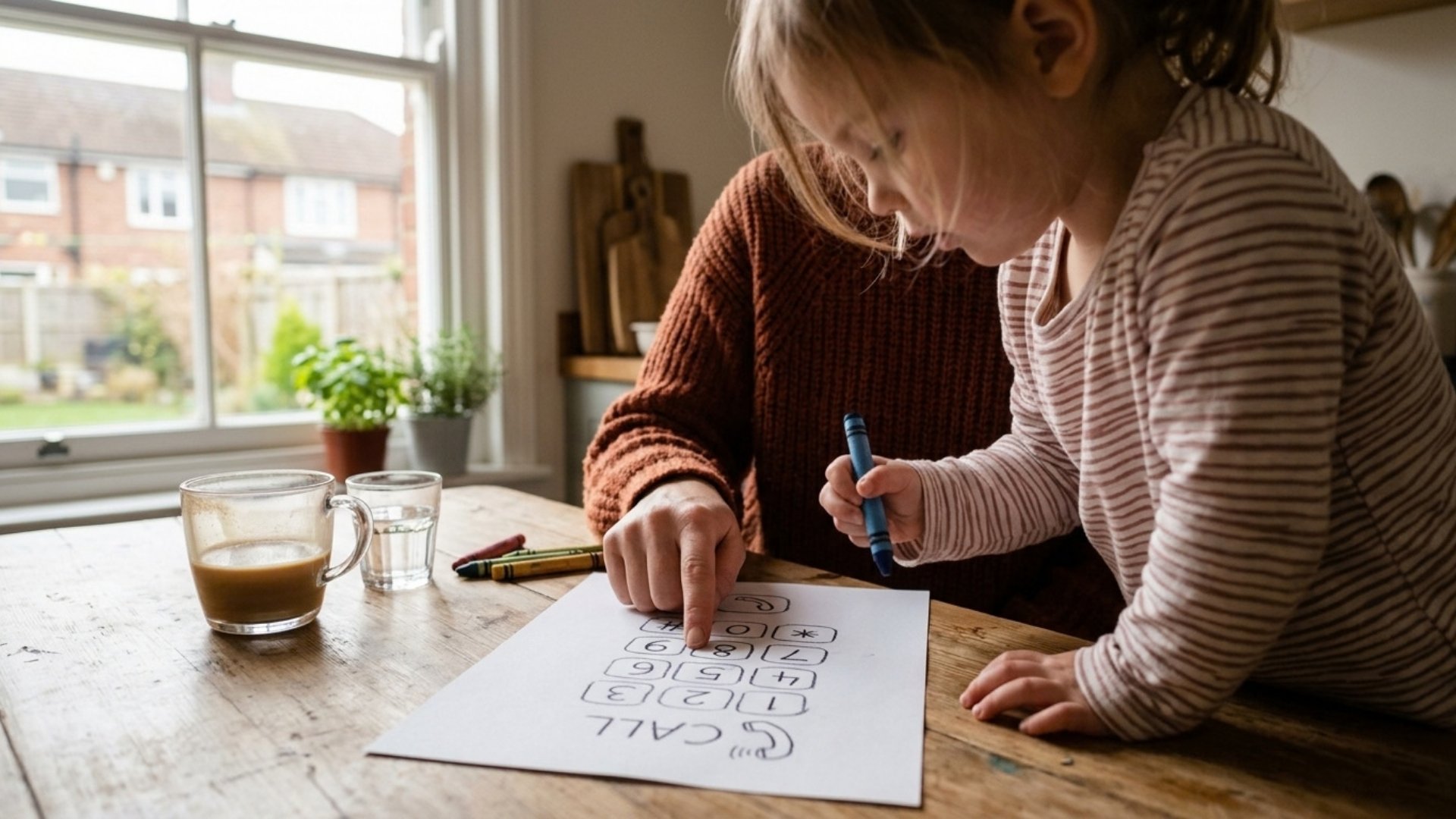
The single most-mentioned method in conversations with parents is setting your phone number, address, or legal names to a familiar tune. There is a reason most adults can still recite the 867-5309 phone number from a 1981 Tommy Tutone song decades later: tunes carry numbers in a way that rote memorization does not.
Tunes parents come back to over and over:
- Twinkle, Twinkle, Little Star (the most-used)
- Jingle Bells (works year-round, kids do not seem to mind)
- Frère Jacques
- Three Blind Mice
- Do You Know the Muffin Man
- A custom chant with no melody at all, just a rhythm: "da-da-da, da-da-da, da, da-da-da" matches a 10-digit number's natural cadence
How to do it: take your phone number (area code, then the first three, then the last four). Sing the digits to the tune, repeating once or twice for practice. Sing it together at bath time, in the car, at the dinner table. Within a few weeks, most kids have it.
Use an AI chatbot to generate a custom song
One mom told us she asked an AI chatbot to write a custom song setting her actual phone number to Twinkle, Twinkle, Little Star. The chatbot returned a four-line song with her real digits embedded in the rhythm, and her preschooler picked it up in a few days. Any of the common AI chatbots in 2026 (ChatGPT, Claude, Gemini, Copilot) can do this in a few seconds. Prompt example: "Write a short song to the tune of Twinkle, Twinkle, Little Star that includes the phone number 555 246 8137, for a 4-year-old to learn." Then practice the song with your child once or twice a day until it sticks.
Other ways to make a phone number stick
Beyond the song, several methods come up consistently. They work because they fold the phone number into something the kid already does.
Make your phone number the tablet or iPad passcode
For small kids who use a tablet daily, this is the single best daily-exposure tool. The child enters your phone number to open the device, multiple times a day, week after week. The number becomes part of their muscle memory before they realize they have learned it. Set the tablet to auto-lock after a few minutes so the child actually re-enters the code through the day instead of leaving it unlocked once in the morning. Works best for ages 3 to 7.
Use streaming-service profile PINs
If your kids access their own Netflix, Disney+, YouTube Kids, or similar profiles with a PIN, make the PIN a chunk of your phone number (the last 4 digits is the natural fit). Every time they open the streaming app, they type a piece of the phone number. A small daily reinforcement that adds up.
Wi-Fi password as a phone-number practice
Setting your phone number as the Wi-Fi password has a practical wrinkle: once a device saves the password, it stops asking, so the kid loses the daily exposure. The simple workaround: pick a day each week (Sunday evening works for many families) and have your child tap "forget this network" on the family tablet or their own device, then reconnect by typing the password. One minute of practice per week, no router-side changes needed, no other family members affected. The method also covers the natural moments when the practice happens by itself: when an older kid gets a new device, when friends come over and ask for the password, or when a guest joins the network.
Hand the kid the keypad at store checkout
Loyalty programs at Walmart, Target, grocery chains, pharmacies, and even hair salons usually let you enter a phone number at checkout to access points. Hand your child the keypad and let them enter the number. Keep a small written backup in your wallet for the first few weeks if your kid blanks under pressure. Most kids master the number within a month of doing this two or three times a week.
Practice-dial from grandma's phone (or a friend's)
Hand your child a relative's phone and ask them to dial your number. It rings. You answer. You have a 30-second silly conversation. Your child is now connecting that string of digits to the experience of calling mom or dad. This works especially well for kids who think of phone numbers as abstract and need to see the cause-and-effect.
Chunk the number into three parts
A 10-digit number is a wall; three smaller chunks are climbable. Teach the area code (three digits) first. When that is solid, add the next three. When that is solid, add the last four. One parent shared that her daughter memorized the number this way in about three weeks, even after a slow start with the full number.
Voicemail repetition
One mom told us her kids learned her phone number because she runs a business and ends every voicemail with "my cell number is 555-246-8137, thank you, bye." Her preschooler picked it up entirely passively. If your work involves regular voicemails, consider whether ending each one with your callback number could double as your child's exposure to it.
Daily practice that compounds
One parent told us her own mother started the family phone number with her as a toddler (just saying it together aloud, a few times a day), and added writing practice once she could form numbers around age 4 or 5. The combined approach stuck so well that she could still recite that childhood phone number decades later. The takeaway: short daily reps over weeks beat long sessions on a single afternoon. Three minutes a day at the breakfast table works better than 30 minutes once a week.
Travel-family tip: if your family travels often, teach the country code along with the phone number once your child is around 5, so an international call to mom works whether they are at home or away.
How to teach your address without overwhelming a young child
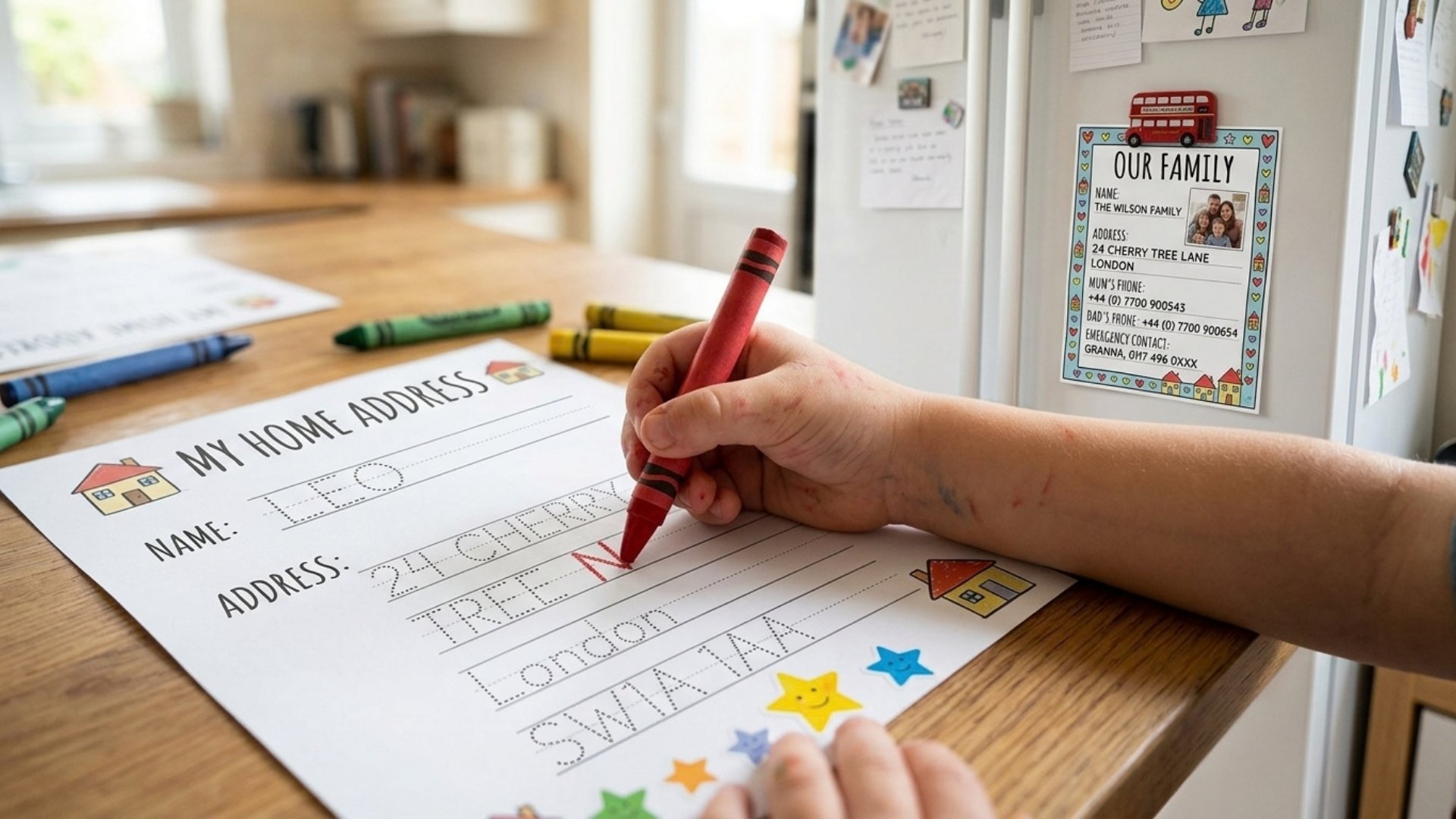
An address is a longer string than a phone number, but it has the advantage of being attached to a daily experience: arriving home. The most-cited address strategy from parents is using that arrival moment.
The drive-home announcement
Every time you pull into your driveway or your apartment block, say the address out loud: "We are home at 1234 Main Street, Brisbane, Queensland." Every single time. Within a few weeks, your child will start saying it before you do. Pair it with the city and state or country if you are working on those too.
Put it on the fridge or a whiteboard
Print your address (and phone number, if you want both in one place) and magnet it to the fridge at kid-eye level. Daily exposure does most of the work. Some families add allergies and the names of trusted adults to the same board, which turns it into a small family-info noticeboard.
The envelope game
Print your address on the front of an envelope and put it in a specific spot the child knows. Once a day, ask your child to fetch the envelope and read the address back to you. Repeat for a few weeks. The repeated retrieval-plus-recall pattern is one of the most effective forms of memorization research describes for young children, and the envelope makes the game tangible.
The chatty-kid caveat
Some young kids tell every cashier their life story. One parent told us her son shared the family's exact address, length of trip, and travel plans with strangers anywhere they went, so she taught him the city and state but held back the exact street number until he was older. This is a reasonable call. You know your child. If they share information freely, teach city and state first and add the street address when they are ready to understand when to share and when not to. There is no shame in waiting on this one piece.
Allergies and medications: a different bar
Almost every other safety milestone can wait until kindergarten. Allergies and life-saving medications cannot.
If your child has a known severe allergy (peanuts, tree nuts, dairy, eggs, shellfish, sesame, or other) or relies on a daily life-saving medication, they need to be able to communicate that as early as they can grasp the concept of danger. In conversations with families managing severe allergies, several patterns come up.
- Build the language into daily life. At the grocery store, when you pick sunflower butter instead of peanut butter, narrate it: "We pick this one because your body sees peanuts as something dangerous." One mom said her 4-year-old could explain her allergy this way: "My body sees peanuts as an enemy." That kind of plain-language framing sticks.
- Teach the "is it safe" question. By age 3 or 4, a child with severe allergies should be in the habit of asking a parent or caregiver "Is this safe for me?" before eating anything offered. Many preschools and pre-K programs reinforce this; ask the teacher to do it consistently.
- Defer to the pediatrician on epinephrine self-administration. Some families teach the mechanics of an epinephrine auto-injector (such as an EpiPen) as early as age 3 once the diagnosis is in place. The right age for your child is a conversation with the pediatrician.
- Add allergies to anything the child wears regularly. A medical-alert bracelet, a name patch on the backpack, an emergency card in the lunchbox. Visible, easy to find, easy for a teacher or caregiver to spot.
If your child goes to playdates at other homes, our guide to playdates and food allergies covers what to tell the host family and what to send along.
For language that works with young children, FARE's guide to talking with children about their food allergy suggests simple words like safe food and unsafe food, teaching kids to eat only food from parents or trusted adults, and using we language ("we read the ingredients to be sure this food is safe") so the habit builds gradually.
The script for getting lost: more important than the phone number
If your child cannot remember the phone number perfectly, that is fixable in a week. If your child does not know what to do when they realize they are alone, that is the bigger gap.
The script most parents we hear from settle on:
"If I cannot find Mom or Dad, I find a worker in a uniform or a mom with kids. I tell them my name. I tell them my mom's name. I ask them to call my mom."
Practice the script as a game. Play "what would you do?" at the dinner table. Walk through the script in different scenarios: in a grocery store, at the playground, at a theme park, on the beach. The goal is automatic recall, not perfect performance. One parent told us her 7-year-old got separated from his family at a busy museum, found an employee, asked her to call his mom, and the script worked the way they practiced it.
Two small additions that come up often.
Use a home-screen shortcut on a parent's phone
If your child is too young to dial a number, set up a one-tap shortcut on the parent's phone with a photo and a name like "Grandma" or "Dad." Teach the child to find the parent's phone in the parent's pocket, unlock it (or use the emergency-call screen if locked), and tap the shortcut. Some 3-year-olds master this; most 4-year-olds can. Pair it with teaching the number for the kids who are ready.
Body-marker backup at fairs, theme parks, and beaches
In crowded outings, write your phone number on the inside of your child's forearm with a permanent marker before you leave the car. Pair it with the verbal teaching; do not replace it. It belongs on the same pre-outing list as sunscreen and water; see our family water day packing guide for beach, splash pad, and waterpark days. The marker is the belt-and-suspenders move for the day. Some families also use temporary tattoo-style ID stickers (SafetyTat is a common brand) that last several days. For travel-family households, this is the same kid-ID approach used in our unusual things experienced families pack guide.
The warm version of an emergency drill
If you want to practice the full emergency-call sequence with your child, run it as a game. Grandma (or a trusted relative) plays the emergency operator. The child uses your phone, dials, and reports their name, address, and what is wrong. Five minutes of practice once or twice a year keeps the script alive without scaring the child.
Nemours KidsHealth's guide to teaching your child how to use 911 adds two details worth copying: say nine-one-one, not nine-eleven, so a child does not hunt for an 11 on the keypad, and practice with what-would-you-do questions rather than lectures. Use your own country's number in the same way.
A simple two-week plan
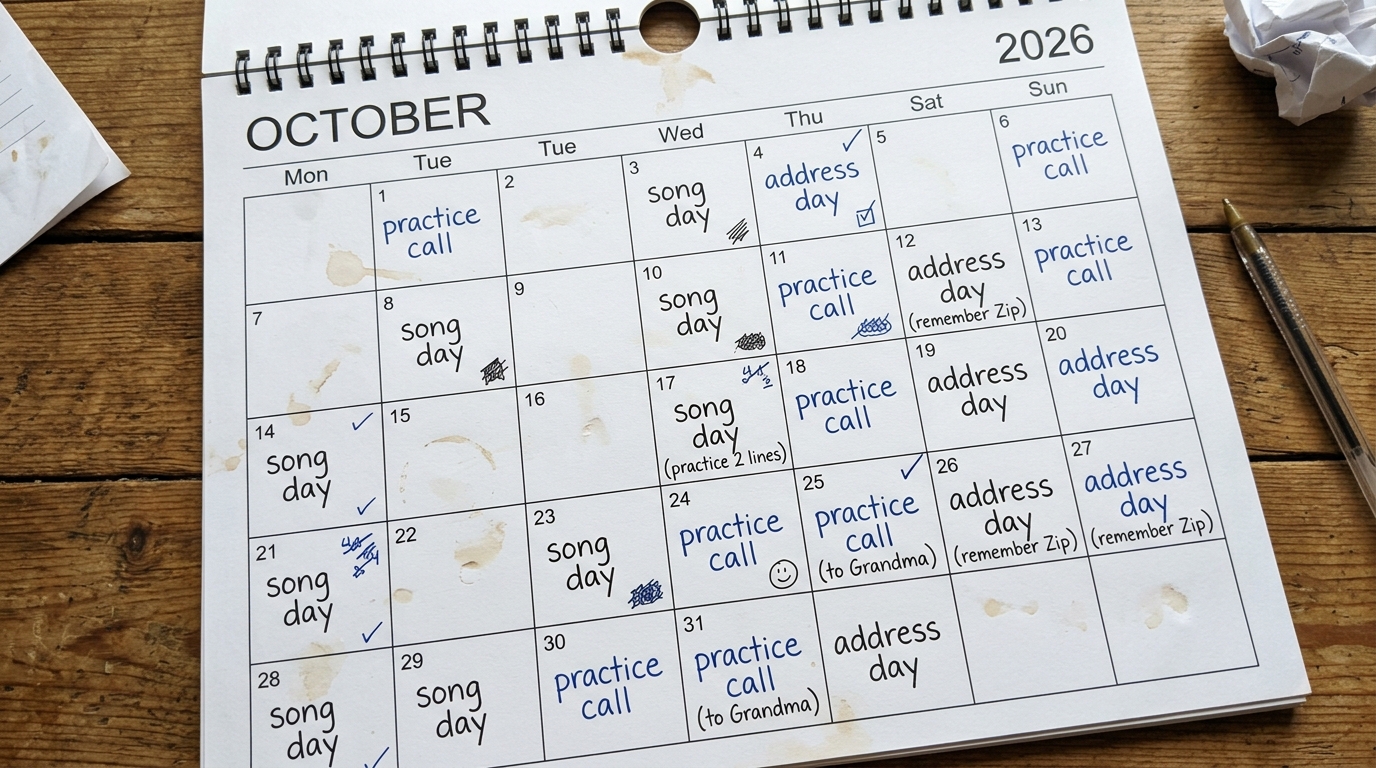
If you would rather not figure this out from scratch, here is a two-week starter plan that works for most kids ages 3 to 6.
Week 1
- Day 1: Print your address and phone number, magnet to the fridge at kid eye-level. Start the drive-home address habit.
- Day 2: Choose a tune (Twinkle Twinkle is the easiest starter). Sing your phone number to the tune three times together at breakfast.
- Day 3: Sing the phone-number song again at breakfast and in the car. Add parents' legal full names to the fridge sheet.
- Day 4: Wi-Fi password change (optional). Start using your phone number on the family tablet.
- Day 5: Sing the song at breakfast. Walk through the "if I get lost" script as a game at dinner.
- Day 6: At the grocery store, hand your child the loyalty-program keypad and have them enter your phone number.
- Day 7: Ask your child to recite the song without prompts. If they have it, celebrate. If they do not, that is week 2.
Week 2
- Day 8: Add your address to the song (some families use Jingle Bells for the address and Twinkle Twinkle for the phone number).
- Day 9: Practice the "if I get lost" script again, this time at a real grocery store or park.
- Day 10: Use the home-screen shortcut on your phone to practice-call grandma. Let your child tap the button and talk to her.
- Day 11: At the dinner table, quiz your child on legal names, the city, and the phone number. Keep it casual; this is not a test.
- Day 12: Body-marker if you are heading anywhere crowded. Pair with the verbal practice.
- Day 13: Sing the song again. Most kids have the phone number locked in by now.
- Day 14: Decide what to add for the next two weeks: the second parent's phone number, the full street address, or the emergency number for your country.
Some kids hit mastery on day 7. Some take six weeks. Both are normal. The pattern that almost never fails is short daily practice over weeks, not long sessions on the weekend.
Before you start: a final note
If your pediatrician asked your 4-year-old a list of questions they could not all answer, that is normal. Most pediatricians use the visit to identify where to start, not to find what is missing, and most kids do not master this full list until kindergarten. Pick one item from the age-by-age list above and start tomorrow. Two weeks from now, your child will know one thing they did not know today. That is the only goal.
Frequently asked questions
At what age should a kid know their parents' phone number?
Most kids reach reliable recall of one parent's phone number between ages 4 and 6, with mastery of both parents' numbers around kindergarten age (5 to 6). Starting at age 4 is on the early side; starting at age 5 is on time. If your 6-year-old does not have it yet, two weeks of daily song practice usually closes the gap.
What age should a kid know their full home address?
Kindergarten age (5 to 6) is the typical mastery point for a full street address. Younger kids can learn the city and state earlier (around 3 to 4). The drive-home announcement ('We are home at 1234 Main Street, Brisbane, Queensland') is the single most effective method for teaching the street address to young kids.
Should a 4-year-old know parents' full legal names?
Yes, by ages 3 to 4 most kids can learn parents' legal first and last names, and this is genuinely useful: a parent's full legal name gives police, school staff, or a store worker the best chance of reaching you quickly. Use the version that matches the school registration, the pediatrician's records, and the insurance card.
How can I make my child memorize my phone number faster?
Three methods come up consistently. Set the number to a familiar tune (Twinkle Twinkle, Jingle Bells, or a custom AI-chatbot song). Make the number your Wi-Fi password or tablet passcode so your child types it every day. Hand the kid the keypad at store-loyalty checkout. Used together, most kids master the number in two to four weeks.
What if my child has life-threatening allergies?
Allergy literacy is the one safety category that does not wait for an age milestone. Teach the allergy as soon as the child can grasp the concept of danger, build the 'is this safe for me' question into daily life, and follow your pediatrician's guidance on epinephrine self-administration. FARE's guide to talking with children about their food allergy is a good place to start.
What is the right age to teach my child how to dial the emergency number?
Many families and school safety programs introduce emergency-number dialing around kindergarten age (5 to 6). Younger kids (3 to 4) can learn a home-screen shortcut on a parent's phone with one-tap calling to a trusted relative. Run the call as a game with a relative playing the operator; five minutes of warm practice beats anxious lecturing.
Is it risky to teach a young child their home address if they share information with strangers?
If your child is the kind who shares the family's life story with every cashier, it is reasonable to teach the city and state first and hold the exact street address until they understand when to share and when not to. There is no shame in waiting on this one piece. You know your child best.
What emergency number should kids know in different countries?
The US, Canada, Mexico, and many other countries in the Americas use 911. The UK and Ireland use 999, and 112 also works in both. The European Union and Switzerland use 112. Australia uses 000. New Zealand uses 111. If your family travels internationally, teach the emergency number for the country you live in first, and add the destination country's number to a printable card in the kid's backpack for trips.