
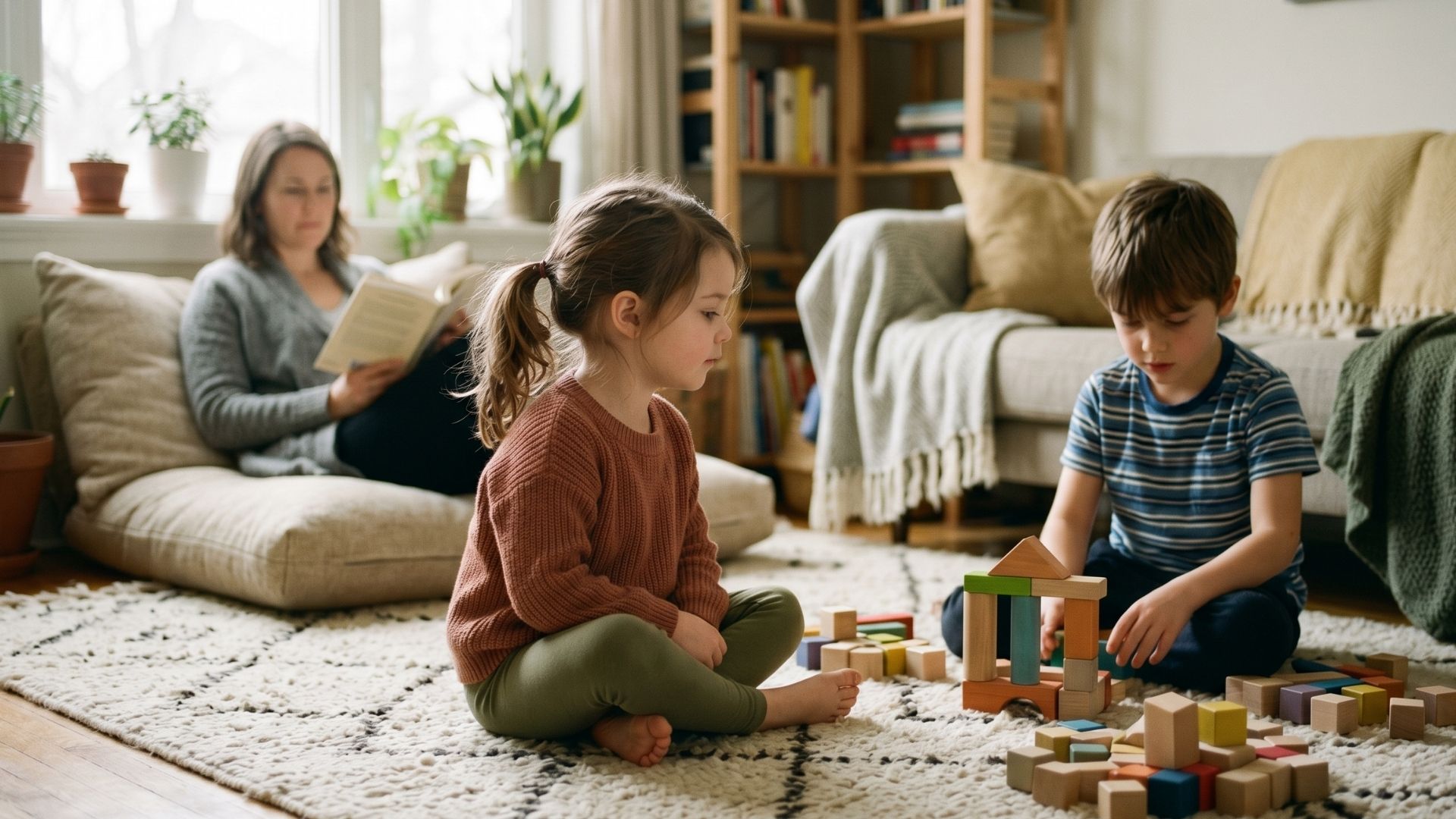
Shy kids are not broken kids. Shyness is a temperament; it shows up early, it has measurable biological markers, and most shy kids stay somewhere on the introverted side of the spectrum their whole lives. The right playdate format meets a shy kid where they are: smaller, more familiar, more predictable, with longer warm-up windows. Here is what to do, what to skip, and how to tell when shyness has become something that needs more support.
Shy is not broken (the temperament reality)
Roughly 15 to 20 percent of kids are born with a temperament researchers call "slow to warm up" or "behaviourally inhibited." These kids approach new situations cautiously, watch from the edge before joining, and need longer to feel comfortable in unfamiliar settings. The pattern shows up in infancy and is one of the most stable temperament traits across childhood.
What this means for playdates: a shy kid is not failing at socialising; they are doing it on a slower clock. Raising Children Network's guide to shyness in children explains it clearly: shyness is part of temperament, many shy kids are better described as slow to warm up, and the guide covers when shyness might be something else, such as social anxiety.
Most shy kids grow up to be perfectly happy, well-socialised adults with smaller, deeper friend groups. The risk is not the shyness itself; it is the parental over-correction that pushes too hard, signals to the kid that they are wrong for being shy, and turns a temperament difference into a confidence problem.
If you are still building out the broader playdate playbook, our complete guide to playdates covers the bigger picture. This piece is the shy-kid-specific layer.
The warm-up arc (most shy kids take 20 to 40 minutes)
Watch a shy kid arrive at a playdate and you will see the same arc most times. Minute 0 to 5: clings to the parent, will not look at the other kid, may hide behind a leg. Minute 5 to 20: parallel play, watching but not engaging. Minute 20 to 40: tentative engagement, brief shared activity, first laugh. Minute 40 onward: real play, often indistinguishable from any other kid in the room.
The arc is the work. Pushing for engagement during minute 5 makes the warm-up take longer, not shorter. Letting the kid sit with the parent for 15 minutes while the other kid plays nearby is the active investment that produces the breakthrough at minute 35.
Two principles for honouring the arc.
- Do not narrate it. "Look at Sam, he wants to play with you, why are you being shy?" makes the shyness conscious and harder to move past. Stay neutral.
- Do not apologise for it. "Sorry, she's just so shy, I don't know what's wrong with her" said in front of the kid lands as criticism. The other parent does not need an explanation; the kid does not need to be diagnosed mid-playdate.
Plan the playdate length around the warm-up. A 60-minute playdate for a shy kid is barely worth it; the kid spends the first 30 minutes warming up and the next 30 in the good zone. A 90 to 120 minute playdate gives them a real hour of engagement. Always lean toward longer playdates with shy kids, not shorter ones.
Format adjustments that work
The same playdate that overwhelms a shy kid in one format works fine in another. Five adjustments that consistently help.
- One-on-one, not groups. Two kids is the right number for any shy kid playdate. Three kids creates a constant 2-versus-1 dynamic that almost always leaves the shy kid out. Save group settings for school and family events; keep the friend playdates pair-based.
- Familiar venue. The kid's own home is the easiest setting; they have the home-turf advantage. The other kid's house is harder; out-of-home venues (libraries, museums, parks) are middle. Stick to home or familiar park settings until the friendship is well-established.
- Same playmate, repeated. Shy kids form friendships through repetition, not variety. Five playdates with the same kid in a row does more for them than five playdates with five different kids. Pick one or two friendly families and visit regularly; the recognition does the social work.
- Activity that does not require interaction. Side-by-side activities (drawing on a shared piece of paper, building separately from a shared bin of LEGO, watching the same fish in the tank) work better than collaborative-from-the-start activities. The interaction emerges naturally when the kid is ready.
- Predictable structure. Tell the kid what will happen before the playdate. "Maya is coming over at 3, we'll play in the garden, then have a snack, then she'll go home at 4:30." Knowing the shape removes one source of unease.
If the playdate is at your kid's home, our guide to hosting a playdate at home covers the broader logistics. The shy-kid version is essentially the same playbook with smaller groups and longer windows.
The pressure trap (and why pushing makes it worse)
The instinct most parents have when their kid is shy is to push: "Go say hi." "Why don't you join in?" "Don't be shy, look at all the other kids playing!" The instinct is understandable; it makes the shyness worse.
What happens in the kid's head when you push: their cautious-temperament brain reads the social pressure as one more thing to be cautious about. The shy kid was already monitoring the room; now they are also monitoring the parent's frustration. The result is more shutdown, not less.
What works instead.
- Stay close, stay neutral. Sit on the floor a few feet from the action. Available, but not directing.
- Narrate what others are doing, not what your kid should do. "Sam is building a fort." Not "Why don't you go help Sam build the fort?" Information without instruction.
- Trust the warm-up. Most shy kids do not need help warming up; they need time. Step back, breathe, give them 30 minutes.
- Do not over-praise the rare interaction. "You played with Sam! That was so brave!" turns a small social moment into a Big Thing. Treat their engagement the same way you would treat any other kid's. Just notice; do not announce.
If you find yourself pushing, you are anxious about your kid's shyness. That anxiety is the more important thing to handle than the shyness itself. Most parents who relax about their shy kid see the shyness ease over months and years; parents who keep pushing tend to see the kid get more, not less, withdrawn.
Pre-playdate prep (the conversation the night before)
Shy kids do better when they know what is coming. The night-before conversation does most of the work.
What to cover, in 5 minutes max.
- Who is coming. Name the kid. Show a photo if you have one (from a previous playdate or the kid's school photo).
- What you will do. The activity options. "We can play in the garden, draw at the kitchen table, or do LEGO in your room." Predictable shape, optional choice.
- Snack and timing. "Maya will come at 3, we'll have a snack at 3:30, she'll go home at 4:30." The end time is often the most reassuring detail.
- Their out, if they need one. "If you ever need a quiet moment, you can come find me." Naming the escape is what makes them less likely to need it.
What not to cover. "Don't be shy this time." "Try to talk to her." "I want you to have fun." Pressure framing is exactly what you are trying to avoid.
Some shy kids will go quiet during this conversation, which can feel like resistance. It usually is not; they are processing. Keep the conversation short, do not require participation, and trust that the information landed even if the kid did not respond.
When your shy kid is the visitor (the host's job vs. yours)
Visiting playdates are harder for shy kids than home playdates. New venue, no home-turf comfort, an adult they do not know well, the sense of being watched.
Three things you can do to make a visiting playdate easier on your shy kid.
- Stay for the first 15 to 20 minutes. Drop-and-leave does not work for shy kids until they have done at least 4 or 5 playdates with this family. Stay, chat with the host parent, let your kid see you in the new space, then leave when they have settled.
- Bring a comfort object if your kid needs one. A small soft toy in the bag, a familiar water bottle, a snack from home. Familiar objects act as anchors in unfamiliar spaces.
- Brief the host parent (briefly). "She is slow to warm up; she'll need 20 minutes before she really engages, and that is fine." Most parents are reassured by the heads-up and do not push for early interaction. Avoid the long apologetic version.
Pickup is also worth thinking about. Arrive a few minutes early, do not yank the kid out of an activity at the exact moment they have warmed up. "Five-minute warning" works for shy kids the same way it works for any kid; the heads-up smooths the transition.
When shyness crosses into social anxiety
Shyness is a temperament. Social anxiety is a clinical pattern that interferes with daily life. The line between them is not always sharp, but the signs that you are looking at more than shyness are usually clear.
What looks like normal shyness:
- Slow to warm up in new situations, but warms up eventually.
- Prefers smaller groups; happy with one or two close friends.
- Quiet in unfamiliar settings; chatty and confident at home.
- May refuse a playdate occasionally; does not refuse most playdates.
- Can attend school, birthday parties, family events without major distress.
What looks like more than shyness:
- Distress that does not lift after the warm-up window. Crying, physical symptoms (stomach aches, headaches), refusal to engage even after 60 minutes.
- Avoidance that grows over time. The kid who used to do playdates and now refuses all of them; the kid who attended school last term and now resists daily.
- Significant impact on daily life. Cannot order their own food at a familiar restaurant by age 8. Cannot answer a question from a teacher even when they know the answer. Cannot speak in class settings.
- Physical anxiety symptoms. Panic, racing heart, hyperventilating in social settings. Stomach pain that comes only before social events.
- The kid is unhappy about it. Not just the parent; the kid themselves expresses distress about not being able to engage.
If several of the second-list signs apply, talk to your pediatrician. There is no need to wait for it to get worse before asking. The Child Mind Institute's quick guide to social anxiety disorder is a good starting read.
The long view (shyness eases or stays, both are fine)
Some shy kids stay shy. Some loosen up significantly between ages 7 and 10. A few become outright extroverted in their teens. The trajectory is not predictable, and it does not need to be a goal.
What matters more than whether shyness eases: whether the kid grows up feeling that their temperament is okay. The shy kid whose parents accepted their pace, set them up for success in the right formats, and never told them they were broken usually grows into a confident adult who happens to prefer smaller social settings.
The shy kid whose parents pushed, criticised the shyness, dragged them to large events, and signalled disappointment when they did not perform extroverted-ly tends to grow into an adult with anxiety and a self-image of being socially defective. The shyness was not the problem; the parental response was.
Three long-view moves for raising a happy shy kid.
- Find one or two activities they love that involve other kids in low-pressure ways. A weekly art class with the same group. A swim team. A book club. The structured side-by-side environment is where shy kids build deep, lasting friendships.
- Talk about their temperament directly, in positive terms, by age 7 or 8. "You are someone who likes to know people well before opening up. That is a real gift; the friends you make will be close, lifelong ones."
- Model the kind of social life you want them to know is okay. If you are an introvert, talk about it: "I love going home after a long event. I need quiet to recharge." Kids learn that their temperament is normal partly by seeing it normalised in the adults they live with.
Frequently asked questions
Is it normal for my 3-year-old to hide behind me at every playdate?
Completely normal at age 3. Most kids this age are some flavor of shy in new social situations, and the kids who are confident in groups by age 3 are the exception, not the rule. Plan for longer warm-ups, smaller groups, familiar venues. By age 5 or 6, most kids loosen up significantly; by age 8, the pattern is usually clear (shy temperament vs. growing out of it).
My shy kid is fine one-on-one but melts down in groups. Should I push group settings?
Mostly no. Some kids are temperamentally one-on-one; that is a real preference, not a problem. Get the bulk of their social time in pairs (playdates, swim lessons with a partner, one-on-one cousin time). Use group settings sparingly: school provides plenty already, you do not need to add more. By the teen years, many introverted kids find their group through a shared interest (theatre, robotics, music); pushing group settings before then often backfires.
Should I prep the other parent that my kid is shy?
Briefly, yes; a long apologetic explanation, no. "She's slow to warm up" is enough. Most parents have either parented a shy kid themselves or know the pattern. Over-explaining tends to land as anxiety on your part, which then affects the playdate dynamics. One sentence, then drop it.
What if the other parent keeps pushing my shy kid to engage?
Address it gently in the moment if needed: "She'll warm up; she just needs a few minutes." Then pivot the conversation. If the parent persistently pushes across multiple visits, this is not the right family for your kid, no matter how friendly they are otherwise. Find a different playmate whose parent gets it.
When should I worry about my shy kid not having friends?
Look at quality, not quantity. A shy kid with one or two real friends they see regularly is socially well-fed; a shy kid with no friends across an entire school year is worth a closer look. Talk to the teacher first; they see the social patterns at school. If the teacher confirms isolation and your kid expresses unhappiness about it, talk to your pediatrician about whether more support is needed.
Will my shy kid grow out of it?
Some do; many do not. Roughly half of behaviourally inhibited kids loosen up significantly by adolescence; the other half stay introverted but happy. Either outcome is fine. The goal is not extroversion; the goal is a kid who likes their own temperament and has the social skills to handle the world they are growing into. Both shy adults and outgoing adults live full lives.