
Most kids are ready for drop-off playdates between ages four and six, though it varies. The signs: your kid has been comfortable at preschool drop-off for a while, has played at the host's house with you present at least once, and asks to go without you (or at least does not melt down at the idea). The first drop-off should be short, with a familiar host, ending well before bedtime.
What is a drop-off playdate, and when does it become normal?
A drop-off playdate is a playdate where the visiting parent leaves their child at the host's home and returns at pickup. Drop-off becomes typical between ages four and six and standard by school age. Before age four, stay-and-play is the default for most families.
There is no exact age. The right time is the moment your kid is ready, the host you trust is ready, and the playdate is short and well-set-up. If you are working out the broader rules, our complete guide to playdates covers the whole picture; this piece zooms in on drop-off specifically.
Sleepovers are a separate question entirely, and the readiness signs are different. If you are wondering about that next step, see our piece on the right age for a first sleepover.
How do I know if my child is ready for drop-off?
Five signs to look for. You do not need all five, but you want most of them.
- Comfortable at preschool or school drop-off without prolonged distress
- Has been to the host's house at least once with you present and had a good time
- Can articulate a basic need to an adult who is not you ("I'm thirsty," "I need the bathroom")
- Asks to go without you, or at least does not refuse the idea
- Knows your phone number, or has a way to ask for it
Five signs your kid is not ready yet, and that is okay:
- Cries hard at most preschool drop-offs
- Has never been to the host's house at all
- Will not eat or use the bathroom unless you are there
- Tells you directly they want you to stay
- Has had a recent transition (new sibling, move, parent traveling) and is feeling extra dependent
Readiness is not linear. A kid who could do drop-off at age four can refuse it at age five during a hard month. HealthLink BC's guide to encouraging independence in preschoolers shows how to build it in small steps, by letting kids practice and praising the effort.
Who should the first drop-off be with?
Pick the host carefully. The first drop-off should be with a family you already know reasonably well, ideally one where your kid has been to the house at least once.
The right host for a first drop-off:
- A family you have spent time with as a parent
- A child your kid has played with at least three times before, ideally at both houses with parents present
- A house your kid has been inside before (not a first-time visit and a first-time drop-off in one day)
- A parent who has done drop-offs before and is comfortable handling small meltdowns
- An adult who will be home the whole time, not a teenage older sibling, not a babysitter you have not met
Wait on these:
- First-time drop-off at a house you have never been inside
- Drop-off with a kid your child has only played with at school
- Drop-off where the parent has another big thing going on the same day (a baby shower, a deadline, a sick relative)
- Drop-off where you cannot easily get back within 20 minutes if you need to
How long should the first drop-off be?
Keep it short. Ninety minutes is a good sweet spot for a first drop-off at ages four and five. Two hours is fine at ages six and up. Schedule it for a low-stakes time of day: mid-morning on a weekend after breakfast and before the lunch wobble, or mid-afternoon between nap time and the dinner crash.
Avoid: late afternoon (overtired kids, dinner approaching, parents stressed about the day winding down), right after a missed nap, the day after a late night. The drop-off has to compete with all the rest of your kid's life that day.
Pick a clear pickup time and stick to it. Do not say "I'll be back when I'm done with errands." Say "I'll be back at 3pm." Kids and host parents both need the anchor.
Our piece on how long playdates should last by age has more on optimal duration as kids get older.
What to share with the host before drop-off
The host parent should know everything they need to handle the next two hours without having to text you. Send a single clear message the day before, and confirm with a one-line text the morning of.
What to share:
- Allergies and intolerances, even mild ones
- Any meds your kid takes or might need (inhaler, EpiPen, allergy meds)
- Pickup time, in writing
- Your phone number, even if they have it
- An emergency contact in case you can't be reached
- Anything that helps your kid settle in ("he warms up faster with a quiet activity to start" or "loves Lego")
- House rules you would like respected (no screens, no soda, vegetarian)
If you would like a script to copy and adapt, our piece on playdate etiquette for guests has the wording.
What to ask the host before drop-off (the home-safety conversation)
The first drop-off is when you have the home-safety conversation. It feels harder than it is. Ask once, in a normal voice, and you never have to ask again with that family.
What to ask:
- Who else will be home (other adults, older siblings, teenagers, babysitter)
- Will an adult be home the whole time
- Are there pets, especially dogs, and how the dog handles new kids
- Is there a pool or other water access
- What screen rules they will follow during the playdate
Adapt the list to whatever risks are real for your area: balconies and high windows in apartments, scooters and helmets on shared paths, sun and heat safety, pool fences. If there could be firearms in the home, asking whether they are stored locked and unloaded fits naturally into the same list.
Our playdate safety questions checklist has the full wording. The Australian Raising Children Network's guide to preschooler friendships has practical playdate ideas that work in any country.
When the other parent wants to stay (or expected you to)
Sometimes the plan is a drop-off and the other parent arrives ready to stay. Or you planned to stay and the host clearly expected a drop-off. Both are normal. In a University of Michigan national poll of parents of 4- to 9-year-olds, 43% said they would stay with their child if the invitation came from a family they did not know well.
If the visiting parent wants to stay, say yes warmly the first time. Offer a coffee and a seat where they can see the kids without being in the middle of the play. Staying once is how many parents get comfortable enough to drop off next time. If you cannot host an extra adult that day, say so when you set it up: "This one is a drop-off, but you are welcome to come in for a few minutes at the start."
If you want to stay and the host expected a drop-off, ask rather than assume: "Would it be easier if I stayed this first time, or would you rather I head out?" Either answer is fine. If you leave, the goodbye steps below apply.
The simplest fix is one line when you set the playdate up: "Drop-off, or would you like to stay for a coffee?" Staying is for when the plan or the comfort level is different. When the plan is drop-off and your child is ready, a short goodbye still works best.
How to handle the goodbye
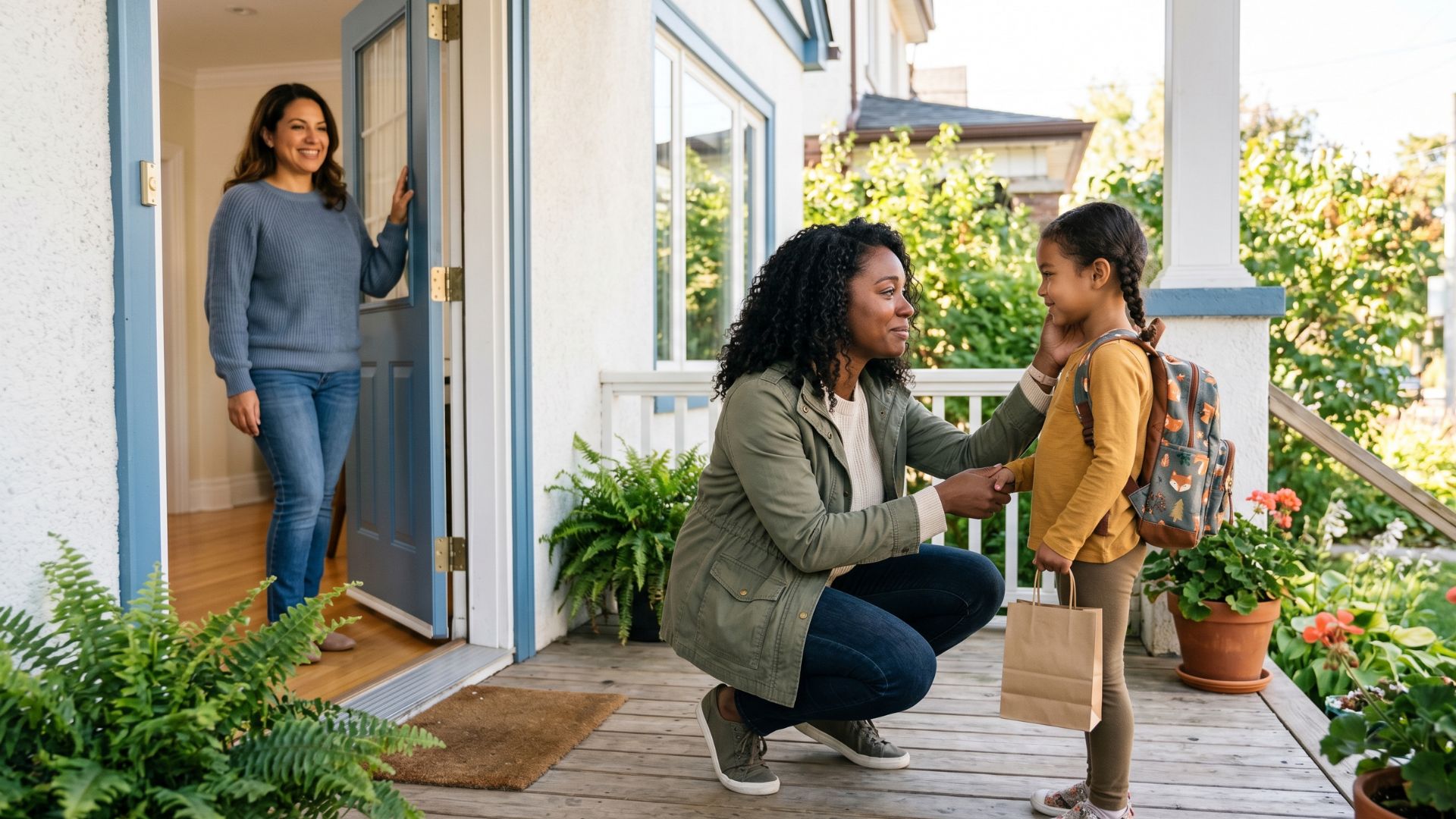
The goodbye is the hardest minute of the whole drop-off. The trick is to make it short, warm, and confident. Long goodbyes signal to your kid that something hard is happening and make the separation worse.
The goodbye script:
"Have so much fun. I love you. Pickup at three. Bye!" Hug, kiss, out the door. Do not linger in the doorway. Do not check back twice.
If your kid cries when you leave, the host parent should redirect within 60 seconds. "Want to show me your favorite Lego set?" or "Let's see if Maya wants to do markers with you." Most first-drop-off tears stop within five minutes of you leaving. Zero to Three's tips on separation anxiety, such as a short goodbye ritual and no big scenes, are helpful context if your kid is on the younger end and tends to struggle.
Do not bargain or extend. If you say "I'll stay five more minutes" you teach your kid that crying extends your stay. Confidence in the goodbye builds confidence in the playdate.
What to do during the playdate (you, not your kid)
Stay close. The first drop-off is not the day to drive 40 minutes away. Pick somewhere within 15 minutes of the host's house. A coffee shop, the supermarket, a walk around the block. Have your phone on, on full volume, in your hand.
Resist the urge to text the host. One short check-in 30 minutes in is fine the first time, especially if your kid was wobbly at goodbye. "Just checking, how's it going?" After the first drop-off goes well, skip the check-in entirely. Repeated texts are hard on a host who is busy with two kids, and they keep you half on the phone instead of using the time for yourself.
Use the time. Most parents underestimate how much they need this. Do something that resets you, even if it is just sitting with a coffee and a book for 90 minutes. Your kid having an independent good time is good for both of you.
How to do pickup well
Pickup is the moment that defines whether your kid wants to do this again. Get it right.
Arrive on time. Earlier than late. If pickup is at 3pm, you are at the door at 2:58. Late pickup is the single biggest etiquette complaint host parents report and it is doubled for first drop-offs.
When the host opens the door, ask how it went. Listen to the answer. If they tell you the kids ate two pieces of pizza and watched an episode of Bluey, you say "that's great, thank you" not "oh I try to limit sugar." Save that conversation for never.
Get your kid out the door in three minutes. Shoes on, jacket on, thank-you to the host kid, thank-you to the host parent, out. If your kid does not want to leave, that is the best news of the day, and it is also the moment to set the limit. "I know, it was so fun, we'll do it again. Time to go."
What to do if the first drop-off goes badly
Sometimes the first one is hard. The kid melts down, the host parent calls you to come back early, your kid does not want to go to that house again. None of that is a failure.
Pick them up calmly. Do not narrate the meltdown in front of the host. "Thanks for trying it, looks like she needed me today, no problem at all." Save the debrief with your kid for the car ride.
Wait two to four weeks before trying again, and shorten the next attempt. A 60-minute drop-off at the same trusted family is a good redo. Do not switch hosts for the second try; familiarity is the variable that matters most.
If your kid refuses outright the second time, listen. They may need another six months. Some kids are not ready for drop-off at five, and they are completely ready at six. The Raising Children Network's guide to separation anxiety recommends short separations that grow little by little rather than avoiding separation altogether. If your child is strongly and regularly upset about being apart from you for more than a few weeks, it suggests talking with your child's doctor.
And if something at the host's house felt off (an unsafe situation, an older kid being unkind, a parent who was distracted in a way that worried you), trust that signal. Our piece on playdate red flags has more on what to watch for.
Frequently asked questions
What is the average age for drop-off playdates?
Most kids are ready for short drop-offs between ages four and six. By age seven, drop-off is the default for most families. There is huge variation: some four-year-olds are completely ready, some seven-year-olds are not. The age matters less than the readiness signs and the host.
Should I stay for the first 15 minutes of a drop-off playdate?
No, but you can extend the goodbye to two minutes the first time. A long stay teaches your kid that you are anxious about leaving, which is the opposite of what you want. Confident, short, warm, then out the door. The host will redirect any tears within a minute or two.
Is it rude to ask for an early pickup if my kid is not ready?
Not at all. Hosts would much rather you collect a struggling kid than pretend it is fine. "Can I come grab her now? I think she has had enough" is completely normal. Most hosts will say yes immediately. You can also negotiate a shorter playdate the next time around.
Can my child have drop-off playdates with kids from school I have not met the parents of?
Have at least one family activity with the parents first: a coffee at the playground, a stay-and-play at one of your houses, even a quick chat at school pickup. You do not need to be friends with the parent to do a drop-off, but you need a sense of who they are. Drop-off cold with a parent you have never met is a step too far.
What if the host parent leaves and an older sibling or babysitter is in charge?
That is a different arrangement and you should know about it before you say yes. "Will you be home the whole time?" is a fair question. If the answer is "my 14-year-old will be in charge for an hour while I run an errand," decide if you are comfortable with that for your child's age. For kids under eight, most parents say no to that arrangement on a drop-off.
Should I send my kid with their phone for emergencies?
If they have one already, yes. If they do not have one, no, do not send a phone for the playdate. The host has a phone. The host has your number. The right move is to give your kid a sticky note in their bag with your number on it, and tell them they can ask the host parent to call you any time.