
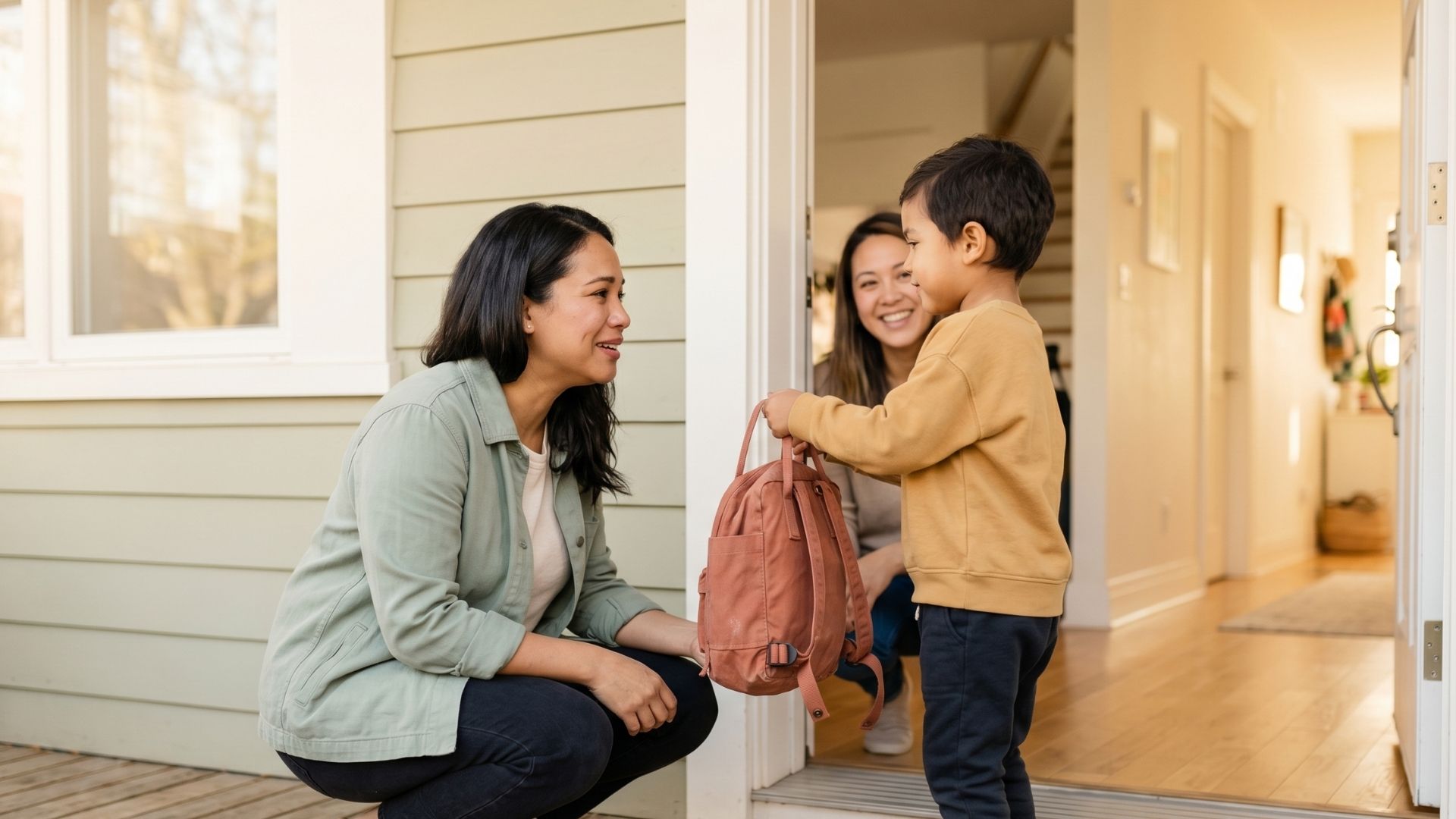
Being a good playdate guest comes down to four habits: confirm the day before, send your kid with what they need (water bottle, meds, lovey, snack if picky), arrive and leave on time, and follow up with a one-line thank-you text that night. Do those four every time and you will get re-invited every time.
What does a good playdate guest family look like?
From the host's side, a good guest family is the one that shares everything the host needs to know up front, sends a kid who knows the basics of being in someone else's house, and closes the loop afterward. The host should not have to chase you for information or guess at your child's allergies.
If you want the broader rules of the road, our guide to playdate etiquette covers both sides. This piece is the visiting-family version, written for the parent who is dropping off or stay-and-playing at someone else's home.
Three habits make the difference: prep the host, prep the kid, prep the follow-up. Most guest families nail one and forget the other two.
What to share with the host before you arrive
The host parent will worry less and host better if they know what they are working with. Send the basics in a single text the day before. You do not need to wait for them to ask.
What to send:
- Allergies and intolerances, even mild ones ("she is a bit dairy-sensitive, no big deal but FYI")
- Any meds your kid takes or might need (inhaler, EpiPen, allergy meds, antihistamine for hay fever)
- Pickup time confirmation
- Anything that helps your kid settle ("he warms up faster if there is a quiet activity at the start" or "loves Lego")
- Your phone number, even if they have it. Saves them looking for it.
If your kid has any rules at home that you want kept (no screens, no soda, vegetarian), name them. Hosts will not be offended; they will be grateful for the heads up. A quick text the day before works well: name the one or two rules that matter most and leave the rest to the host.
What to send with your child
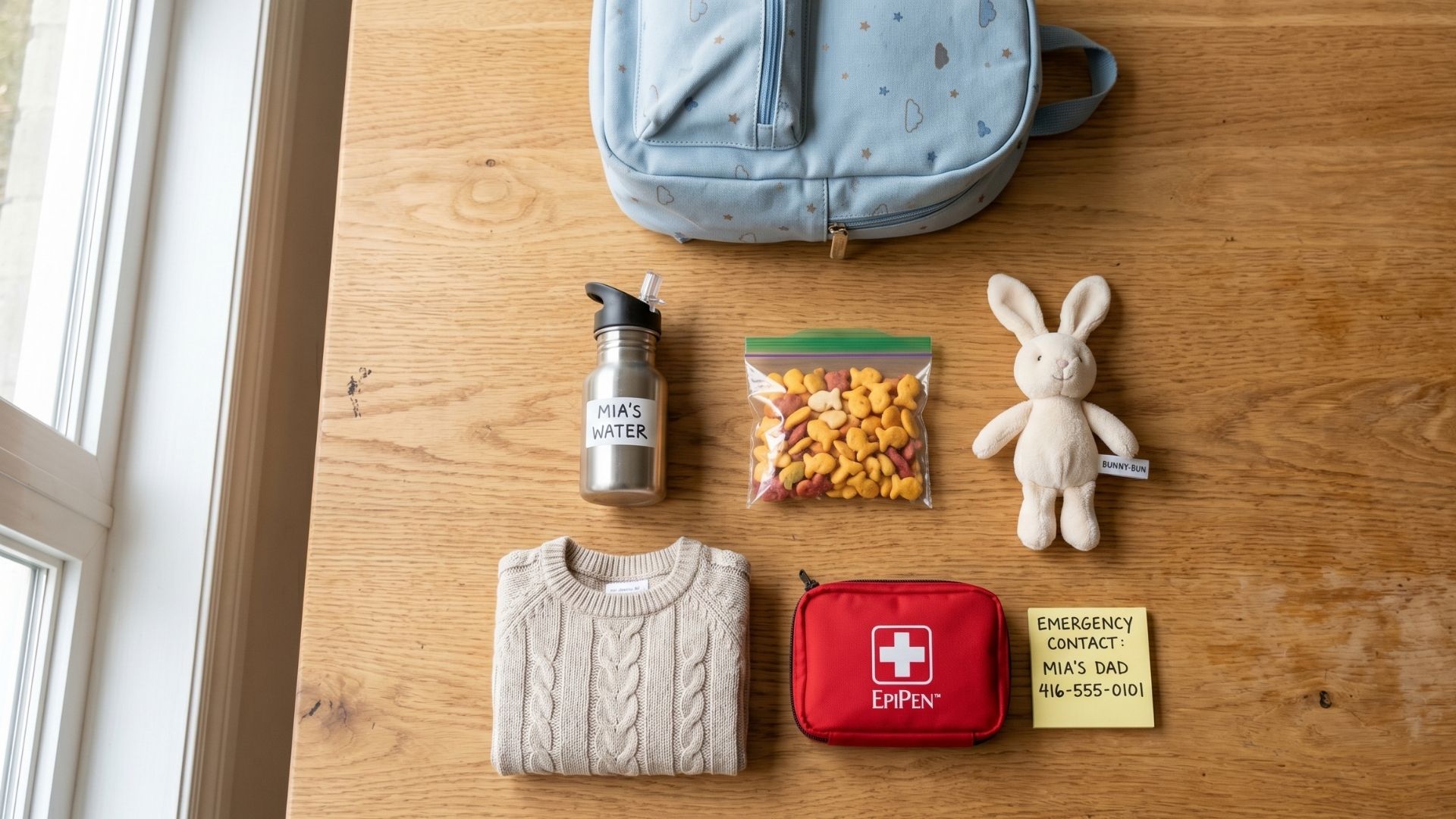
Pack a small bag, even for a two-hour drop-off. Less in the host's house to keep track of, and your kid has what they need.
The kit:
- Water bottle, labeled with their name. Even if you know the host has water. Their bottle, their bottle.
- A snack if they are picky or have allergies. "Just so you don't have to worry about it." Hosts love this.
- Any meds: inhaler, EpiPen, allergy meds. Hand them directly to the host parent at the door, not in the bag.
- A change of clothes for kids under six, two if it is a long playdate. Someone will get wet or paint-covered.
- The lovey or comfort item if a nap might happen, or if your kid struggles in new places.
- Sunscreen and a hat if outside play is likely and the host might forget.
What to skip:
- Toys from home, unless the host has asked. Outside toys often cause sharing fights, and beloved toys get lost.
- iPads or screens. Even if your kid uses one at home. Different houses, different rules.
- Anything you would be devastated to lose.
Drop-off etiquette: the two-minute door conversation
If you are doing a drop-off playdate, the door conversation is the whole interaction. Make it short, useful, and warm.
Hand the host:
- Any meds (inhaler, EpiPen) directly into their hand, not into a bag
- Your phone number on a sticky note if they don't have it saved
- A one-line reminder of any allergies ("reminder she's tree-nut allergic, EpiPen is in the bag side pocket")
- Confirmation of pickup time
Then say:
"Have fun, see you at four. Text if you need anything." That is it. Do not linger. Your kid will say goodbye faster if you are quick.
If this is your kid's first time being dropped off at this house, see our drop-off playdates guide for the readiness signs and the longer version of the door conversation.
Stay-and-play etiquette: how to be a good guest parent
Stay-and-play playdates have a different set of rules. You are a guest in someone's home, and you are also co-parenting for a couple of hours.
- Take the host's lead on whether to socialize or do parallel parenting. Some hosts want a coffee and a chat. Others want to fold laundry while you scroll your phone. Both are fine. Read the room.
- Help with your own kid first. If your kid is getting into something they shouldn't, you handle it. Do not wait for the host to do it.
- Help with the snack and cleanup, but do not take over. Offer once. "Want me to grab plates?" If they say no, sit down.
- Stay off your phone for the first chunk. Especially with a host you do not know well. Twenty minutes of attention upfront builds the friendship faster than any text would.
- Do not bring extra people without asking. Not your other kid, not your sister who is in town, not the new puppy.
If you are hoping to actually become friends with the host parent, our piece on how to make mom friends as a parent has more on what works.
What to ask the host (without making it weird)
There are a few questions you should ask before any first-time drop-off. Ask them once, in a normal voice, and you never have to ask again with that family.
- Who else will be home (other adults, older siblings, teenagers, babysitter)
- Will an adult be home the whole time
- Are there pets, especially dogs, and how the dog handles new kids
- Is there a pool or other water access
- Any older-sibling content on the TV the kids might catch (movies above their age rating, news, video games)
- What screen rules they will follow during the playdate
If there could be firearms in the home, asking whether they are stored locked and unloaded fits naturally into the same list. Adapt the list to whatever risks are real for your area: balconies and high windows in apartments, scooters and helmets, pool fences, sun and heat safety.
Frame it casually: "This is dumb but I always ask, anything I should know about the house?" Most hosts will appreciate that you asked. Our playdate safety questions checklist has the full wording if you want a script.
When the host's house has rules different from yours
Their house, their rules. This is true even when their rules are looser than yours and your kid notices. Especially then.
If your kid eats more sweets than usual, watches a show you would not pick, or runs around barefoot in the yard when you would have insisted on shoes: let it go. One playdate of someone else's parenting is not going to undo yours.
There are exceptions. If something happens that crosses a hard rule (a violent video game, an unsafe situation, an older kid bullying), text the host calmly: "Hey, can we move the kids to the kitchen? Trying to keep screen time low today." Most hosts will adjust without it being a thing. If they do not, that is information about whether to do another playdate.
Tell your kid in advance, once, what to expect: "Different houses have different rules, and we follow theirs when we are over. If something feels weird, just text me." Older kids especially appreciate the heads up.
How to pick up well (and leave on time)
Pickup is the part the host parent will judge you on. Doing it well takes 90 seconds.
Arrive on time. If pickup is 4pm, you are at the door at 3:58. Late pickup is the single biggest etiquette complaint host parents report.
When the host opens the door, say hello first, then ask how it went. Listen to the answer. If they tell you the kids ate two pieces of birthday cake and watched an episode of Bluey, you say "that's great, thank you" not "oh I try to limit sugar." Save that conversation for never.
Get your kid out the door in three minutes. Shoes on, jacket on, thank-you to the host kid, thank-you to the host parent, out. Kids drag goodbyes; you set the pace.
If your kid does not want to leave, do not extend. "I know, it was so fun, we'll do it again. Time to go." The host is watching you set the limit. The next invite depends on it.
The follow-up: the text that gets you re-invited
Send one short text within the hour after pickup, while the host can still picture your kid's face. This is the single most useful thing you can do in playdate etiquette.
What to write:
"Theo had so much fun today, thank you for having him! Want to come to ours next weekend?" Two sentences. The first one is the thank-you. The second one is the reciprocation, the most important part of the loop.
If you are not ready to host yet, skip the second sentence and reciprocate within a month. "Theo had so much fun, thanks again! We'll have you over soon" is a fine version when you mean it.
Do not send a gift. A handmade card from your kid, occasionally, is sweet. A bottle of wine for a stay-and-play with a parent you like, also sweet. Anything more than that turns a normal playdate into a thing.
Frequently asked questions
Should I send my kid with a snack even if the host says they will provide one?
Send a small backup if your kid is picky, allergic, or sensitive about food. "Just so you don't have to worry about it" is the right framing. If your kid is an easy eater and the host you trust has it covered, no snack is needed. The default is: when in doubt, send a small backup.
Is it okay to text the host to check in during a drop-off?
One short text mid-playdate is normal, especially the first time. "How's it going? Any issues?" is fine. More than that and you are signaling you do not trust the host, which is its own message. After the first drop-off goes well with that family, skip the check-in entirely.
What if my kid behaves badly at the playdate?
Apologize directly to the host that night, not in front of the kids. "I'm sorry he had a hard time, that wasn't his best day. We'll work on it." Do not over-explain. Hosts have seen kids have bad days; they care more about how parents handle it than the meltdown itself. Try the same family again in a few weeks with a shorter playdate.
How do I gracefully decline an invite if the host's house is not a good fit?
A specific scheduling reason is always polite: "That weekend is tough for us, can we do another time?" If you do not want to do this house at all, slow-roll the rescheduling and pivot to neutral spaces (parks, libraries, museums) for the next few hangouts. Most parents take the hint.
What should I bring as a thank-you gift for the host?
Nothing, usually. A short text is the standard. If it was a big deal (an overnight, a long babysitting favor disguised as a playdate, a birthday), a small gift is nice: a bottle of wine, a tin of nice cookies, flowers from the supermarket. Skip the gift card; it makes the playdate feel transactional.
Do I need to host a kid back if my own kid did not have fun?
Reciprocate at least once. Two playdates in, if your kid genuinely does not enjoy it, you can let the rotation taper. Reciprocating once preserves the social fabric. Forcing five playdates with a kid your kid does not click with is too much. The piece on what to do when kids don't click on a playdate covers the longer version.