
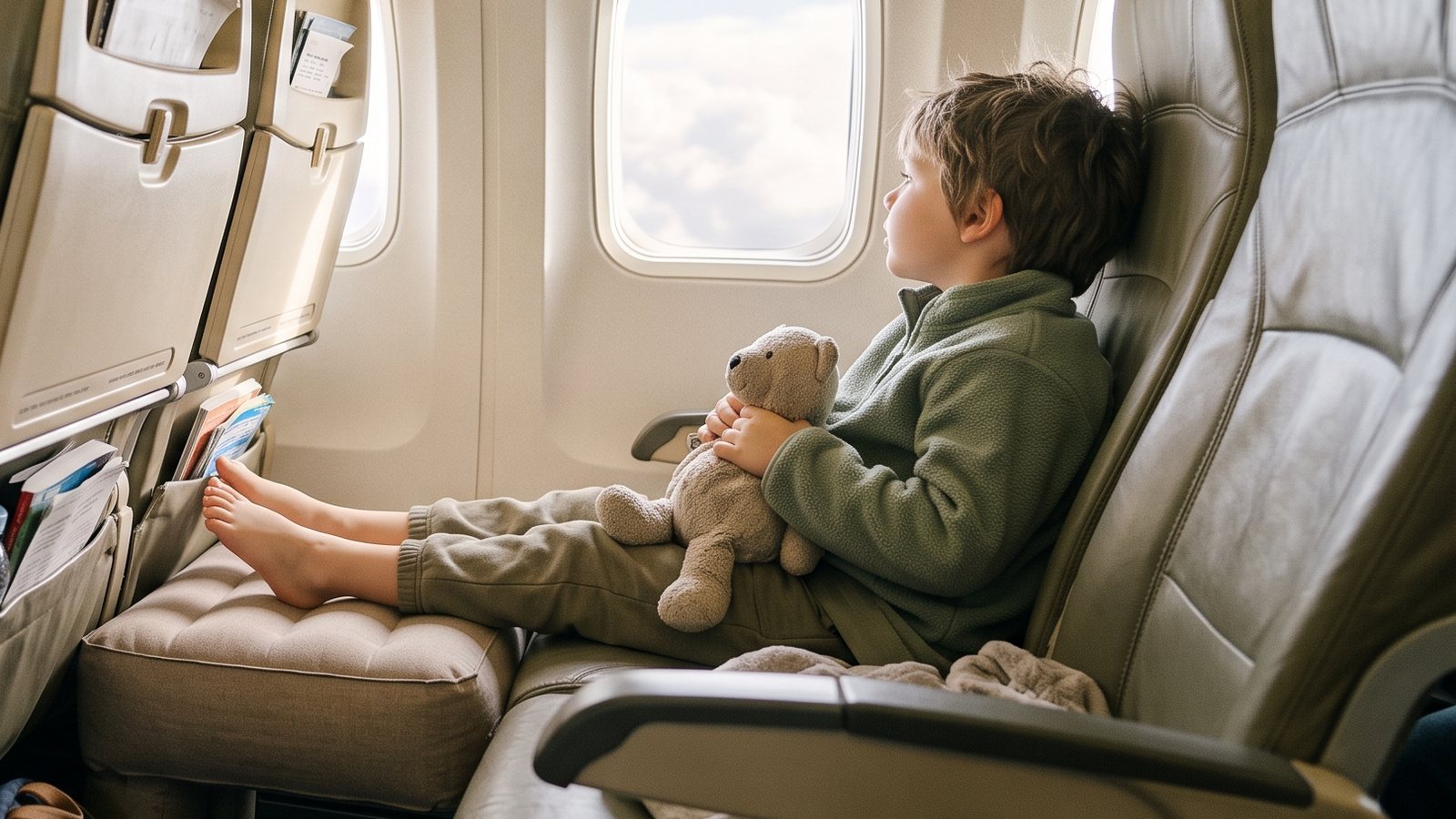
A long-haul flight with kids goes much more smoothly when you plan for it as a long event, not a flight. The day before matters; the flight selection matters; the seats matter; the bag matters; sleep matters; food matters. Get those right and a ten-hour flight with a preschooler is achievable, sometimes even pleasant. Here is the full plan.
The pre-flight reset
Long-haul flights with children are won or lost before you reach the airport. What happens the day before, and especially the morning of, shapes how the flight itself goes.
What works the day before:
- Pack the night before. Do not pack the day of departure with children watching, which produces stress, missed items, and a fraught morning. Pack everything except chargers and toothbrushes the night before.
- Aim for normal-but-slightly-earlier sleep. Pushing children to bed dramatically earlier the night before a flight rarely helps; protect their normal bedtime instead.
- Manage your own expectations and theirs. A short, calm conversation about the day ahead (what an airport is like, how long the flight will be, what to expect at the other end) helps even young children cope.
- Confirm online check-in, seat assignments, and any special meals or bassinets you booked. Resolving issues at home is far easier than at the airport with children.
What works the morning of:
- Feed everyone a real breakfast, not just airport snacks. A child traveling on real food handles the flight better than one traveling on a muffin and juice.
- Aim to arrive at the airport early but not so early that children are already exhausted by boarding. Two to two-and-a-half hours before an international flight is usually right; three or more starts to hurt with children.
- Build pre-security and pre-boarding move-around time. Children who have walked, run, and used real toilets just before boarding cope far better with the confinement that follows.
- Refill water bottles after security and stop at the toilet one more time before boarding.
This article sits inside our complete guide to traveling with kids and pairs with our guide to the first international trip with kids.
Picking the right flight
Which specific flight you book shapes the whole experience more than first-time parents realize. A few rules separate easy long-hauls from hard ones.
- Direct over connecting, always. A direct long-haul is one event; a connecting one is two events plus a fraught middle. With children, the cost difference between a direct flight and a one-stop is small compared to the difference in stress.
- Overnight where possible. For flights of eight hours or more, an overnight (red-eye) flight where children sleep through most of it is usually far easier than a daytime flight where they have to be entertained the whole way. Eastbound trips (such as North America to Europe) are typically overnight by default.
- Avoid the worst day-of-week timings. Friday-evening departures are crowded and tired; midweek mornings often offer better airport conditions and fewer business travelers.
- Book seats with the family together. Most airlines reserve some seat selections for families, often free of charge with advance request. Confirm at booking that your family is seated together; airlines are not obliged to rearrange other passengers at the gate.
- Consider departure airports. A larger airport with more amenities (play areas, family lounges, more food options) is often easier with children than a smaller airport with fewer facilities, even if it requires a longer drive.
On a first international family trip especially, the right flight selection is half of a successful trip. Spend the time on the booking; it pays back across the trip.
Seat strategy
Where you sit on the plane changes the flight more than most other decisions. Within the realities of pricing and availability, several seat strategies reliably help.
- Bulkhead seats, especially with a bassinet. The bulkhead row at the front of each cabin has more floor space and often holds an airline bassinet for infants. Most airlines offer these on request to families with babies; ask at booking.
- Window plus aisle for a family of three, with children between. The child has a window to look at and the adult on the aisle has bathroom access and bag access without disturbing the family. Some families add a middle adult.
- Two side rows on a wide-body. On many international wide-body aircraft, the side rows seat two; a family of four can take two side rows in a 2-2 configuration, with children paired with parents and bathroom access in the aisle.
- Avoid the very back rows where possible. The toilets are often there, with associated noise and movement; engines are louder; service often reaches you last.
- If a bassinet is not available, consider a paid premium economy or business upgrade for a long flight. The cost is real but the difference in seat space, sleep, and flight experience with young children is genuine.
On boarding, take advantage of family pre-boarding where offered. The extra time helps you settle, install seat-belts and any extra equipment, and start a child's first impression of the flight calmly rather than in the crowd.
The activity-bag rotation
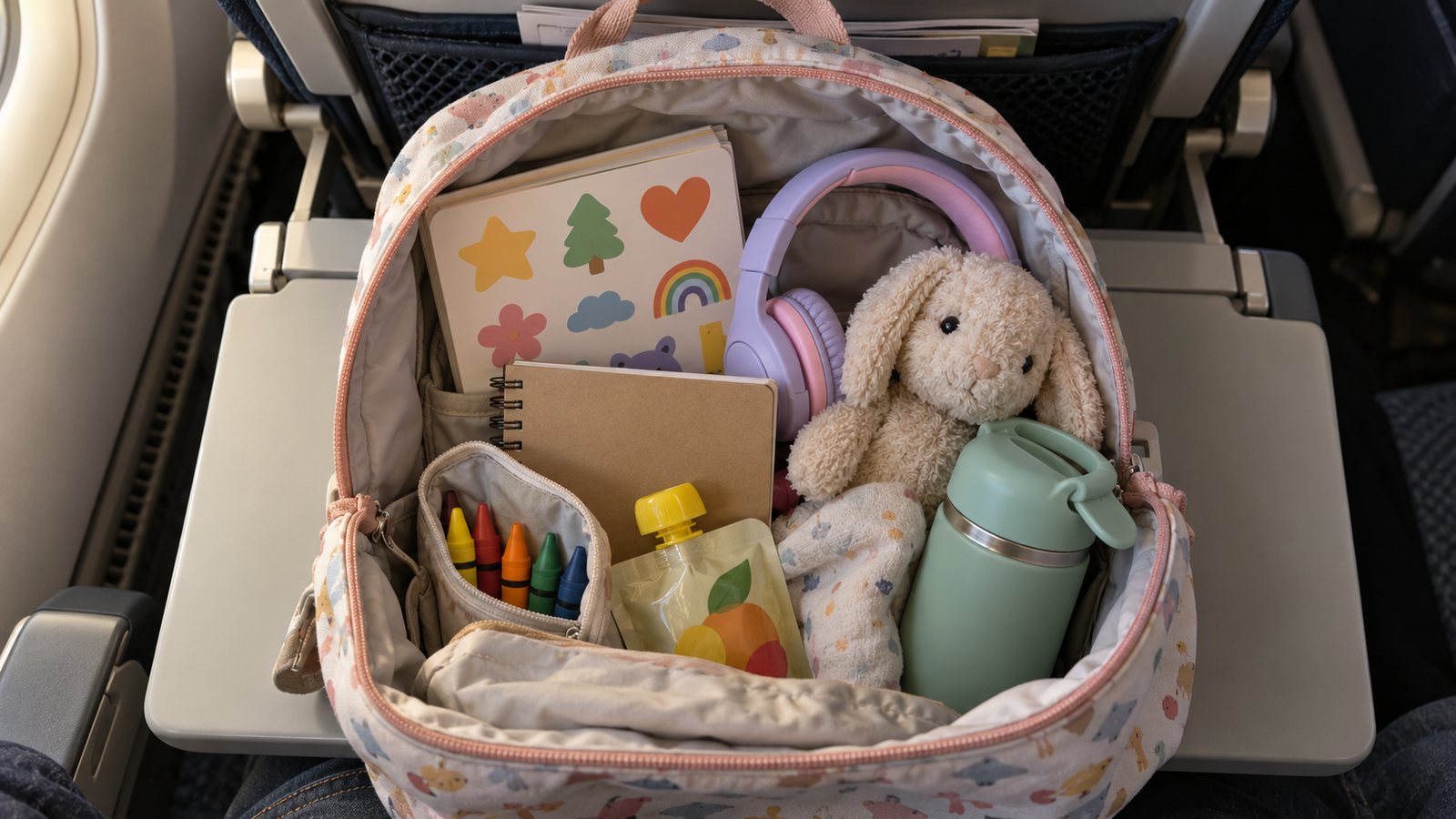
The single piece of luggage that decides a long-haul flight is the carry-on activity bag. Pack it with the flight, not the destination, in mind.
What to pack for each child:
- Several small activities, hand-out one at a time. Sticker books, simple puzzles, small toys, coloring with chunky crayons or mess-free pens, a couple of small surprises wrapped to extend novelty.
- Audio. A loaded device with downloaded audiobooks, music, and story podcasts, plus kid-friendly headphones (over-ear ones are usually more comfortable than earbuds for children).
- A screen, where families allow it, with downloaded content. A long flight is the moment most families relax screen rules; treat it deliberately rather than reactively.
- Comfort items. A favorite small soft toy, a familiar blanket or small pillow, anything that helps the child settle to sleep.
- Spare clothes for younger children, accessible without opening the main suitcase. Spills happen; toilet accidents happen.
- Snacks and a refillable water bottle. Airplane food on a long flight is fine but not always children's favorite, and snacks bridge the gaps.
- Wipes, plenty of them. Useful for spills, hands, and surfaces.
Rotation rules: hand things out one at a time, not all at once; save the screen and the wrapped surprises for the hard middle stretch; let the child eat and drink during takeoff and landing (swallowing helps with ear pressure, and KidsHealth has more ear tips for flying). The bag's job is to carry you between meals and any sleep stretches, not to entertain across the whole flight.
The sleep reality
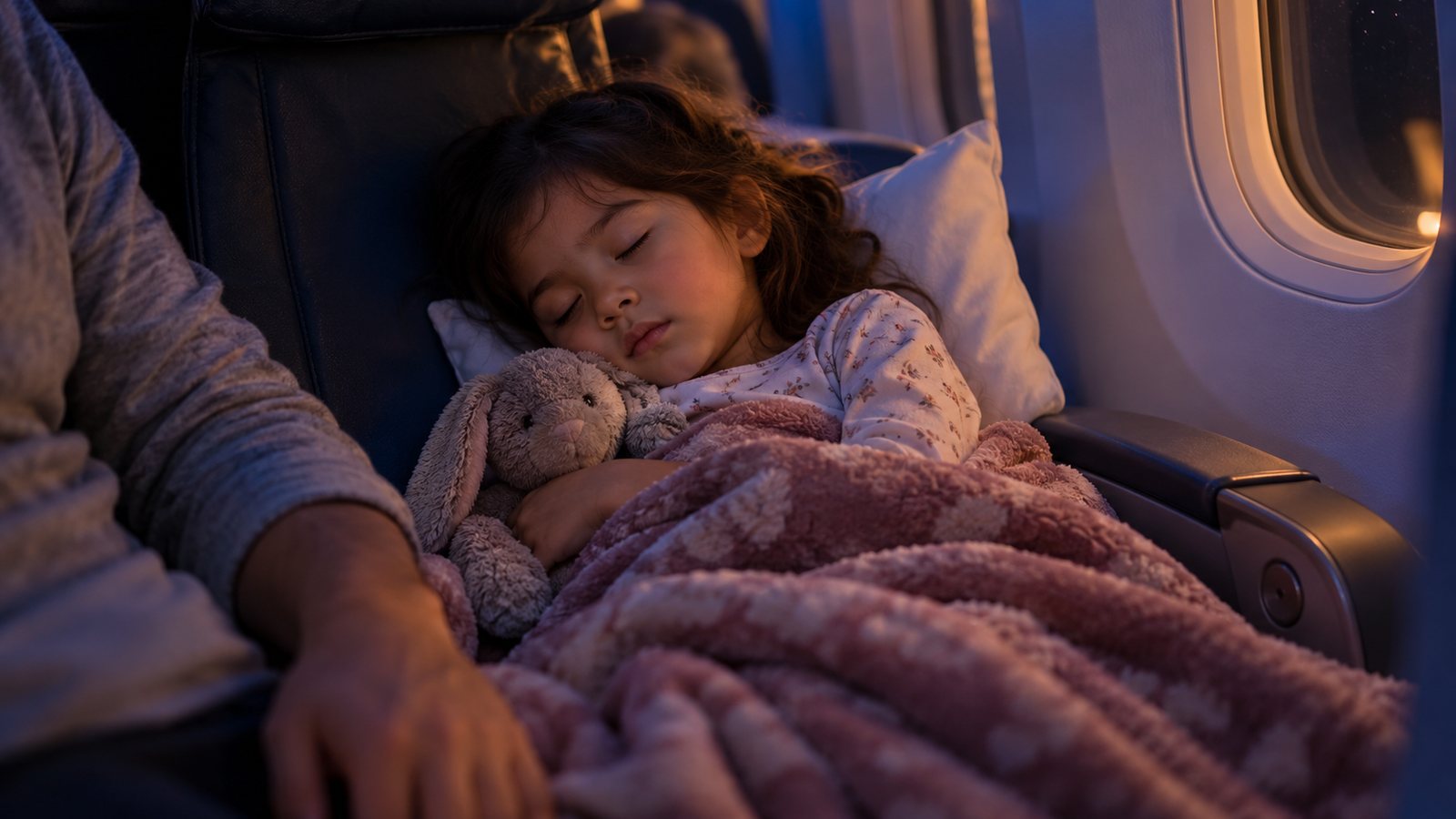
Whether children sleep on a long flight is the single biggest variable in how the flight goes. Some children sleep beautifully; some refuse entirely. Both are normal, and the trip plan should accommodate either.
What helps sleep when it is possible:
- Dimmer cabin. Most long-haul cabins dim the lights after the meal service; encourage children to sleep then rather than fighting it earlier or later.
- A familiar bedtime routine, compressed. A short version of your child's home bedtime routine, even on a plane, signals sleep: pajamas, a teeth-clean, a familiar story, comfort items in place.
- Window seat for a sleeping child. The wall to lean against is easier than the middle, and the cabin lights are less direct.
- Inflatable foot rest or leg-up pillow. The biggest barrier to children sleeping in economy is that their legs do not reach the floor; an inflatable foot rest fills the gap and lets them stretch out across the seat. Check your airline's rules before you buy one: some airlines do not allow them, or allow them only in certain seats (more on travel beds below).
- Familiar sleep cues from home: a particular blanket, soft toy, white-noise app, lullaby playlist.
What to do if sleep does not come. Some children will not sleep on a plane, and forcing it produces tears. If your child is awake, switch into entertainment mode: a screen, an audiobook, a quiet activity, a walk to the toilet, a stretch. The whole family arrives tired; a parent who stayed up entertaining is better than a child who cried through the night.
Travel beds and seat extenders: check before you buy
Kids' travel beds turn an economy seat into a small flat bed by filling the gap between the seat and the seat in front. There are three common types: inflatable cubes and leg-rest cushions that sit in the footwell; ride-on suitcases that open into a bed, such as the JetKids BedBox; and flat boards or mattresses that rest across the seat and footwell, such as the Flyaway Kids Bed or Plane Pal. Foot hammocks that hang from the seat in front are a fourth type, and most airlines refuse them.
Airline rules vary widely, and they change. A few examples from the airlines' own pages, checked in October 2026:
- Qantas: inflatable cubes are allowed in Economy and Premium Economy, in window or middle seats on widebody aircraft and window seats on narrowbody aircraft, but not in exit or bulkhead rows. The cube must inflate by hand and have a quick-release valve; cubes with a battery-powered pump, or self-inflating battery cubes, cannot be used. Hard-shell bed boxes and leg hammocks are not allowed. (Qantas)
- British Airways: approves specific named products only, including the Flyaway Kids Bed, Plane Pal, and JetKids BedBox, in window and center seats when the window passenger is in your party, and never in aisle seats or emergency exit rows. Other similar items are not permitted. (British Airways)
- Air Canada: Flyaway- and BedBox-type beds can be used for comfort, but not during taxi, takeoff, or landing, or whenever the seat belt sign is on, and they cannot block the aisle. Hammock-type seats are not allowed. (Air Canada)
- Singapore Airlines: an inflatable cushion or convertible bed is fine for a child with their own seat, in a window seat or a center-section middle seat, not in exit rows. It must be stowed for taxi, takeoff, and landing, and the child must be able to wear the seatbelt. Seat extenders and foot hammocks are not allowed. (Singapore Airlines)
- SWISS: seat extenders may be used only after the seat belt sign goes off after takeoff, in window seats or middle seats between two aisles, never attached to the seat, and not in aisle seats, the row behind a bulkhead, or exit rows. Two devices cannot be used side by side. (SWISS)
- Lufthansa: air-filled blocks, bed-style aids, and seat extenders cannot be used on board. (Lufthansa)
For a wider list, Flyaway, the maker of the Flyaway Kids Bed, keeps a list of airlines that accept its bed. Treat it as a starting point; the airline's own page is the final word. Even where a device is allowed, the cabin crew has the final say on the day. So before you buy one, and again before you pack it for each trip: check the airline's page, contact the airline to confirm, and ask them to note the device on your booking. Take a screenshot of the policy to show the crew if asked, and book the seat it requires: usually a window seat, with your own family in the seats beside it.
When you can use it. On airlines that allow these devices, the usual rule is cruise only. The device is packed away for taxi, takeoff, and landing, and whenever the seat belt sign comes on, including for turbulence, and your child stays buckled in while using it. Set it up once the seat belt sign goes off, and keep it easy to pack away quickly, even with a sleepy child on it.
Think about how that plays out on a night flight. The seat belt sign can come on several times during the night for turbulence. On an airline that requires the device to be packed away whenever the sign is on, that can mean waking a sleeping child, folding or deflating the bed, and settling them again, sometimes more than once. A child woken at 3 a.m. is often a grumpy child for the rest of the flight. Before you pack a bed, read exactly when your airline makes you put it away, and decide whether it is worth it for that flight.
Inflating it. Most cubes and leg rests inflate by mouth or with a small hand pump. That takes a few minutes and is easiest once you are settled after takeoff, not in the boarding line. A pocket-size rechargeable pump weighing about 80 grams (2.8 ounces), such as the Flextail Tiny Pump, is much quicker, but check the rules first: some airlines, Qantas among them, do not allow cubes that use a battery-powered pump. If your airline does allow one, remember that a pump is loud in a quiet cabin, so inflate early in the flight rather than after the lights dim. Pack the pump in your carry-on, and any spare batteries too, because spare lithium batteries and power banks must travel in cabin baggage (FAA). A quick-release valve makes packing away much faster when the seat belt sign comes on; Qantas requires one so the cube can be deflated quickly.
If the device is not allowed, or the crew says no on the day, fall back on the basics: a pillow and blanket from home, a window seat to lean against, and a compressed bedtime routine.
Food on board
Airline food on long-haul flights is fine in general but inconsistent with children's preferences. A small amount of planning prevents food becoming the cause of a difficult flight.
- Pre-order a children's meal at booking, where the airline offers one. Children's meals on most international airlines are simpler and more child-aligned than the adult menus, served first, and free.
- Bring familiar snacks from home. Whatever your child reliably eats: crackers, fruit (where allowed by the destination's customs rules), small sandwiches, dry cereal. A child who eats their own familiar food is far less likely to refuse the airline meal entirely.
- Hydrate steadily. Cabin air is dry and children dehydrate faster than they realize. Refillable bottles, refilled after security, are the easy solution; ask cabin crew for water refills during the flight if needed.
- Eat lightly before takeoff and after a meal. A heavy meal followed by a sleep cycle is rarely comfortable; keep portions small and consistent.
- Account for allergies or dietary needs in the meal pre-order. Most airlines handle major allergies with a separate meal if booked in advance; do not rely on managing it at the meal service.
Cabin crew on most long-haul international airlines are notably helpful with families; ask for what you need rather than guessing. Extra blankets, a drink for a sleeping child, water at an unusual time, a microwave to warm baby food, are all routine requests they expect.
Landing and the recovery hour
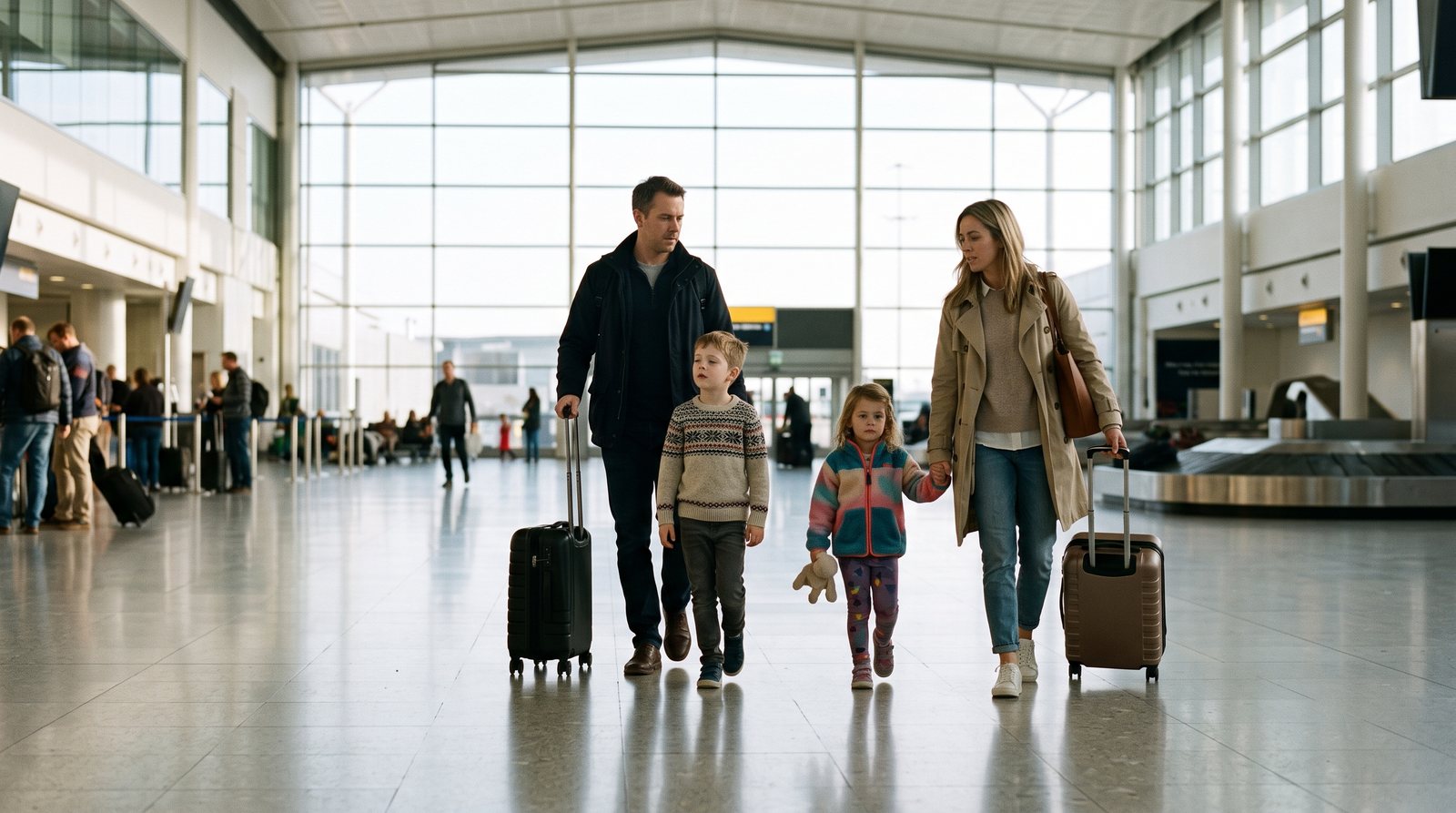
How you handle the first hour after landing shapes the next day and the first day of the trip. What happens after the flight matters as much as the flight.
- Build buffer time at arrivals. International immigration and baggage can take 60 to 90 minutes with children; plan for it rather than against it. Onward transport or a pickup arranged with that buffer in mind means less stress.
- Hydrate and feed before leaving the airport. A small snack and drink in the airport before facing onward travel resets exhausted children and adults.
- Walk. A short walk through the arrivals hall or just outside before getting into a car or train makes everyone feel human again after the confinement.
- Plan a low-key first day. Whatever the trip plan says, the day you land internationally should be a recovery day: arrive at the accommodation, eat a simple meal, sleep early in local time. Save the real activities for day two.
- Adjust to local time immediately. Eat meals on local time, sleep at the local bedtime; the body adjusts faster when you behave as if you have already adjusted.
For what to do over the following days, our guide to jet lag in kids covers the recovery strategy. A good long-haul flight includes a gentle arrival, not only the hours in the air. For the complete kit to pack into the carry-on, see our guide to the plane kit for kids by age.
Frequently asked questions
What is the most important thing for a long-haul flight with kids?
Picking the right flight is the single biggest factor. A direct flight rather than a connecting one, an overnight where children can sleep through part of it, family seats together at booking, and a major-airport departure with amenities all matter more than what you pack. Get the flight right and the rest of the strategy becomes manageable.
Where should families sit on a long-haul flight?
If a bassinet is available for an infant, the bulkhead row at the front of each cabin is the strongest choice. For older children, window plus aisle for three with the child between, or two side rows on a wide-body for a family of four. Avoid the very back rows near the toilets where possible. Confirm seats together at booking; airlines are not obliged to rearrange at the gate.
What should I pack in a long-haul activity bag for kids?
Several small activities to hand out one at a time, loaded audio with downloaded content and kid headphones, a screen with downloaded content where families allow it, comfort items, spare clothes, snacks and a refillable water bottle, and plenty of wipes. Rotation is the trick: hand things out one at a time and save the screen and wrapped surprises for the hard middle stretch.
Will my child sleep on a long-haul flight?
Some children sleep beautifully on planes; some refuse entirely. Both are normal. What helps when sleep is possible: a window seat, a compressed bedtime routine after the dim, an inflatable foot rest if your airline allows one, and familiar sleep cues from home. If sleep does not come, switch to entertainment mode; do not force it. The whole family arrives tired regardless.
Are kids' travel beds and inflatable foot rests allowed on planes?
It depends on the airline, and the rules change. Some airlines allow inflatable cubes or travel beds in window or middle seats during the cruise only (for example Qantas, Air Canada, Singapore Airlines, and British Airways for named products), while others, such as Lufthansa, do not allow them at all. Check your airline's own page before you buy, book the seat it requires, and expect to pack the device away for taxi, takeoff, landing, and whenever the seat belt sign is on.
Should I book a special meal for my child on a long-haul flight?
Yes. Pre-order a children's meal at booking; airline children's meals are simpler, more child-aligned, served first, and free. Also bring familiar snacks from home (subject to destination customs rules) so a child who refuses the airline meal still has food they will eat. For allergies, book a dedicated meal at booking and confirm with the airline rather than managing at the meal service.
What should we do right after landing on a long-haul trip?
Build buffer time at arrivals (immigration and baggage can take 60 to 90 minutes with children), hydrate and feed everyone before leaving the airport, take a short walk through arrivals, and plan a low-key first day at the accommodation. Adjust to local time immediately: meals on local time, sleep at the local bedtime. The body adjusts faster when you behave as if you have already adjusted.