
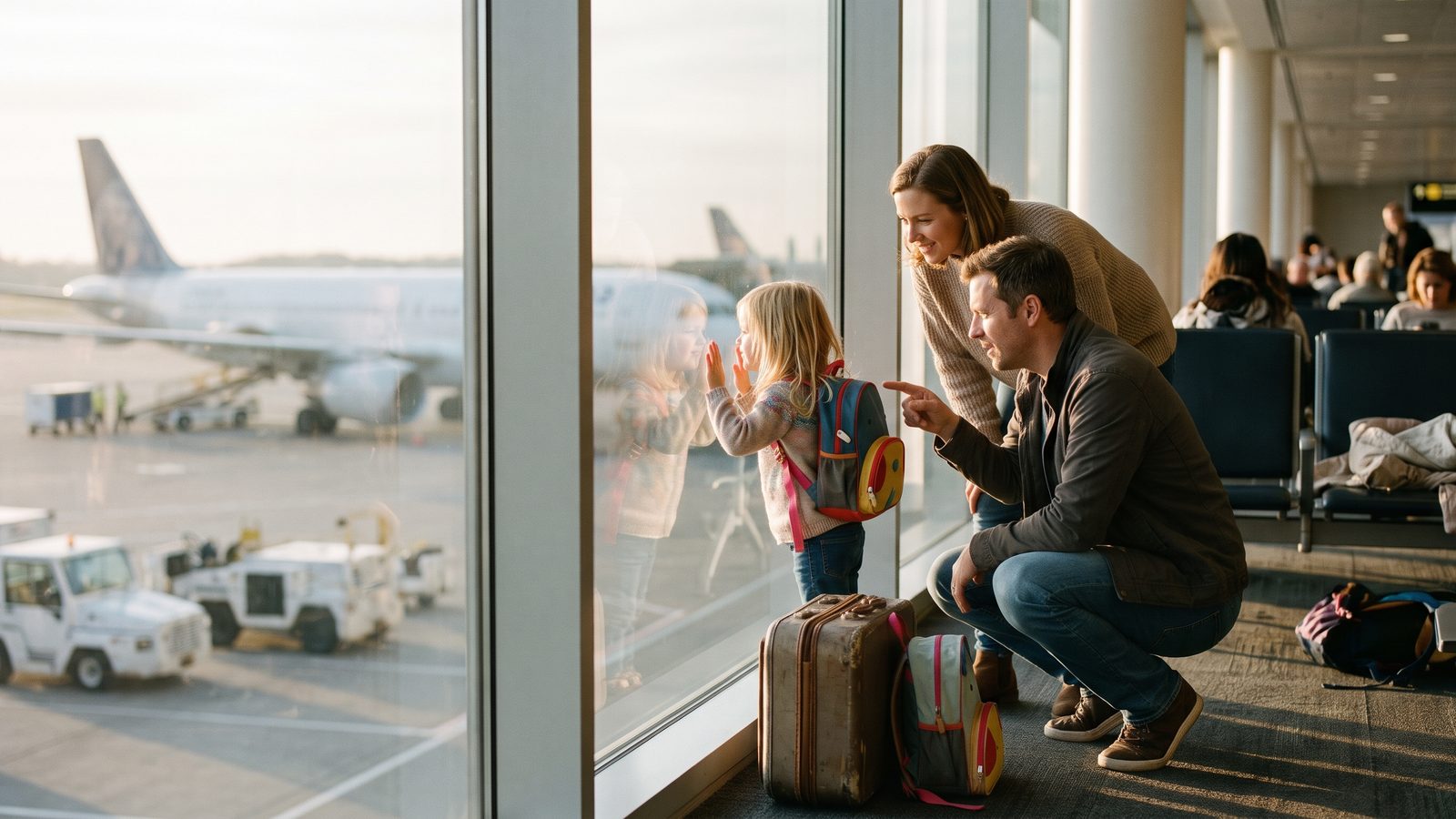
The best first international trip with kids is short, direct, and pitched at the family you actually have rather than the family you wish you were. Pick a country with a direct flight, a small time difference, a language you can manage, and easy family basics. Below are the four tests and good starting points wherever you live.
How to choose your first country
The best first trip abroad is rarely the most exciting place on your list. It is the easiest one for your family right now. Four tests do most of the work:
- A direct flight, or a short drive or train ride. This matters more than anything else with young children (more on this below).
- A small time difference, ideally under about six hours, so nobody loses days to jet lag.
- A language you can manage at the tourist level: reading signs, ordering food, asking for help.
- Easy family basics: medical care you can reach, food your kids will eat, simple transport, and places to stay with room to spread out.
A country that passes all four will feel like an adventure without piling on too many new things at once. A country that fails two or more is a better second or third trip.
Good starting points, depending on where you live
These are examples that pass the four tests for many families, not a ranking. Your nearest airport, budget and children's ages matter more than any list.
From the US and Canada
- The neighboring country: Canada for US families, the US for Canadian families. Short trip, familiar food, no language change, and a gentle first taste of passports and border crossings.
- Mexico's resort coasts. Short direct flights from many cities, and all-inclusive resorts that make the logistics simple. Check your government's travel advice for the specific area you are visiting.
- Costa Rica. A manageable flight, a small time difference, wildlife that fascinates children, and English widely used in tourist areas.
- The UK and Ireland. English-speaking, with direct flights from many cities and a five-hour time difference from the East Coast.
- Iceland. About five hours from the East Coast, English widely spoken, and dramatic nature that keeps older kids interested. Best for preschoolers and up.
From the UK and Ireland
- Short-haul Europe: France, Spain, Portugal or the Netherlands. Often one to three hours away, with an hour's time difference or none, and plenty of family-friendly places to stay.
- Iceland. About three hours away, with no time difference from the UK in winter.
- Italy. A short flight, walkable towns, and food most children are happy to eat.
From Australia and New Zealand
- Each other: New Zealand for Australian families and Australia for New Zealand families. Short flights, English-speaking, and a small time difference.
- Fiji. About four hours from the east coast of Australia, English widely spoken, and resorts built around families.
- Singapore. A longer flight, but a small time difference, English as an official language, and very easy public transport.
- Japan. A long flight but only one or two hours' time difference from the east coast of Australia, with excellent transport.
Once the basics feel easy
Destinations further away, such as Japan from North America or Europe, or Italy from North America, are wonderful with kids once you know how your family handles a long flight and a big time change.
This article sits inside our complete guide to traveling with kids.
The direct-flight reality
On a first international trip with children, the single biggest variable is having a direct flight. The difference between a direct flight and a connecting one is far larger with kids than without them.
A connection adds layover stress, the risk of missed connections and lost luggage, an extra plane change with a tired toddler, and significantly more total travel time. With young children, a one-stop trip that looks 90 minutes longer on paper often takes four hours longer in practice, and at much higher risk of going wrong.
Practical rules:
- Always prefer a direct flight, even at a higher fare, especially with children under about seven. The cost difference is small compared to the cost of a missed connection with a toddler.
- Check direct-flight availability before you commit to a destination. A country only reachable from your home by two-stop flights is the wrong first international trip; pick a closer one until your child is older.
- Where a connection is unavoidable, build in a long layover (three to four hours minimum), pick a major hub airport with family amenities, and treat the layover as a planned rest stop.
- For trips over about eight hours, an overnight (red-eye) flight where children sleep through some of it is often easier than a daytime flight where they have to be entertained the whole way.
The direct-flight test alone eliminates many otherwise tempting destinations from a first international trip with young children. Take the test seriously.
The time-zone math
Time zones matter as much as flight distance. A six-hour flight east is harder than an eight-hour flight south because the time change has to be lived through by everyone afterward.
Useful rules of thumb:
- Under three hours of time change is barely noticeable for most families. Trips that stay close to your own time zone (the US to Mexico, the UK to Spain, Australia to Japan) avoid most jet-lag pain.
- Four to six hours of time change is real but manageable. East Coast US to the UK, for example, takes a few days to adjust at each end.
- Seven or more hours is significant and needs planning. Trips between North America and Asia, or Europe and Australia, are in this bracket; budget several days of disrupted sleep at each end.
- Traveling east is usually harder than traveling west. Eastbound trips shorten the day; westbound trips lengthen it. A trip from North America to Europe usually feels harder than the return.
For first international trips with young children, keeping the time-zone shift under about six hours makes the whole trip easier. Once you accept multi-time-zone travel, our guide to jet lag in kids covers what actually helps recovery.
Language: how much it matters
Language is one of the biggest hidden loads of travel abroad, and the easiest first trips keep it small. If your family speaks English, that usually means one of three levels:
- English is the main language: for example Canada, the US, the UK, Ireland, Australia and New Zealand. No adjustment needed.
- English widely used at the tourist level: for example Iceland, Singapore and Fiji, the tourist areas of Costa Rica and Mexico's resort coasts, and the main sights and transport in Tokyo.
- English usable in tourist areas, but a few local words help: for example Italy, Spain, France and Portugal. A small phrasebook effort goes a long way, and kids often love learning the first words.
On a first international trip, lean toward a language you already know or can easily get by in. The language load combines with every other new thing (different food, different transport, different time zone) and a destination where you can read signs and ask directions easily removes a layer of stress. A second international trip is the time to take more language risk.
Healthcare and safety basics
International travel with children adds two practical layers most families do not think about in advance: healthcare access if something goes wrong, and the general safety profile of the destination.
Healthcare:
- Travel insurance that covers medical care and emergency evacuation is worth the cost for any international family trip. Many domestic health policies do not cover international care, or cover it poorly.
- Check what is required before you go: prescription medicines, any vaccinations recommended for the destination (the CDC travelers' health pages are a useful US-focused reference; in the UK, the NHS Fit for Travel site fills the same role).
- Carry copies of children's prescriptions, your pediatrician's contact, and the local equivalent of an emergency number at the destination.
- Know where the nearest medical care that speaks your language is at your destination, especially if your child has a long-term condition.
Safety:
- Check your home country's official travel advisories for the destination before booking. The US State Department, the UK Foreign Office, Global Affairs Canada, and equivalent bodies publish these and update them.
- Register the trip with your government where that service exists (for example the US STEP program or Canada's Registration of Canadians Abroad), so you can be contacted in an emergency.
- Carry both physical and digital copies of passports and important documents, stored separately.
The US State Department travel site is the main source for US travelers; the UK Foreign Office, Global Affairs Canada, Smartraveller in Australia and SafeTravel in New Zealand do the same for their citizens. Build the check into your booking habit; it takes five minutes and prevents most preventable problems.
The cost reality
International family travel costs real money, and being realistic about the budget up front prevents the post-trip credit-card sting that ends many otherwise lovely trips.
The main cost categories:
- Flights. Often the single largest cost. For a family of four, flights alone to most international destinations are a meaningful chunk of the total. Book early; flight prices for school-holiday weeks rise sharply as the date approaches.
- Accommodation. Hotels, apartments, or resorts vary widely. Apartment rentals often save substantially over hotels for stays longer than three or four nights, especially for larger families.
- Food. Three meals a day for a family of four for a week adds up. Self-catered breakfasts and one casual dinner a day at the accommodation cut food spending substantially.
- Local transport. Trains, buses, taxis, or a rental car. Public transport is usually cheaper but requires more energy with young children; rental cars require parking and driving in unfamiliar conditions.
- Attractions and excursions. Often surprisingly expensive at major tourist sites; a family of four through a few headline attractions in a week can match a meaningful share of the flight cost.
- Travel insurance and visa fees where required.
Two real cost-savers for a first international trip: an all-inclusive resort bundles many costs into a single fare, which removes the daily cost-tracking pressure; and a longer trip in cheaper accommodation often costs less overall than a short stay in central premium hotels, because the daily costs are lower.
Building from a first trip
A first international trip also shapes how your family travels for years afterward. The lessons learned on it shape the next ones.
What to take from a first international trip:
- How your specific children handle the flight, time-zone change, and new food. Some children adapt easily; others struggle. The first trip tells you which kind you have, and the next trip plans around it.
- Which travel choices worked and which did not. Apartment versus hotel, kid-club resort versus exploration, daily restaurant meals versus self-catered. Each family lands differently, and the first trip is when you learn yours.
- What you over- or under-packed. Almost every first international family trip has both; the next trip's packing is sharper because of it.
From there, the family travel habit builds: a similar trip again, a slightly more ambitious one, eventually the longer or more distant ones. Many families who now travel abroad often started with one easy trip like these and worked outward. For a calm plan for long flights, see long-haul flights with kids; and for the packing system that works across multiple trips, our guide to packing for a family trip.
Frequently asked questions
What is the easiest first international trip with kids?
Usually a nearby country with a direct flight or short drive, a small time difference and a language you can manage. For US and Canadian families that often means each other, Mexico's resort coasts or Costa Rica. From the UK and Ireland, short-haul Europe such as France, Spain or Portugal. From Australia and New Zealand, each other, Fiji or Singapore.
How important is a direct flight on a first international trip?
Very. A connection adds layover stress, the risk of missed connections and lost luggage, and significantly more total travel time. With children under about seven, the cost difference between direct and one-stop flights is small compared to the cost of a missed connection with a toddler. Always prefer the direct flight, and pick destinations that have one.
How much time-zone change can kids handle?
Under three hours is barely noticeable for most families. Four to six hours is real but manageable with a few days of adjustment at each end. Seven or more hours is significant and requires deliberate jet-lag planning. Traveling east is harder than west. For first international trips with young children, keeping the time-zone shift under six hours makes everything easier.
Do I need travel insurance for international trips with kids?
Yes. Travel insurance that covers medical care and emergency evacuation is worth the cost for any international family trip. Many domestic health policies do not cover international care, or cover it poorly, and a single medical issue abroad can otherwise cost more than the trip itself. Insurance is a small part of the budget and protects against a large risk.
How much does an international family trip really cost?
It varies enormously by destination, length, and travel style, but the main cost categories are flights, accommodation, food, local transport, attractions, and insurance. Flights are usually the largest single cost for a family of four. An all-inclusive resort bundles many costs into one fare and is often the most predictable first international trip budget. Longer trips in cheaper accommodation often cost less overall than short stays in premium central hotels.
Where should we go for our second international trip?
It depends on what worked on the first. If your family handled the time-zone change and the flight well, a more distant destination is now in range. If the trip was hardest because of language, choose somewhere your language is widely used next. If the flight was the worst part, pick a closer destination for the second. The first trip teaches what your family handles; the second plans around it.