
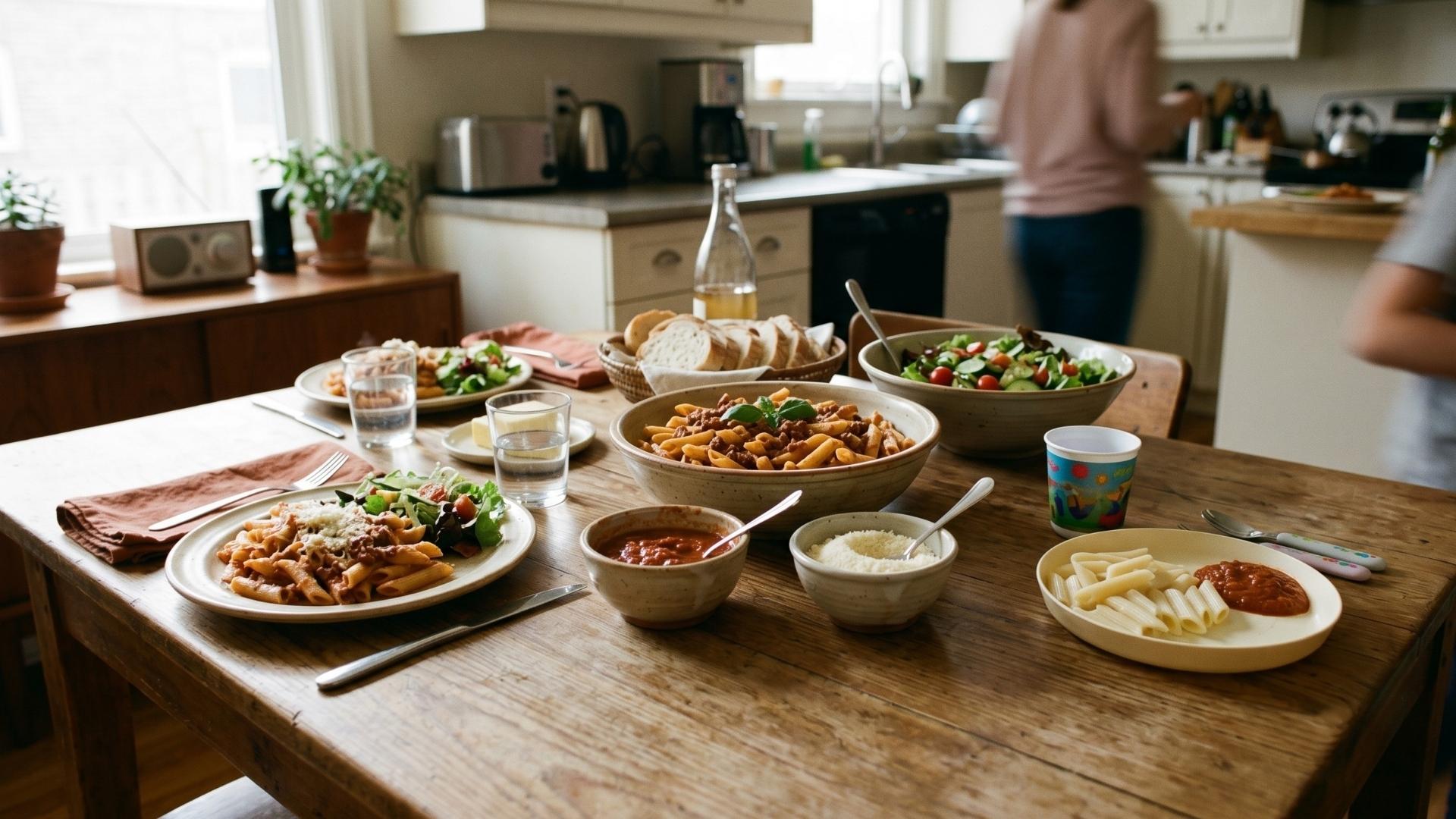
Feeding kids is one of the loudest, longest-running parenting projects. From the first solid food at six months to packing a tween's lunchbox a thousand times, food is on the parent's mind every single day. This pillar is the Funday master guide to family food: snacks, family dinners, cooking with kids, allergies, lunchboxes, picky eating, eating out, and the holiday menus that span every culture. It is the central map. Use it as the index; click into the deep-dive articles for the specifics.
The big picture: three principles that hold across every food decision
Most parents drown in food-rule advice because the advice is mostly tactical (what to feed at lunch on Tuesday) without the strategic framing. Three principles cover most of the strategic work; the tactics flow from them.
- Parents decide what to serve and when; kids decide if and how much they eat. This is the Division of Responsibility, the most-effective single feeding framework available. Cooking two meals every night doubles your work and produces a kid with a narrower menu. One meal, with components for everyone, is the answer.
- Real numbers, real ages, real specifics. "Eat your vegetables" lands less well than "two cucumber rounds and a few cherry tomatoes alongside your pasta." Specificity is what makes the food acceptable, the portion fair, and the planning tractable.
- The pattern across the week matters more than any single meal. Most kids self-regulate intake over 5-7 days even if they look erratic at any one meal. Track the weekly intake; let the meal-by-meal report card go.
The framework that underlies the first principle is the Ellyn Satter Institute Division of Responsibility, the gold-standard feeding research used by pediatricians and feeding therapists. Our deep dive into the Division of Responsibility walks through what it looks like at the family table.
Snacks: the foundation of family food
Most kids eat 2-3 snacks a day plus three meals. Snacks are not optional; they are roughly 25-30% of a kid's daily intake. The snack approach you build is foundational.
Three rules of thumb that hold across ages:
- Combine a fruit or vegetable with a protein or fat at every snack. Apple with peanut butter; cheese and crackers; cucumber with hummus. The protein-and-fat keeps energy steady; the all-carbs snack produces the late-afternoon crash.
- Two snacks a day at fixed times beats constant grazing. The kid who grazes all day is never hungry enough to eat a real meal. Fix the snack times; protect the gap between snack and meal.
- Stock the fridge and pantry weekly with the same 12-15 staples. The snack-stash setup means you never run out at 4pm.
Our guide to the 50 best snacks for kids covers the full menu, organised by prep time. The guide to healthy snacks kids will actually eat covers the what-healthy-means-at-each-age question. For the playdate-specific snack list, see the 30 best playdate snacks.
Family meals: dinner that everyone eats
The single biggest meal-time fix in most families is to stop cooking two dinners. One dinner with multiple acceptable ways to eat it. Kids take the plain version (pasta with butter, taco shells with just chicken, rice with soy sauce); adults take the dressed-up version. This is the shared-meal principle, and it changes the family dinner from a nightly battle to a routine that works.
What helps most weeknight families:
- Pick 5-7 dinners and rotate them. Most families eat the same 8-12 dinners on rotation; embrace it. The meal-planning load drops to nearly zero.
- Sunday prep for weekday assembly. 60-90 minutes on Sunday saves 3-4 hours across the week of nightly cooking.
- Build-your-own dinners (tacos, bowls, pizza night, breakfast-for-dinner) are the highest-yield format for mixed-eater families. Everyone picks what they want from the components.
- Family meals eaten together (even briefly) outperform any other single feeding intervention on long-term kid eating outcomes.
Our 30 family dinners picky kids and adults both eat covers the recipe and format guide; the upcoming guide to weeknight dinners under 30 minutes covers the fast-meal sub-menu; the guide to meal planning for families covers the rotation system.
Cooking with kids: when, what, and how much help
Kids who help cook are more likely to eat what they helped make. The age-progression matters; what a 2-year-old can do is different from what a 9-year-old can do.
By age:
- Ages 2-3: wash vegetables, tear lettuce, stir cool batter, push down toast lever.
- Ages 4-5: pour from small measuring cups, peel hard-boiled eggs, knead dough, crack eggs (with practice and crunch tolerance).
- Ages 6-8: read recipes, measure ingredients, use a knife with adult supervision, operate the toaster oven, scramble eggs on the stove.
- Ages 9-12: full meal prep with supervision, follow recipes independently, use most kitchen appliances, plan and shop for a meal.
Safety progresses alongside skill. Knife use, stove access, hot liquids, and allergen handling all need explicit teaching, not just supervision.
Our guide to cooking with kids by age walks through the age-by-age skill progression; the first recipes for kids is the starter recipe list; and kid kitchen safety: when to step in, when to step back covers the safety side specifically.
Food allergies: the system, not the panic
About 1 in 13 kids in the US has a food allergy. If your kid has one, the foundation is: read every label, communicate proactively with hosts and schools, carry the action plan, and build the safe-snacks list that travels with you.
If your kid does not have allergies but their friends do, your responsibilities at playdates and parties are smaller but real: ask before serving snacks, default to safe foods (fruit, vegetables, plain crackers) for shared spreads, and respect labels when serving someone else's kid.
The FARE guide to managing food allergies is the standard reference. Our cluster covers four layers: playdates and food allergies (the home-playdate context), food allergies at school (the school context), reading food labels (the practical skill), and common allergen swaps that actually taste good (the cooking adjustments).
Lunchboxes: the 4-component formula that ends the morning packing rush
Most kid lunches at school come home half-eaten because they were packed for the parent's idea of what is healthy, not for what the kid will actually eat in a 20-minute lunch break with a social audience and no parent encouragement.
What works: 4 components, every day, rotated within categories.
- Main (sandwich, wrap, pasta, rice bowl, or hot thermos)
- Fruit (apple slices, grapes, berries, mandarin segments)
- Vegetable or savoury side (cucumber rounds, baby carrots, cheese cubes, hummus and pita)
- Small treat (a couple of cookies, a granola bar, yogurt)
The lunchbox that takes 5 minutes on a school morning is the one that has 80% of the work already done from Sunday prep.
Our lunchbox ideas kids will actually eat covers 20 specific lunches across sandwich, no-sandwich, hot-thermos, and snack-plate formats. The upcoming weekly lunchbox plan covers the rotation; no-sandwich lunchbox ideas covers the alternative formats; and best lunchboxes and containers worth buying covers the gear.
Picky eating: what works, what makes it worse, and when to worry
Picky eating peaks between ages 2 and 6, and most of the things parents instinctively do to fix it (pressuring, bribing, cooking separate meals, sneaking vegetables) make it worse, not better. The strategies that work are slower and counter-intuitive: serve the same meal to everyone with one familiar component, repeat exposure without pressure, model genuine enjoyment, trust the kid's hunger cues.
Most picky eating resolves on its own with these strategies over months and years. A small minority of kids cross into something more clinical (ARFID, sensory-driven extreme selectivity); the warning signs are real and worth a pediatrician conversation.
The full sub-cluster: picky eating: what works and what makes it worse (the foundation), the Division of Responsibility explained (the underlying framework), when picky eating becomes a problem (the clinical-territory companion), and expanding the menu: 10 strategies that work (the tactical playbook).
Eating out: surviving restaurants with little kids
Restaurants with kids under 5 are a different format than restaurants without them. The right choices make the experience workable; the wrong choices produce the meal everyone wants to forget.
Three principles that hold across ages:
- Time the meal around the kid's energy. Lunch and early dinner work better than late dinner. Avoid the 5-7pm meltdown window with under-fives.
- Pick the right restaurant. Family-friendly does not mean a kids' menu; it means tolerant servers, high chairs available, food that arrives reasonably fast, and other families visible.
- Bring the activity bag. A small set of toys, paper and crayons, a book, and a small snack to take the edge off while you wait for the main meal.
Our guide to eating out with little kids and actually enjoying it covers the tactics; family-friendly restaurant picks: what to look for covers the venue-selection question.
Birthday and party food: the shortcut menu
Kids' party food does not have to be elaborate. The 3-element rule (one main, one snack platter, one cake) covers almost any kid's birthday. Allergy-safe defaults (fruit, vegetables, plain crackers, hummus, plain cheese) are the safe spread for any visiting kid set.
Our cluster covers: birthday party food that holds up (the basics), allergy-safe party menus (the safe-spread approach), and easy birthday cakes for beginners (the decorating playbook). For the broader party-planning context, see how to throw a 5th birthday party on a real budget from the Birthday cluster.
Holiday and special-occasion menus
Family food peaks at the holidays. Thanksgiving, the December holidays, Lunar New Year, Diwali, Eid, Easter and Passover; each is its own food project, and each has a kid-friendly playbook.
Three principles that work across the holiday calendar:
- The kid version is one acceptable component on the big spread (plain rice, plain bread, a familiar protein); they do not need their own menu.
- Save the most elaborate dishes for adults who will appreciate them; do not stress about kid acceptance of the trickier recipes.
- Build a few annual traditions around food (the same dessert every Diwali, the same Thanksgiving morning breakfast); kids remember these into adulthood.
Our holiday family menus across cultures covers Thanksgiving, Hanukkah, Diwali, Lunar New Year, Eid, and the shared-meal logistics for big-family holidays.
The quick-reference: 7 things to remember if you forget the rest
If you take nothing else from this guide, these seven things are the core.
- Parents decide what is served; kids decide how much they eat from what is offered. (Division of Responsibility.)
- Two snacks a day at fixed times beats grazing.
- Pick 7 dinners; rotate them every week.
- Sunday prep saves 3-4 hours of weeknight cooking.
- Lunchboxes: 4 components every day. Main, fruit, vegetable, small treat.
- Picky eating peaks at ages 2-6 and usually resolves. Pressure makes it worse. Repeated exposure without pressure works over months.
- Eat together as often as you can. The shared meal is the single highest-yield long-term feeding habit.
Everything else is detail. Use this pillar as the index when a question comes up; the deep-dive articles in the cluster have the specifics.
Frequently asked questions
How many meals and snacks does a kid actually need per day?
Three meals and 2-3 snacks for most kids ages 2-12. Toddlers may need 3 snacks (smaller stomach); active older kids and tweens may need 3-4. The pattern is more important than the exact number; predictable timing produces better appetite at meals.
Should I cook a separate meal for my picky kid?
No. The single biggest meal-time fix is to stop cooking two meals. Cook one dinner with at least one component the picky kid will eat (bread, plain pasta, rice, a familiar protein, or fruit). The kid eats from what is offered; you do not become a short-order cook; the menu expands over months as the kid sees the family eating other foods.
How do I get my kid to eat vegetables?
Serve them at every meal without pressure or commenting. Eat them yourself, with visible enjoyment. Repeat 10-15 times across weeks or months. Most kids will start eating most vegetables eventually if the strategy is repetition without insistence. Sneaking vegetables into other food works short-term but does not build long-term vegetable acceptance; serve them visibly instead.
Is it okay to give my kid a multivitamin instead of fighting over vegetables?
A standard kid multivitamin is fine as a safety net during a picky-eating phase. It is not a substitute for actual food long-term, but it covers the nutritional bases. Talk to your pediatrician for specifics; iron and vitamin D are the most commonly low in picky eaters.
What should I do if my kid has a food allergy?
Get the diagnostic confirmed with an allergist (not just a pediatrician). Get the action plan in writing. Learn to read labels carefully ("may contain" matters). Build the safe-snack list that travels with you. Tell schools, friends' parents, and any caregivers explicitly. Carry the EpiPen if prescribed. For the full framework, see our food allergies sub-cluster linked above.
How do I handle different parenting styles around food in my extended family?
At your house, your rules. At grandparents' house, mostly their rules with one or two non-negotiables flagged in advance (no nuts if allergy, no high-sugar before bed, etc). Most family food differences are stylistic; pick the small number that genuinely matter to you and let the rest go. Constantly policing food across family settings burns the relationships and rarely changes the kid's eating much.