
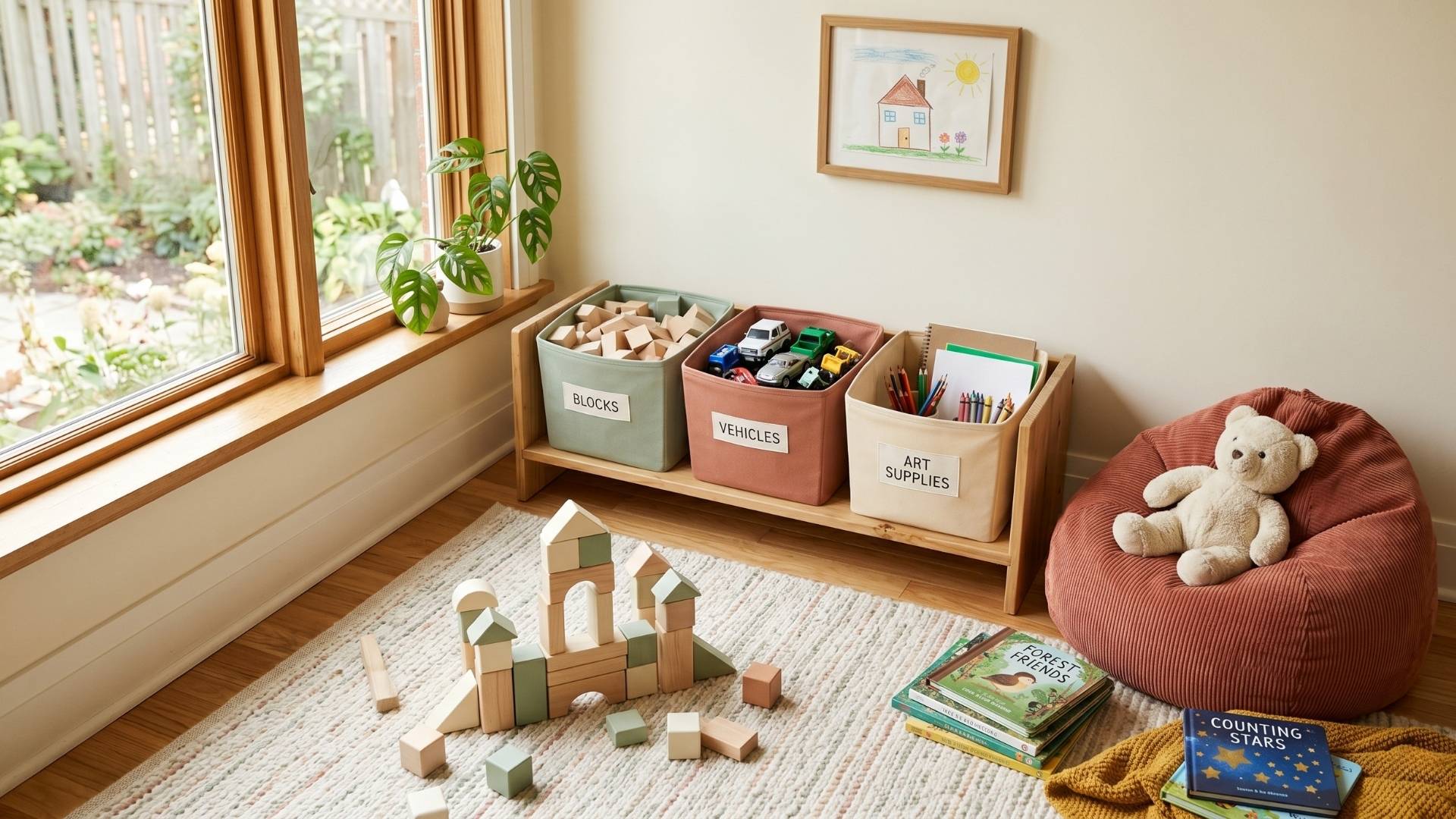
The play spaces that work are not the ones on Instagram. They are the ones with eight toys instead of eighty, a soft place to sit, and a corner kids can disappear into when the energy gets too big. Here is how to set up a play space that actually gets used, holds two to four kids during a playdate, and cleans up in under five minutes.
What kids actually use vs. what looks good in photos
Walk into most kids' rooms and you will see the gap. The pretty wooden kitchen barely touched, the cute felt-ball garland up high, the curated bookshelf untouched. The actual action: a pile of LEGO on the rug, a single doll, a cardboard box from yesterday's Amazon delivery.
Kids gravitate to a small number of things, deeply. Open-ended materials (blocks, dolls, vehicles, art supplies, dress-up) get used over and over. Single-purpose toys (a battery-powered drum, a board game with one game inside it, a complicated puzzle) get used once or twice and then go on the shelf.
If you are setting up a play space from scratch, the question is not "what is the most beautiful arrangement." It is "what are the eight to twelve things my kid will actually pick up every day." The NAEYC guidance on creating play environments is the best research-backed primer on what young kids need from a play space.
Once the space is set up, you can host. For the wider playdate logistics, see our complete guide to playdates.
Toy rotation: the single biggest upgrade
If your play space feels chaotic and your kid still says they are bored, you probably have too many toys out at once. Research and a hundred parent reports point the same way: kids play longer and more imaginatively with fewer toys, rotated regularly.
How to rotate. Pick eight to twelve open-ended things to keep out: a basket of blocks, a small set of vehicles, a doll or two, a few books, art supplies, one or two pretend-play sets (a kitchen set, a doctor kit). Pack the rest into bins and store them out of sight in a closet or under a bed.
Every two to four weeks, swap. Take a bin out, put a different bin away. Kids treat the swapped-in toys like new again. The first day after a rotation is reliably calm and absorbed; you get an hour of independent play out of toys that had been ignored for a month.
What stays out always: art supplies, books, dolls or stuffed animals the kid is attached to, and one open-ended building set. Everything else can be on rotation.
Open-ended toys vs. one-trick toys
Open-ended toys can be played with in many ways. Wooden blocks become a castle one day and a ramp the next. A doll is a baby on Monday and a doctor's patient on Friday. Art supplies become whatever the kid imagines.
One-trick toys do one thing. A battery-powered fire truck makes a fire-truck noise and that is the play. A puzzle is one puzzle and then it is solved. A board game is one game with one set of rules.
Both have a place; one-trick toys are fine, especially for car rides and quiet time. But the play space should be majority open-ended. The sets that earn shelf space across thousands of family reviews:
- Wooden or duplo-style blocks (under-five) and LEGO (five and up). The single best long-term toy investment for most kids.
- Magna-Tiles or magnetic tiles. Used by toddlers as ramps, by preschoolers as castles, by grade-schoolers as elaborate engineering builds.
- A basket of vehicles (cars, trucks, dinosaurs, animals). Kids combine these with blocks and tiles in endless ways.
- Art supplies: a covered table or tray with paper, washable markers, crayons, scissors, glue, and a small pile of recycled containers (yogurt cups, egg cartons, paper-towel tubes).
- Pretend-play essentials: a small kitchen set, dress-up clothes (a doctor coat, a fire helmet, a couple of dresses or capes), and a doctor or vet kit.
- A few well-loved dolls or stuffed animals.
Six categories cover most kids ages two to ten. Add an instrument or two if your kid likes music; add a few craft kits if they are building-oriented.
Quiet corners: the upgrade most parents skip
Two or three kids playing together get loud and high-energy fast. By minute 45 of a playdate, one of them usually needs to disappear into a softer space, even if they cannot articulate it. A quiet corner gives them somewhere to go without ending the playdate.
What works: a small reading nook with a beanbag or floor cushion, a couple of books, and a soft light. A teepee or a small fort tucked into a corner. A window seat with pillows. Bonus if it is partly hidden by a curtain or a piece of furniture so the kid can have a moment of pretend-privacy.
The quiet corner does not have to be elaborate. A cushion, a basket of books, and a soft throw blanket on the floor of a closet works. The point is a defined low-stim space, not a fully built-out reading room.
On a playdate, do not announce the quiet corner; just have it available. Most kids self-discover it when they need it, and the visiting kid often uses it more than your own.
Setting up for two to four kids playing together
A play space designed for one kid is not the same as one set up for a playdate. Two upgrades make the difference.
- Two of the popular things, not one. If your kid is into LEGO, have two baseplates out. If they love art, two chairs at the table and a clearly divided supply tray. If they are into the kitchen set, two of the popular pretend foods and two spatulas. Conflict drops in half.
- An open floor area at least four feet by six feet, clear of furniture. Big enough for a fort, a track, a dance party, or a wrestling match (which will happen). If your play space is all bins and shelves with no clear floor, the kids end up crammed and frustrated.
- A clear "shared" zone and a clear "do not touch" zone. The shared zone is everything that is fair game for the visiting kid. The do-not-touch zone is the small box of your kid's most precious or most fragile things, packed away before the playdate so the question never comes up.
For more on the pre-playdate setup itself (snack prep, toy stash, having one shared activity ready), see our guide to hosting a playdate at home.
Cleanup-friendly layouts: how to make a 5-minute reset possible
If cleanup takes 30 minutes, you will host fewer playdates. The difference between a play space that resets in five minutes and one that takes thirty is the storage system, not the size of the room.
- Open bins, labelled. Not lidded boxes (kids will not open them). Not cute matching baskets without labels (kids cannot remember what is in each one). Open, low, accessible, and labelled with a picture for pre-readers.
- One bin per category, broad. "Vehicles" not "red vehicles + blue vehicles." Toddlers and preschoolers cannot sort to a finer level than that without it becoming an adult job.
- Low shelves the kids can reach. If they cannot reach to put things back, they will not. A waist-high or lower bookshelf with bins on it works far better than a tall storage unit.
- A "misc" bin or a junk drawer for the playroom. There will always be small parts you cannot identify. Throw them in the misc bin during cleanup; sort it monthly when you have a coffee.
The five-minute reset routine: kids put toys back in bins ("vehicles bin, blocks bin, art supplies tray"), you wipe the table, you reset the cushions on the reading nook. If everyone (including the visiting kid, briefly) helps, it is genuinely five minutes.
Small play spaces: making it work in a tiny apartment
You do not need a dedicated playroom. Most families do not have one. A corner of the living room, a section of a bedroom, or a portion of a hallway can all work as a defined play space.
What matters: a defined zone (a rug helps mark the boundary), low storage the kid can access, and somewhere to do art (a small table or even a tray on the floor).
Storage that earns its place in a small space: a low cube shelf with bins, a wall-mounted book ledge, a bench with hidden storage inside, and one rolling cart for art supplies that can be wheeled out and tucked back. Skip the giant toy chest; things at the bottom never get played with.
On a playdate in a small space, expect the kids to spread out. Block off the bedrooms or bathrooms you do not want them in, push back any breakable furniture, and use the kitchen table as a backup activity zone (puzzles, art, snack).
Outdoor extension: the backyard or balcony as part of the play space
If you have any outdoor space, treat it as part of the play setup. Even a small balcony with a water table, a few sidewalk-chalk pieces, and a basket of bubbles becomes the most-used part of a playdate in warm weather.
What earns its place outdoors: a sand or water table, sidewalk chalk, bubbles, a few balls, a small slide or climbing structure if you have the space, and a low table for art outside. Kids self-organise around water and sand for hours.
The outdoor zone resets faster than the indoor one (water dries, chalk washes off in the rain, sand stays in the sandbox). For more on building outdoor playdates that work, see our outdoor playdate ideas piece.
Frequently asked questions
How many toys should be out at once?
Eight to twelve open-ended things, plus art supplies and books. Anything beyond that and most kids start to skim instead of dive in. Rotate the rest in and out of bins every two to four weeks.
What age does toy rotation stop working?
Around age seven or eight, kids start to develop deeper attachments to specific sets (a LEGO city in progress, a particular doll family setup). At that point, do not rotate the in-progress builds; rotate the surrounding stuff (the older toys, the unused puzzles, the books they have outgrown).
Are screens part of the play space?
If your family uses screens, give them their own clear zone (a tablet on the couch, the TV in the living room) and keep them out of the active play space. The play space is for the open-ended hands-on stuff. Mixing the two means screens win every time.
How do you handle a play space where one kid is much older than another?
Two zones, even informally. A low-shelf area with the toddler stuff (large blocks, dolls, soft toys) and a higher area or a separate bin for the older-kid stuff with smaller parts (LEGO, marble runs, art supplies with sharp tools). Make the small-parts zone explicitly off-limits to the toddler, and supervise mixed play.
What do I do with toys we have outgrown?
Give them away or pack them up while the kid is at school, not while they are watching. Outgrown toys often get rediscovered with weird intensity if a kid sees you removing them. A monthly quiet sweep when the playroom is empty is the way.
How do I get my kid to actually clean up?
Two things. First, make the system possible (open bins, labelled, low shelves). Second, build the habit: cleanup is part of every play session, not a separate event. Set a five-minute timer, put on a song, do it together for the first 50 cleanups. By the 51st, most kids will start it on their own.