
Hosting a good playdate at home is mostly about three things: a 10-minute tidy of the play area, two simple activities staged in advance, and a clear plan for snack and goodbye. You do not need a Pinterest setup, a craft kit, or a deep clean. You need just enough structure that the kids can find a starting point and just enough food that nobody melts down at hour two.
What hosting a playdate at home actually requires
Less than you think. The version of "hosting" you see on social media (themed snack platters, craft stations, a freshly mopped floor) is not what makes a playdate good. What makes a playdate good is a friend, an inviting starting activity, and a parent who is calm. Aim for that, not for a magazine spread.
The real prep list is short. Pick a play space, put away the toys your kid will not share, set out one or two starter activities, plan one snack, and decide where the parents will sit if the visiting parent is staying. That is the whole job.
If you are still working out the broader playdate logistics, our complete guide to playdates covers the bigger picture. This piece is the at-home hosting question.
The 10-minute pre-playdate prep
Set a timer. You have 10 minutes. Here is where they go:
- Two minutes: clear a play surface. Floor of the living room, kid's bedroom, kitchen table, whichever room you want them in. Push the stray laundry pile somewhere they will not see it. Done.
- Two minutes: hide the no-share toys. Your kid's special bear, the toy they got yesterday, the LEGO build they have been working on. Put them in a closet. Telling a five-year-old to share their brand-new thing is a setup for a meltdown.
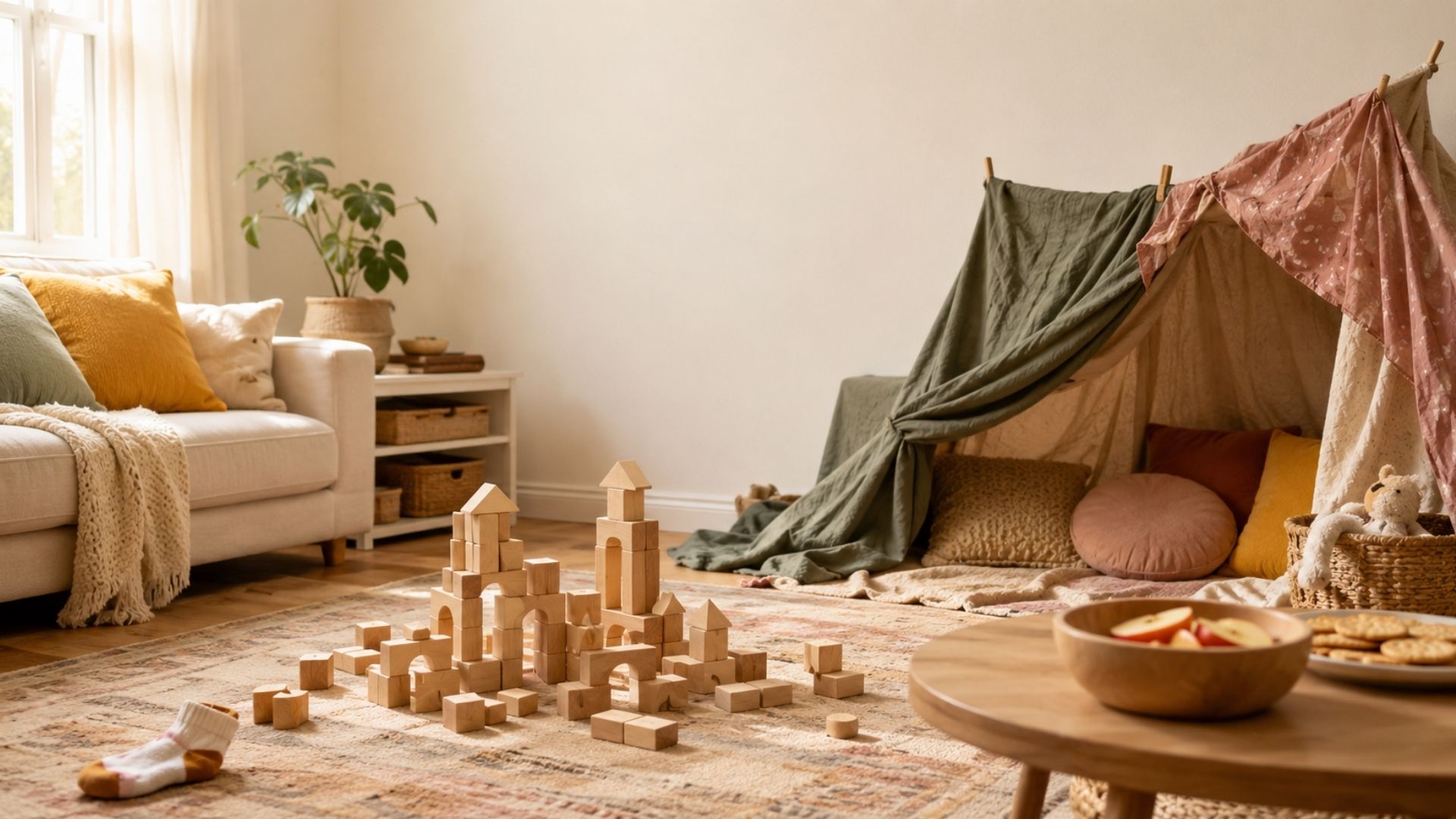
- Three minutes: stage two starter activities in different parts of the room. One quiet (drawing, puzzles, magnatiles) and one active (dress-up, a fort, a building set). Kids gravitate to one or the other and you have not wasted any thought on it.
- Two minutes: snack prep. Cut the apple, fill the water bottles, plate the crackers and cheese. Cold snack on the counter, ready to go. Saves you 15 minutes mid-playdate when you do not want to be in the kitchen.
- One minute: bathroom check. Toilet paper present, hand towel clean, soap full. That is the entire host-of-the-year checklist.
Notice what is not on this list: vacuuming, decorating, dusting, baking, putting on real clothes. None of that matters. Most other parents are quietly relieved when your house looks lived-in.
The activity rotation: how to fill 90 minutes without effort
Most playdates fall apart in the middle, when the first activity has run out of steam and nobody knows what to do next. The fix is to have a soft rotation in your head, not a schedule.
A reliable three-act structure for ages 4 to 9:
- Act 1, the warm-up (first 20 to 30 minutes): the staged starter activity. Building, drawing, dress-up, magnatiles. Something parallel-friendly that lets the kids settle.
- Act 2, the snack break (10 minutes around the 45-minute mark): apples, crackers, cheese, fruit, water. At the table. The pause resets everyone and prevents the hangry meltdown around minute 75.
- Act 3, the active half (final 45 to 60 minutes): outside if possible, even just the yard, sidewalk chalk, or a 15-minute walk to the park. Bodies need to move. Indoor backup: a fort, dance party, hide and seek.
If you have screens as a backup, use them sparingly and at the end, not the start. A 20-minute episode while you make dinner is fine; a two-hour film is not really a playdate.
More activity ideas in our pieces on rainy day playdate ideas and outdoor playdate ideas.
Snacks: the rules that actually matter
Snack does most of the heavy lifting in a successful playdate. It buys you a calm 10 minutes mid-event, refuels both kids before the second-half meltdown window, and lets the visiting parent feel that the basics have been handled.
What works: simple, familiar, low-mess foods. Apple slices, crackers, cheese cubes, grapes (cut in half for under-fives, see safety note below), pretzels, mini muffins, baby carrots, hummus. Plate it on the table or hand each kid their own bowl. Avoid juice and big sugar hits, which spike and crash the playdate.
Allergies are the one thing you should always confirm in advance. "Anything I should not feed her?" is a 10-second text. Food Allergy Canada's tips for hosting a safer playdate are a useful short read if you are hosting a kid with a known allergy for the first time. Read labels, wash counters, and never assume "a little" is fine.
Choking risk matters too, especially with kids under five. Halve grapes, halve cherry tomatoes, slice hot dogs lengthwise (or skip them), and avoid whole nuts. The AAP choking prevention guidance has the full list of high-risk foods.
More on snack planning in our 30 best playdate snacks guide.
Where the parents sit (if the visiting parent is staying)
Decide this before they arrive. The most common host failure is the visiting parent standing awkwardly in the doorway because nobody invited them to sit down.
Best setup: a spot near the play space (kitchen island, couch with sightline to the kids' play area) where you can both half-watch the kids and have an actual conversation. Two cups of coffee or water on the counter. Both parents seated within the first three minutes.
Conversation tip: do not feel like you have to entertain the visiting parent. Most are quietly relieved to have a quiet hour with another adult, not to be performed at. A loose chat about kids, school, neighbourhood, work, anything light, is the goal. Save the heavy conversations for a coffee that is not also a playdate.
What about siblings? (the under-three-year-old problem)
If you have a younger sibling underfoot, plan for them as you plan the playdate. They are not invisible, and a tantrumming toddler will end the older kid's playdate before the toddler's nap will.
Three options that work:
- Park the toddler with another adult for the duration. Partner home, grandparent across town, neighbour swap. Best case scenario.
- Plan a parallel toddler activity. Snack at the high chair while the older kids do the starter activity. A sensory bin (rice, dry pasta, water beads with supervision) on the kitchen floor. A 30-minute screen window mid-playdate. Anything that buys the older kid 30 to 45 minutes of focused play.
- Time the playdate around the toddler's nap. A 1pm playdate that lines up with toddler nap from 1 to 2:30 is gold. The big kids get a quiet stretch, you and the visiting parent get coffee, the toddler is asleep. Schedule this whenever you can.
If the playdate ends because the toddler is melting down, that is fine and normal. Apologise lightly, plan a return playdate without sibling pressure, and move on.
House rules: what to enforce, what to let go
Enforce the safety rules and the kindness rules. Let everything else slide for two hours.
Enforce: no jumping on the bed (both because of injury and because of the wider household), no closed doors with both kids inside (especially for older kids), no hitting or grabbing, no using "shut up" or whatever the household no-words are. These are non-negotiable for the visiting kid the same way they are for your kid.
Let go: the no-jumping-on-the-couch rule for an afternoon. The no-snacks-in-the-living-room rule. The shoes-off rule if the visiting kid forgot. Most household rules exist for the long run; suspending them for a playdate does no harm. Pick your battles.
If the visiting kid does something genuinely off (breaks a toy, hurts your kid, refuses to listen), the script is calm and direct: "Hey, in this house we don't do X. Let's try Y." The AAP guidance on power of play and conflict is a useful read if you find yourself second-guessing how to step in.
The wrap-up: how to land the goodbye
Give a 10-minute warning. "Friend's mom is coming at 4. Last 10 minutes, finish the build, then we'll tidy." Skipping the warning is the single biggest reason home playdates end in tears.
Help with the tidy together. Both kids put toys away for two minutes, then visiting parent and kid get coats on. Adults do not need to do a deep clean in front of the visiting parent. A two-minute toss-into-bins is enough; the rest can happen after they leave.
Send a quick thank-you text within a few hours. "Thanks again, she had a great time, want to do it at ours next time?" That offer is what turns a one-off into a recurring friendship. The second playdate is much easier than the first, which is why getting the next one on the calendar fast matters.
What to do when hosting goes badly
Sometimes the playdate is bad. Your kid is grumpy, the friend hits, the toddler ruins the build, you spill coffee on the dog. Honestly, hosting is high-volume parenting compressed into two hours and not all of it goes well.
Three things that help. First, lower the bar. Hosting once a month is plenty for most families with young kids. You do not have to alternate weeks. Second, use neutral spaces sometimes. A park playdate has zero hosting load and counts the same socially. Third, talk to your kid afterward, not in the moment. "What was hard today? What worked well?" Five minutes of post-playdate reflection is where the social skills actually develop.
If hosting feels exhausting more weeks than not, it might be time to dial back the frequency. Our piece on how often kids should have playdates has guidelines by age, and our piece on playdate ideas outside the home has options that take 10 minutes of prep instead of 90.
Frequently asked questions
Do I need to clean my house before a playdate?
No. Tidy the play area, put the laundry pile out of sight, wipe the bathroom sink. That is enough. Most other parents are quietly relieved by a lived-in house; a sparkling-clean home actually adds pressure to host them next time. Aim for clean enough, not impressive.
Should I serve lunch at a playdate?
Only if the playdate spans a meal time and you have agreed to in advance. Otherwise, a snack mid-playdate is plenty. "Want to come over 11 to 1, I can throw together pasta" is a great host offer; "come over 1 to 3" assumes the kid has eaten. Be explicit either way.
How do I handle a visiting kid who will not listen to me?
Calm, direct, and short. "In this house we don't jump on the couch. Let's try the cushions on the floor instead." Most kids reset within seconds when you give them an alternative. If a behaviour repeats and is dangerous, pull in the visiting parent if they are there, or text them if it is a drop-off.
What if my kid is being a bad host (grabby, bossy, melting down)?
Pull them aside briefly, name what you are seeing, and offer a reset. "You're feeling pretty done, huh? Let's get water and a snack and start over." If they truly cannot pull it together, end the playdate early. "They are both getting tired, let's wrap up." That is honest and the other parent has been there.
Should I host the same family multiple times in a row?
It is fine to host two or three in a row if the other family is shy or has a small apartment, but the long run wants to roughly balance. After three hosts in a row, send a friendly text that opens the door: "Want us to come to you next time?" Most parents take the cue.
What if my house is too small to host?
Then use a park, a library, a community room, a coffee shop with a kids' corner, a free museum, or your nearest indoor play space. Plenty of perfectly successful playdates happen at neutral locations and skip the hosting question entirely. There is no rule that playdates have to be in a house.