
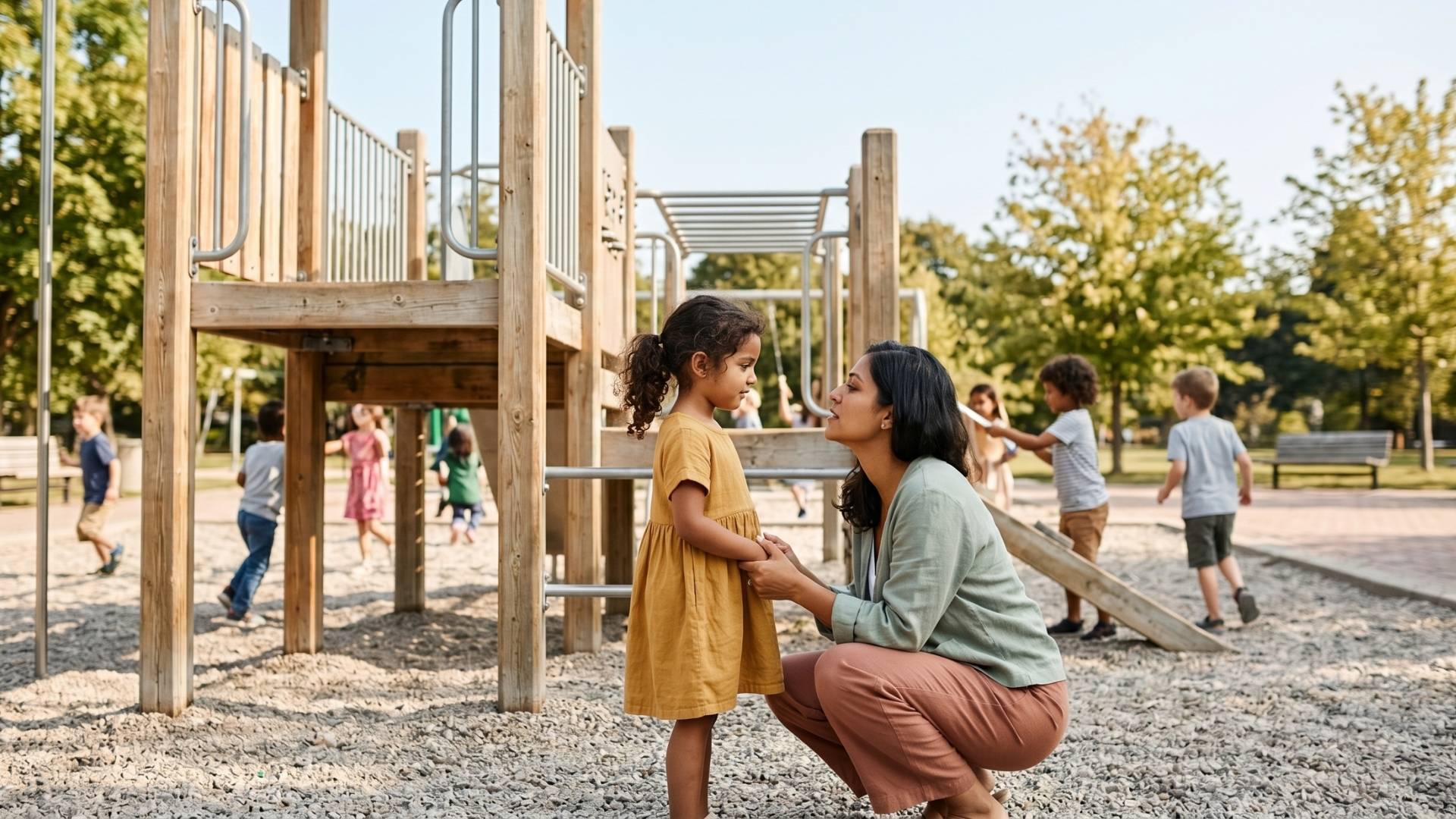
The playground is the first place most kids encounter rules they did not write. It is also the first place most parents have to enforce those rules with an audience watching. The trick is to be warm in tone, clear in language, and quick on your feet. Here is what to do in the seven situations that come up over and over, with scripts you can use in the moment.
Why the playground is harder than home
At home, you have time. You can pause, breathe, repeat the rule, follow through. At the playground, you are doing all of that under the soft glare of other parents, with strangers' kids in the mix and your own kid louder than usual.
Two things make playground discipline different. First, the audience: you can feel watched even when no one is actually paying attention, which makes you over-explain or over-apologise. Second, the speed: a sharing argument escalates to a shove in 10 seconds. You do not have time for a five-minute negotiation.
The playbook for both: shorter sentences, calmer voice, faster intervention. Drop the explanations you would give at home; save them for the car ride after. The kid does not need a lesson on the playground floor; they need a clear next step.
If you are still building out the broader playdate playbook (formats, frequency, what to do at one), see our complete guide to playdates. This piece is the playground-specific companion.
When your kid will not share
Sharing is developmentally hard for kids under five. A 3-year-old who is not sharing is not being selfish; they are doing exactly what their brain is wired to do at that age. Forcing a forced share teaches very little; structuring a turn does.
The script: get down to your kid's eye level. Acknowledge the feeling first, then introduce a structure.
"I can see you really love that truck. Tom would like a turn too. Let us play with it for two more minutes, then it is Tom's turn for two minutes. I will set a timer."
The timer is the trick. It becomes the authority instead of you. When it goes off, the truck swap happens because the timer said so, not because you are being mean. Most kids over age four accept this readily; under-fours will need it three or four times before they trust it.
If the other kid is older than yours and your kid is the one who wants the toy: same script, same timer, you advocate for the wait. "He is using it right now. We can wait two minutes and then ask. Want to find something else while we wait?"
When another kid is being rough with yours
First, decide if intervention is needed. A push is not always a fight; some kids tussle and recover. If yours is upset or hurt, intervene; if both kids are still playing, give it 10 seconds before stepping in.
When you do intervene, describe the behaviour, do not label the kid. "I saw you push him. That hurt." Not "That was mean" or "You are being naughty." The kid is not the problem; the action is.
Then offer the alternative. "You can ask him to move instead of pushing. Want to try?" Most kids will, especially if you crouch and make eye contact while you say it.
If the rough kid's parent is nearby and watching, you can keep your script short and warm. Most parents are quietly grateful you stepped in calmly. If they are not nearby and the kid is unsupervised, you have a slightly different job, which is the next section.
When the rough kid does not have a parent in sight
Common at busy playgrounds. A kid is shoving or grabbing and there is no adult attached. Three principles.
- You can address any kid's behaviour at the playground if it is affecting your child. You are not overstepping; you are doing what any adult should do.
- Keep it brief and behavioural. "Hey, please do not push. He is little." Not a lecture, not a moral framework, just one short instruction.
- Do not raise your voice. A calm tone from an adult almost always lands harder than a loud one. Kids over four register the seriousness from the eye contact, not the volume.
If the same kid keeps causing problems and you cannot find a parent, move your kid to a different part of the playground. You are not retreating; you are choosing your kid's playtime over a fight you cannot win.
If the rough behaviour escalates (hitting hard, biting, scary), get a parent or playground attendant involved. You are not making a scene; you are responding to actual harm.
When your kid is the one being rough
The most stomach-dropping moment. Your kid grabs, pushes, hits. Your instinct is to apologise to the other parent first; suppress it. The kid comes first, the apology second.
- Get to your kid fast and low. Eye level, hand on shoulder if they will let you.
- Name what happened in one short sentence. "You hit her. Hitting is not okay."
- Help them repair. "Can you say sorry?" If they will not, you say it for them: "I am so sorry, he is having a hard moment."
- Decide if you stay or go. For a one-off shove, a quick reset and back to play is usually fine. For repeated hitting in 10 minutes, take a break: "We are going to sit on that bench for a few minutes and try again."
Do not lecture in the moment. Save the conversation for the car or the walk home. "Remember when you hit Sam at the playground? What was happening for you?" That is the teaching conversation; the playground itself is for the immediate fix.
Other parents have seen kids hit other kids; it is not a character verdict on you. Most are sympathetic if you handle it visibly. The parent who silently judges hitting in another kid's parent has not parented a 4-year-old yet.
When other parents disagree with how you handle it
You used a timer. Another parent thinks the kid should learn to share without one. You let your kid climb up the slide. Another parent thinks slides are for sliding only. They glance, sigh, mutter to their friend.
Your kid, your call. The playground is not a parenting forum, and other parents' rules are not yours. Smile politely, do not engage in the debate, do not adjust your approach to win their approval.
If a parent comes up to you directly with feedback, you have two responses depending on the situation. If they have a legitimate safety point ("Hey, your kid is right at the edge of the platform"), thank them and move. If they are policing your discipline ("You really should make him share"), a polite line works: "Thanks, we are working on it our own way." Then change the subject or move along.
Do not get into it. Playground discipline debates with strangers are a bottomless time-suck and nobody has changed their mind on parenting from a single playground exchange. Hold your ground, stay warm.
The playground voice (and why it matters)
Volume is the single biggest tell of a parent who is losing it. The calm, low-volume parent comes across as in control even when their kid is melting down. The shouting parent comes across as overwhelmed even when nothing terrible has happened.
Train yourself to drop your voice when you intervene, not raise it. "Please do not throw sand" said quietly with eye contact lands harder than "DO NOT THROW SAND" yelled across the playground. Other parents notice. Your kid notices most.
When you do need to be loud (your kid is running toward the road, another kid is in immediate danger), make it one sharp word, then drop your voice again as soon as the danger is past. "Stop!" is enough. Not "Stop right now and listen to me young lady, what did I tell you about". That is the volume of a parent who has lost the room.
Kids respond to tone faster than they respond to content. A calm, clear instruction lands. A loud, angry one triggers their fight-or-flight, which makes them less likely to comply, not more.
The big-behaviour moments: tantrums, biting, the full meltdown
Some moments are too big for a calm script. Your 3-year-old is on the ground screaming because you said it was time to leave. Your 4-year-old just bit another kid. Your 5-year-old is sobbing because someone took their turn.
Two things in this order. First, safety: nobody hitting, biting, throwing; nobody at the top of a slide they could fall off. Second, presence: get next to your kid, low, calm. You do not have to talk; you have to be there.
Big feelings need to run their course. A 3-year-old's tantrum is not a behaviour to discipline; it is a flooded nervous system that needs to drain. Sit nearby. Speak rarely. Do not bargain (it never works mid-tantrum). After 5 to 10 minutes, the storm passes and you can move.
If you need to leave the playground because a behaviour is unsafe or uncontainable, leave. Carry the kid out under your arm if you have to. Do not negotiate at the gate; do not threaten three more times. The leaving is the consequence; you do not need to add a lecture.
For the developmental backdrop on why big feelings happen at this age, the Child Mind Institute primer on tantrums is a clear, parent-readable explainer. Worth a read on a quiet evening.
The graceful exit
How you leave the playground sets the tone for next time. The right exit is the one your kid does not feel ambushed by.
Five minutes before you actually need to go, give a warning. "Five more minutes, then we go home for snack." Most kids handle this fine if you do it consistently. The one-minute warning helps the youngest kids; older kids do not need it.
When the time is up, walk to your kid, low and calm. "Time to go." One sentence. Do not over-explain. Hold a hand or pick them up.
If the leaving turns into a meltdown, do not negotiate; the negotiation is what teaches them that meltdowns work. Walk them out gently, validate the feelings ("I know, you wanted to keep playing"), but do not extend the time. Next playground visit will be easier because the rule held this time.
If your kid had a hard time at this playground and you can see it (overstimulated, tired, melting down), say so out loud at pickup or in the car. "That was a lot today. We can come back when you have more energy." Naming it is not weakness; it is the parent talking to the human their kid is becoming.
For more on managing the parent-to-parent side of all this (texts, follow-ups, when to suggest a different setting), see our guide to texting another parent about a playdate.
Frequently asked questions
What about a parent who is staring at me while I handle a meltdown?
Ignore them. They are not in your situation; their opinion does not get a vote. Stay focused on your kid, do what you would do if no one was watching. Most stares are curiosity or recognition ("I have been there"), not judgment. The few that are judgmental are not worth a second of your attention.
What if my kid is bitten or hit and the other parent does not apologise?
Comfort your kid first. If the bite breaks skin or leaves a mark, a calm word with the parent is fair: "He bit her hard enough that she is bleeding. I just wanted you to know." If the parent is dismissive, drop it; you cannot make someone parent the way you would. Move to a different part of the playground or leave.
How do I introduce the sharing timer without it being weird in front of other parents?
Set it on your phone or watch with the screen showing. Most kids are fascinated by a visible timer and other parents see it as a useful trick (some will adopt it). It feels weird the first time and then it just becomes how you do things.
Is it ever okay for my kid to hit back?
Most parenting experts and our own instincts land in the same place: not as a strategy you teach. Self-defence in the moment is a reflex, not a rule. The lesson worth teaching is "get away and find an adult" before "hit back." In an actual fight where your kid is being repeatedly hurt and cannot escape, defending themselves is not the moral failure; the failure is the situation that got them there.
My kid had a meltdown and another parent yelled at us. What do I do?
Take care of your kid first. Address the other parent only after the kid is settled, and only if you want to. "It was a hard moment for him" is enough. You do not owe a stranger a longer explanation. If they were rude in front of your kid, you can name that later in the car: "That parent was upset. That was not your fault. People sometimes have hard moments too."
How early can I expect a kid to share without prompting?
Around age six is when most kids start to share spontaneously without an adult structuring it. Before that, expect to facilitate. Under-fours will need the timer or the script almost every time; ages four to five will start doing it on their own about half the time; six and up will mostly handle it themselves with occasional reminders.