
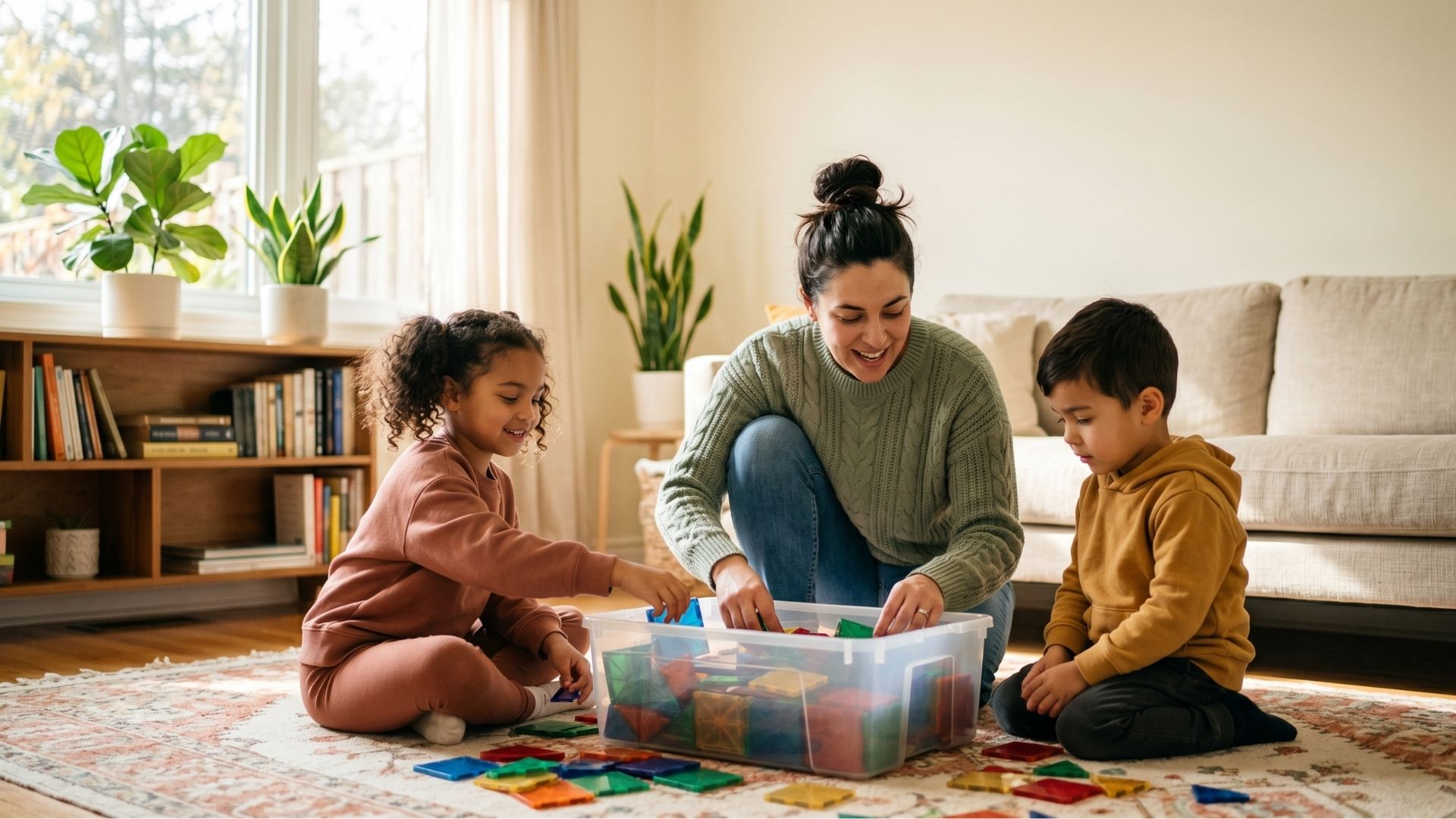
Hosting a good playdate comes down to four things: ask the visiting family about allergies, screen rules, and pickup time before they arrive; set up two or three loose activities so kids do not stare at each other for the first ten minutes; serve a snack that works for everyone; and end on time. The rest is parenting on the fly.
What does a good playdate host actually do?
A good host makes the visiting kid feel like they belong in the house within five minutes and gives the visiting parent the information they need to relax. The bar is not high. It is low and consistent.
If you are figuring out the broader rules of the road, start with our guide to playdate etiquette. This piece is the host-specific version. For the step-by-step on running a home playdate (timing, prep, recovery), see how to host a playdate at home.
Three habits separate the hosts other parents fight to schedule with from the ones who never get a return invite. They prep the space. They prep the snack. They prep themselves to be available without hovering.
What to ask before the playdate (and how to ask it)
Send a single text the day before. Keep it short, keep it specific, leave nothing to be assumed.
The text:
"Excited for tomorrow! Quick check: any food allergies or things Theo doesn't eat? Any meds he takes? Pickup at 4 still good? Anything else I should know?"
Five questions, one text, all the information you need. The visiting parent will be relieved you asked. Most of them never get asked.
If you are hosting a kid you have never met before, add one more line: "Anything that helps Theo feel comfortable at a new house?" The answer is usually nothing fancy ("he warms up faster if there is a dog" or "he loves Lego"), and it gives you a head start. The Child Mind Institute has a useful piece on helping shy or anxious kids settle in new environments if you are hosting a child who tends to take a while to warm up.
How to prep your home (15 minutes is enough)
You do not need a deep clean. You need a play zone, a snack station, and a closed door to anywhere kids should not go.
- Pick the play zone. Living room or playroom, ideally not a bedroom for kids under six. Move the breakable lamp.
- Set out two or three loose activities. Lego on the rug, magnatiles in a bin, a set of markers and paper at the table. You are creating options, not directing the play.
- Stock the snack zone. Plates, two cups of water already poured, snack on the counter, ready to go.
- Close the doors to bedrooms, the office, and any room you do not want them in. Out of sight is out of mind.
- Do a 30-second walkthrough at kid height. Anything sharp, swallowable, or precious gets put up.
If you have a toddler-aged kid hosting an older sibling's friend, or any kid under three running around, our guide to childproofing for playdates has a fuller checklist.
What to serve: the no-fail playdate snack rules
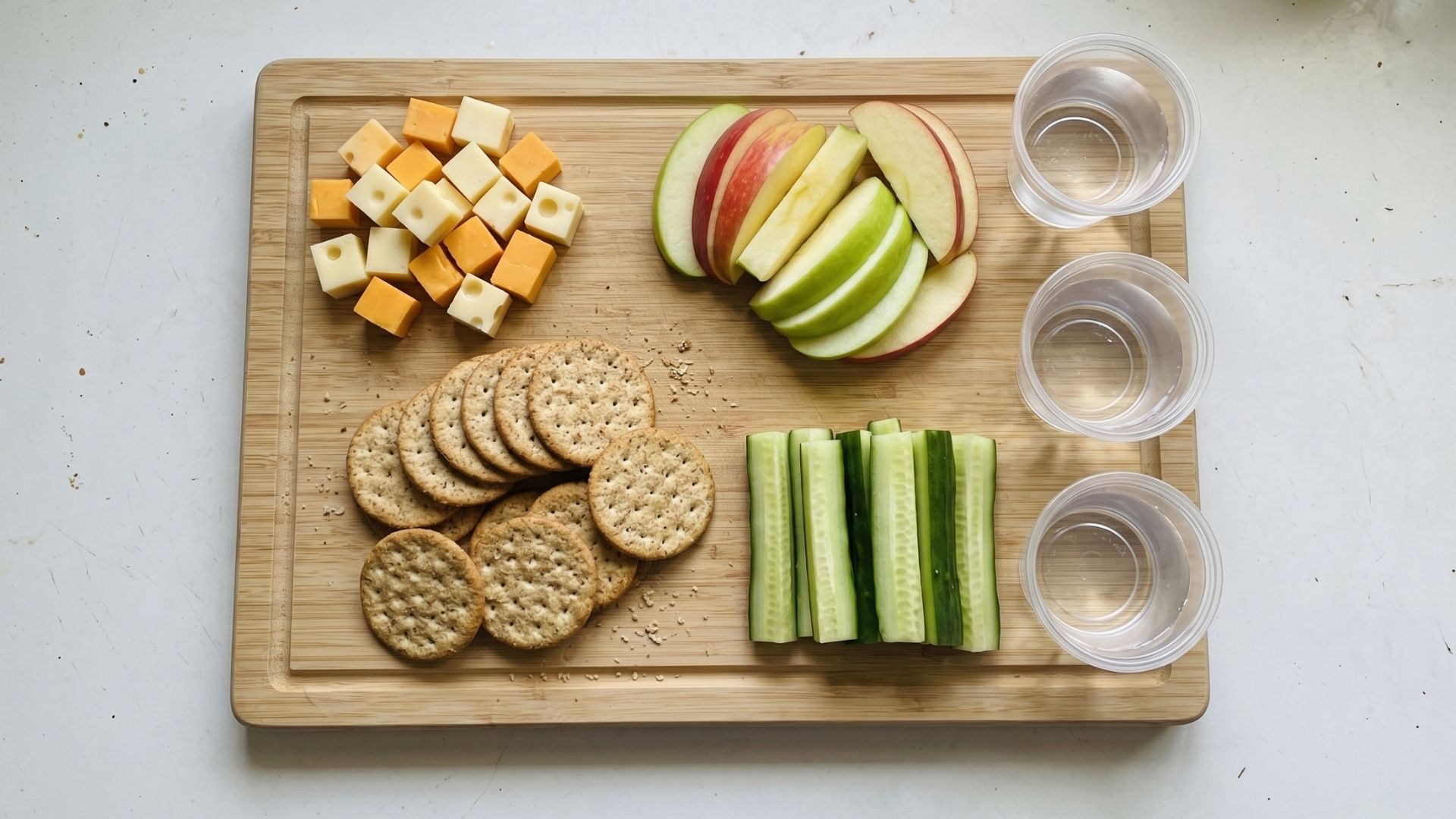
Pick one snack that works for almost any kid: cheese cubes, crackers, sliced apples, cucumber sticks, popcorn, pretzels, yogurt tubes. Avoid: peanut butter (allergy risk), anything sticky right before the kids touch your couch, anything that needs a knife and fork.
Serve at the table or counter. Do not let kids walk around the house with crackers. They will lose them, you will find them, this is a universal law.
If a visiting kid has a food allergy, ask the parent in advance what is safe and what is not. Food Allergy Canada has a short parent-to-parent guide to hosting a safer playdate that is worth a five-minute read before your first hosted playdate of the year. The two big rules: when in doubt, ask the visiting parent (text a photo of the snack), and if they have an EpiPen, know where it is and how to use it before the playdate starts.
Drinks: water in cups already poured. Save the juice and chocolate milk for kids you know want it.
Screens at playdates: when, what, and how to ask
Screens are the single most-asked-about playdate question. The clean answer: default to no screens, save them for transitions, ask the visiting parent before you turn anything on.
Default to no screens. Most playdates last 90 to 180 minutes. Kids do not need a screen in that window; they need each other. If they ask, redirect once: "Let's do snack first and then we'll see." They will move on.
Use a screen as a transition tool, not as the playdate. If energy crashes at the 75-minute mark and you have 30 minutes until pickup, a single 25-minute episode of something age-appropriate is fine. Pick something the visiting kid is allowed to watch (Bluey, PBS Kids, Pixar shorts), not whatever your kid is in the middle of.
Always ask the visiting parent before you turn anything on, especially if the playdate is the first one with that family. "Is one Bluey episode okay before pickup?" The Common Sense Media recommendations on screen time for kids give you a baseline if you do not have a house rule yet.
For age-by-age screen-free playdate ideas, see our indoor playdate activities list or, by age, preschool playdate ideas.
Siblings, pets, and the chaos factor
Three real-world variables that derail playdates: a younger sibling who wants to be in the middle of everything, an older sibling who wants the visitors to leave, and a dog who is amazing in your family's eyes and a stranger to the visiting child.
Younger siblings
Have a plan. Either a parallel activity (sibling on the floor with their own bin while the older two play in the next room), or a 30-minute outing for the sibling with the other parent, or strategic screen time for the sibling so the older kids get focused play time. "He just wants to be where they are" is sweet for the first 15 minutes and exhausting for the next 75.
Older siblings
Older kids do not need to participate, but they need to be civil. Set the expectation in advance: "You don't have to play with them, but no being rude. Stay in your room or come do something with us." Most older siblings will scroll through. That's fine.
Pets
Mention the pet in the prep text: "FYI we have a golden retriever, very gentle, but if Theo is nervous around dogs, let me know." If the visiting kid is nervous, gate the dog in another room for the first 30 minutes. Reintroduce on the kid's terms.
The first 15 minutes (and how to rescue them when kids go shy)
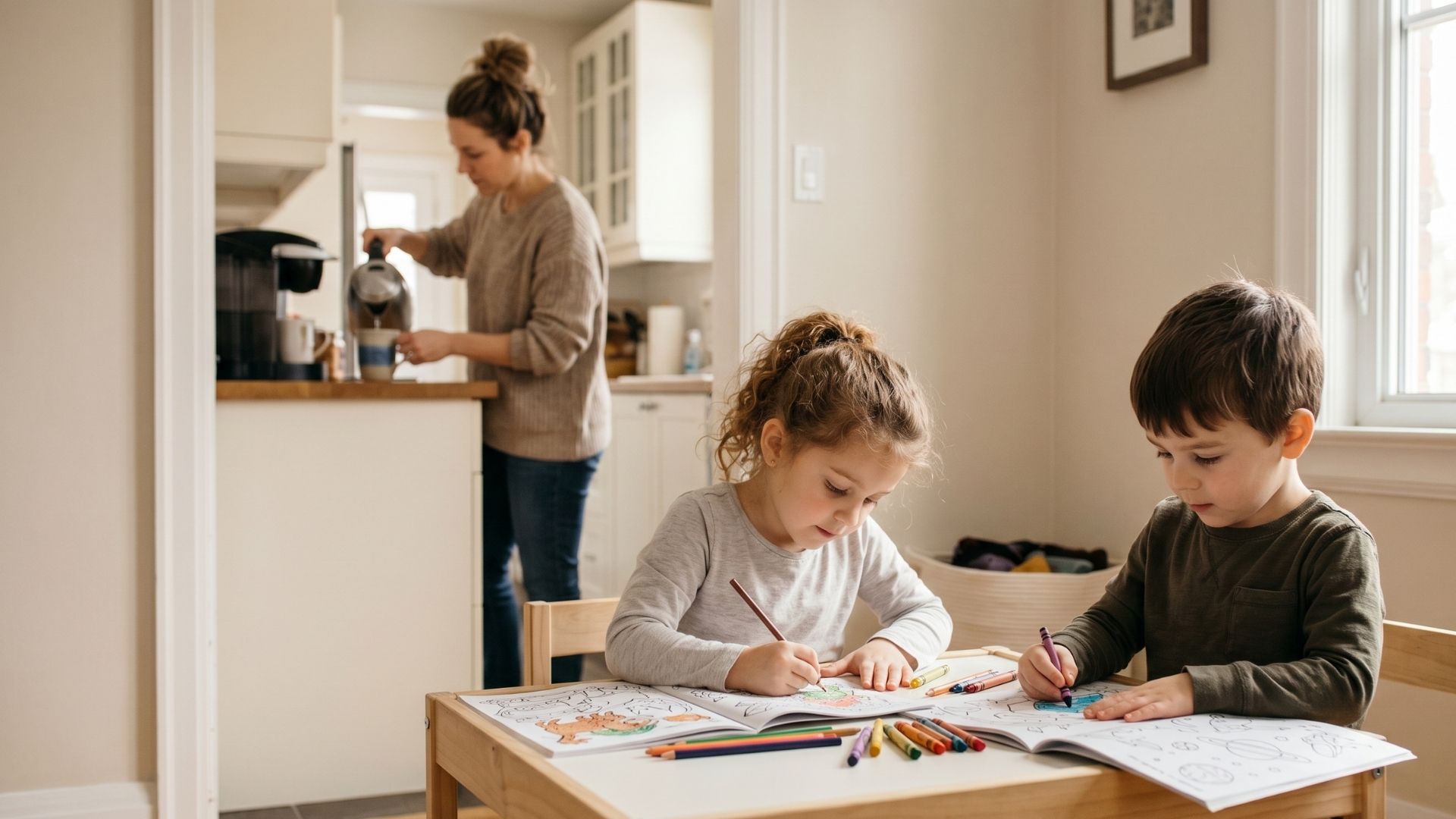
The opening is the hardest part of any playdate. Two kids who barely know each other suddenly have to play, with adults watching. Most kids freeze for the first five to ten minutes.
What works: a low-stakes, side-by-side activity. Snack at the counter. Coloring at the table. Lego on the floor. Anything that does not require eye contact or coordination. Once they have something in their hands, the talk starts.
What does not work: forcing it. Do not say "why don't you two play together!" Do not stand over them watching. Set up the activity, hand them what they need, and step back. Stay in the room but not in the play.
If after 20 minutes one kid is still attached to your leg, change the setting. Move outside, change rooms, take both kids on a quick walk to the mailbox. New space resets everything.
What to do when things break, kids fight, or the playdate is just not working
Things will break. Kids will fight. Not every playdate is magic. Hosting well includes how you handle it.
When something breaks
Stay calm in front of the kids. Save the reaction for after pickup. If it is a real loss (a piece of art, an heirloom), tell the visiting parent that night, in a low-key text, without blaming. They will offer to replace it. You will probably wave it off. The honest mention matters more than the resolution.
When kids fight
Step in once. "Take a break, both of you, snack at the counter for ten minutes." Reset. Do not litigate. Do not call the other parent. If they fight again 20 minutes later, end the playdate gracefully ("I think we are at the end of our run, want me to drop her home?") and try again in a week with a shorter playdate.
When the playdate is not working
Some kids do not click. Two playdates in, if both kids look miserable both times, that is information. End the second one a little early, do not force a third right away, and revisit in a few months. Our piece on what to do when kids do not click on a playdate has the longer version.
How to end a playdate well
The ending is the part the visiting kid will remember and the visiting parent will judge. Do not skip it.
Give a five-minute warning. "Five more minutes, then it's pickup time." Then a one-minute warning. Then start the cleanup together: a fast tidy of whatever they pulled out, hands washed, shoes by the door. If pickup is at 4pm, you and the kids are at the door by 3:58.
When the visiting parent arrives, do a 60-second handoff: "They had so much fun. They built a fort and ate three crackers each. We did one episode of Bluey at the end." The visiting parent wants to know what their kid did, ate, and watched. Then send them off. Do not extend.
After pickup, send a short text within the hour. "Theo was lovely. Welcome any time. Our turn next time." That single text is what gets you booked again.
Frequently asked questions
How long should a hosted playdate be?
For toddlers and young preschoolers, 60 to 90 minutes. For ages four to seven, 90 to 150 minutes. For school-age kids who get along, two to three hours is the sweet spot. Past three hours, even good playdates start to crash. End on a high note rather than letting it die.
Should I provide lunch or just a snack?
A snack is plenty. Lunch invites a longer playdate and adds a layer of food complexity (allergies, preferences, parents who want to eat together). If you want to do lunch, ask the visiting parent in advance and stick to easy crowd-pleasers: pasta with butter and parmesan on the side, quesadillas, build-your-own sandwiches.
What if the visiting child does not want to leave at pickup?
Lean on the visiting parent. "It's pickup time, Mum is here, we'll get to do this again soon." Do not extend the playdate to ease the transition; it teaches the kid the rules are flexible. A short, kind, firm goodbye lands better than a long drawn-out one.
Is it rude to host a playdate without offering anything to the visiting parent?
If it is a drop-off, no, the parent is not staying. If it is stay-and-play, offer them what you would offer any guest in your house: a glass of water, a coffee if you are making one, or whatever is easy. You do not need to entertain them. Letting them sit on the couch with a coffee while the kids play is a kindness.
Can I host more than one visiting kid at a time?
Yes, with caveats. Two visiting kids plus your kid often works well at ages five and up because they form a stable group. Three or more visiting kids is a small party and has different rules: more snacks, more structure, fewer free-play moments. Below age five, two on two is the upper limit before chaos.
What if I do not want to host because my house is messy?
Host anyway. Visiting parents do not care about your laundry pile. They care that their kid is safe, happy, and home on time. Tidy the play zone, close the doors to the rest, and do not apologize for the rest of the house. No host has ever lost a friend over an unwiped counter.