
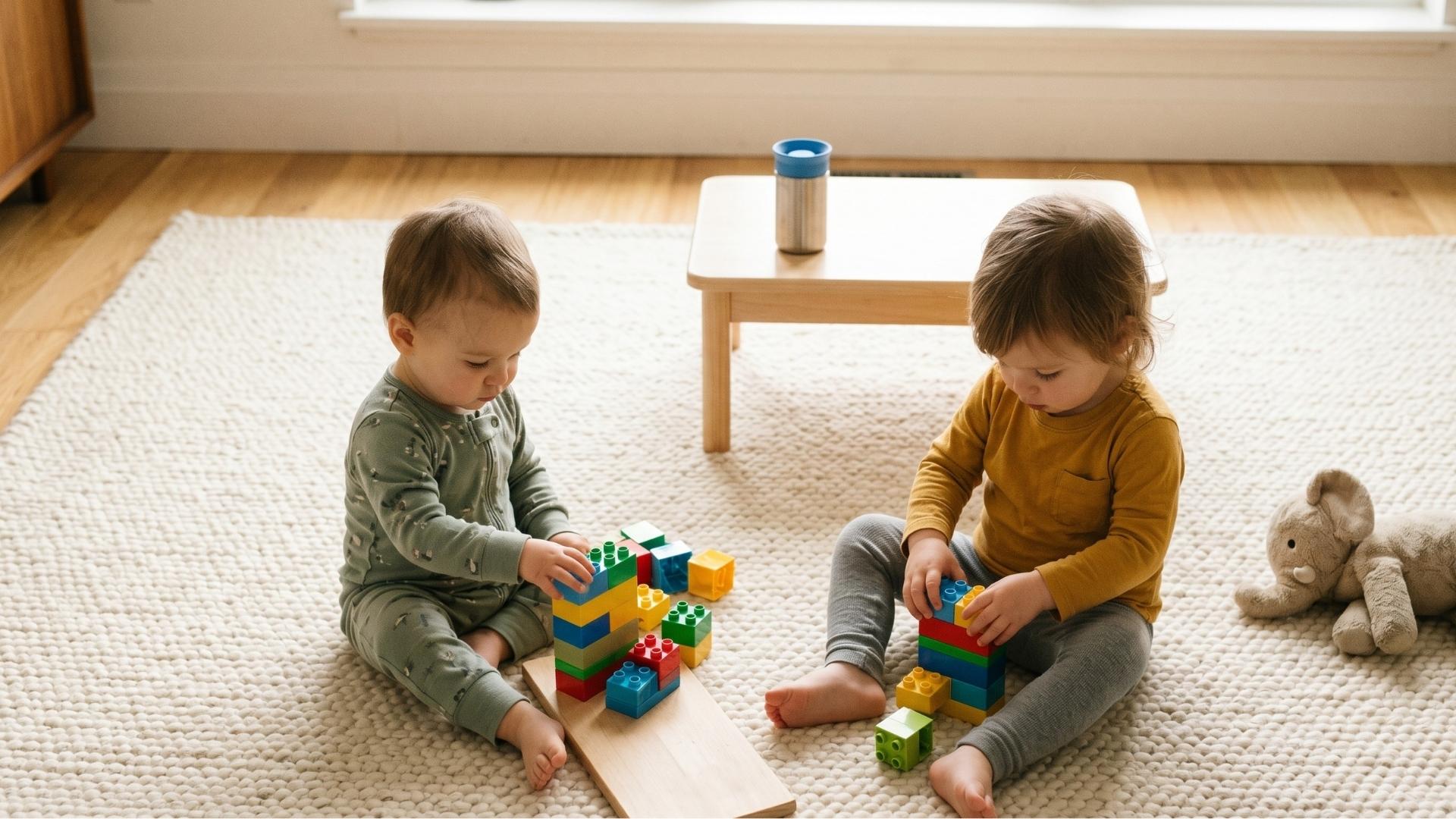
Toddler playdates do not look like older-kid playdates. Two two-year-olds in the same room are usually not playing together; they are playing alongside, with occasional sideways glances at what the other one has. That is exactly right for the age. The job of a toddler playdate is to set up materials that hold up to parallel play, plan around the nap, and accept that parent supervision is the activity. Here are 12 activities that work.
Why toddler playdates look different (and that is fine)
Two-year-olds engage in what developmental psychologists call parallel play. They sit near each other, do similar activities, and occasionally hand each other things. They do not collaborate. They do not negotiate. They do not yet share, except by accident.
This is normal and developmentally on-track. The AAP's HealthyChildren page on social development at age 2 explains that two-year-olds often play side by side without interacting much, and that not wanting to share is typical at this age. The cooperative play most parents expect (turn-taking, joint pretend) comes later. Pushing for it earlier produces a frustrated kid and a worried parent.
What works instead: set up two of everything. Two trucks, two paintbrushes, two cups at the water tray. Each kid gets their own materials. They will glance at each other, occasionally swap, sometimes laugh at each other's noises. That is the whole interaction, and it is enough.
If you are still building out the broader playdate logistics, our complete guide to playdates covers the full picture. This piece is the toddler-specific layer.
The 12 activities that actually work for toddlers
Toddlers do not need novel activities; they need familiar ones with two of everything. Most of these are setups, not games.
- Water table or a tub on the patio. Two cups, two scoops, a few floating toys. Holds two toddlers for 30+ minutes.
- Sandbox with buckets and shovels. Same logic; two of every tool.
- Big-piece blocks (duplo, mega-blocks, soft foam). Pile in the middle of the floor; each kid builds something separate.
- Books. A stack of board books on a rug; one parent reads to both, or each kid flips through their own.
- Push-and-ride toys. A small ride-on car each. They drive in circles, occasionally crash into each other, laugh.
- Bubble blowing. One adult blows; two toddlers chase, pop, run. 15-20 minutes of pure absorption.
- Sensory bin: cooked spaghetti, oats, or rice in a tray with cups. One bin per kid, side by side on a covered floor.
- Sidewalk chalk on a patio or driveway. Each kid gets a piece. The drawings are scribbles; that is the point.
- A basket of stuffed animals with a doll-feeding setup (small bowls, plastic spoons, a tea-set). Each kid feeds their own animal.
- Music and movement. A speaker plays kid-songs; both kids dance, march, fall over. 10 minutes is plenty.
- Painting with water on coloured paper. Each kid gets a brush, a small dish of water, a sheet of construction paper. The colour darkens, then fades. Magic.
- Free time on a soft rug with no plan. Sometimes the best activity is no activity. Toddlers self-organise around what is in the room within five minutes.
Pick three for a 90-minute playdate. Cycle through; each activity holds attention for 15-25 minutes maximum at this age.
The toddler-friendly schedule (work around the nap)
Two-year-olds nap. The nap is non-negotiable. The playdate is built around the nap, not the other way around.
Mid-morning playdate (9:30 to 11:00).
Best window for most toddlers. They are well-rested, well-fed, in their peak attention zone. Ends in time for lunch and the early-afternoon nap. This is the slot 80% of toddler playdates should be in.
Late-afternoon playdate (3:30 to 5:00).
Works after the nap, before the dinner-and-bedtime spiral. Energy is lower than morning; lean toward calmer activities (books, sensory bin, blocks). Snack at the start, dinner at home.
Avoid: 12:00 to 3:00 window.
Fighting the nap is not worth it. A tired toddler is not a fun toddler; the playdate ends in a meltdown either at your house or in the car on the way home. Reschedule.
Length: 60 to 90 minutes is the sweet spot for under-twos. 90 minutes max for two-to-three-year-olds. Anything longer and the second hour is just managing meltdowns.
Parent supervision: how much is too much, how much is right
At this age, parent supervision is not a backup; it is the playdate. Both parents stay present. You are the safety net, the conflict mediator, the snack provider, and (when the kids look up) the audience.
Three things to do as the supervising parent.
- Stay close, but do not direct. Sit on the rug nearby. Watch. Intervene only when needed (a tug-of-war over a single toy, someone heading toward the stairs).
- Do not force interaction. "Say hi to Maya!" almost never works at age two. Let the kids drift toward each other on their own time. They will, often around minute 20.
- Talk to the other parent. The toddler playdate is also a parent playdate. Coffee in hand, sitting on the floor, half-watching the kids, half-talking. That is the whole format.
What to avoid: hovering. A parent who is two feet from their toddler at all times, narrating their actions, redirecting every 30 seconds, makes the kid more anxious and the playdate more exhausting. Sit back. Be available. Do not perform.
Activities and items to avoid at this age
Some activities are popular for older kids and dangerous or pointless for under-threes. The list to skip until age three or older.
- Anything with small parts. Toddlers under three put everything in their mouths. No marbles, small LEGO, beads, coins, or anything smaller than a golf ball.
- Activities that require turn-taking. "Now it is Maya's turn" lands at three; at two, it lands as confiscation, and the meltdown follows.
- Crafts that require sustained focus over 15 minutes. Toddler attention spans are short; a project that needs to be finished in one sitting will not be finished.
- Indoor running games. The combination of fast movement and indoor furniture is how you get bumped heads. Save running for outside.
- Anything with adult-sized scissors, hot glue, or paint that is not labelled non-toxic.
- Open water deeper than ankle level (paddling pools without parent within arm's reach).
- Choking-hazard snacks. Whole grapes, hot dogs, hard candy, popcorn, large chunks of raw apple. Our list of playdate snacks has safer swaps.
When in doubt: smaller pieces are riskier; longer attention spans are unrealistic; older-kid games will fail. Adjust the activity, not the age.
The mess factor (toddler activities ARE messy)
Almost every good toddler activity is messy. Water spills. Paint goes everywhere. Snack ends up on the floor. Plan for it instead of fighting it.
Three setup moves that contain the mess.
- Define the mess zone. A plastic tablecloth on the kitchen floor, a tray, a covered patio. Mess happens on the cover; the cover is the boundary.
- Smock-or-strip. Old t-shirt as a smock, or kids in just a nappy/diaper for water and paint play. Saves clothes.
- Have wet wipes and a small towel within reach. The 30-second wipe-down between activities prevents the all-over mess at the end.
If you want to make peace with the mess longer-term, our guide to messy sensory play covers the broader framework. Toddler playdates are basically applied sensory play.
When two toddlers actually play together (and what it looks like)
Around month 24 to 30, you will start to see flashes of real cooperative play. They will be brief and easy to miss.
Signs that a toddler is moving from parallel to cooperative play.
- Handing each other things spontaneously, without prompting.
- Mimicking each other's actions intentionally ("she stomped, I stomp").
- Parallel play that turns into joint play (both pushing the same big block, both pretending to feed the same stuffed animal).
- Looking at each other for shared response ("is that funny? are we laughing?").
- Asking for the other kid by name between playdates.
When you see these, you are watching the foundations of friendship being laid. Do not over-celebrate it (kids notice when parents make a big deal of small things and it changes the behaviour). Just notice, and keep showing up for the playdates.
These early flashes typically appear by age 2.5 with a familiar playmate; with a stranger, more like 3 to 3.5. Same kid, repeated playdates, builds the kind of recognition that lets cooperative play emerge.
Playdate length and format for under-threes
Under-twos: 45 to 60 minutes. Most one-year-olds are out of attention budget by minute 50.
Two-year-olds: 60 to 90 minutes. The sweet spot for most kids is around 75 minutes.
Two-and-a-half to three: 75 to 100 minutes. Some can stretch to 2 hours if they are well-rested and not in a bad mood.
Format: stay-and-play, not drop-off. Drop-off playdates do not work for under-threes. The kid needs the parent present for safety, comfort, and the social-modelling part of the playdate.
Number of kids: two is right. Three two-year-olds in a room is not three times as social; it is a threesome where one kid is always feeling left out. Stick to pairs until the kids are 3.5 or older.
If you are setting up a playdate format and want the broader logistics, our guide to how long playdates should last covers the full age range.
Frequently asked questions
My toddler does not want to play with the other kid. Is something wrong?
No. Most toddlers do not really play with each other; they play near each other. If your kid is content doing their own thing in the same room as another kid, the playdate is working. "Playing together" is a developmental milestone that arrives around age three for most kids. Until then, parallel is the goal.
How do I handle the toy-grabbing?
Calmly, every time. Get to your kid's level, hand the toy back to the original kid, and offer your kid an alternative. Do not lecture; toddlers do not learn from speeches. Repeat 50 times. By age three, most kids start to resist the impulse on their own. Until then, you are the gentle policy enforcer.
Should I cancel the playdate if my toddler is having a bad morning?
Often yes. Toddler moods are real and short-lived; a playdate during a bad mood often becomes the meltdown center for the day. Better to text the other parent: "She woke up off, can we move to tomorrow?" Most toddler-parent friends are sympathetic.
Is one toddler playdate per week enough?
Yes. For most under-threes, one to two playdates per week is plenty. Toddlers get most of their social practice from family interactions, library story times, and casual park encounters. The structured playdate is a top-up, not the main meal.
What if my toddler is much more advanced (or behind) than the other kid socially?
Pick playmates by temperament, not just by age. A quieter 2-year-old often pairs better with a quieter 2.5-year-old than with a bouncing 18-month-old. Watch the chemistry across two or three playdates; the right pairings show themselves quickly. There is no "correct" pace for social development at this age.
Can I bring a toddler to an older-kid's playdate (sibling situation)?
Yes, with adjustments. Set up a parallel toddler activity (sensory bin, books, push-toys) in the same room or nearby room. The toddler will absorb in their own thing; the older kids will mostly ignore them, which is what you want. Avoid expecting the older kids to include the toddler in their game; that is too much social work for either side.