
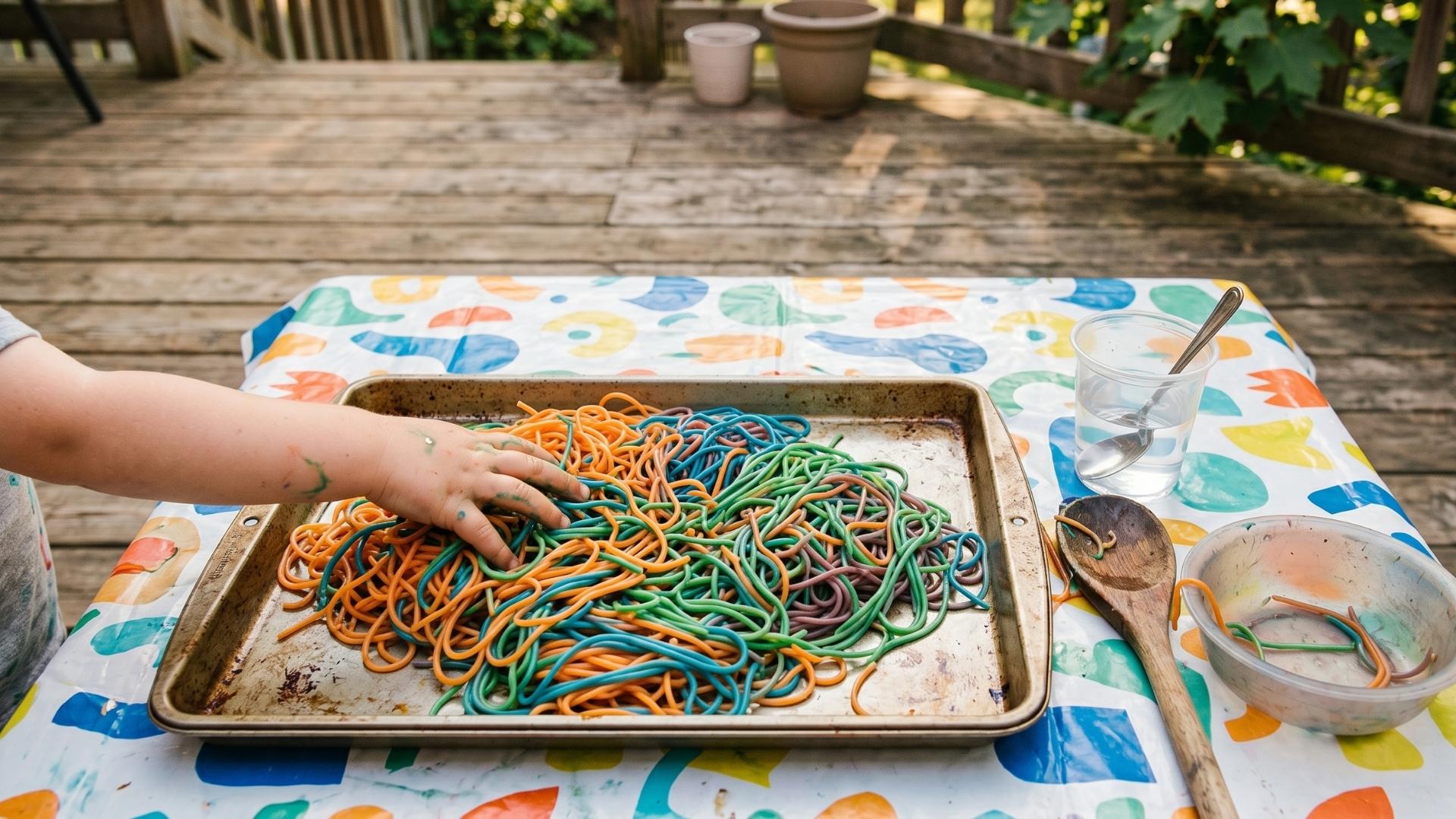
There is a particular kind of parent dread that arrives when a kid picks up a paintbrush near a white wall, or carries a full cup of water across the living room. The way out is not stricter rules; it is a better setup. Move the mess to a defined zone, hand the kid the right tools, and the cleanup contract takes care of itself. Here is how to say yes to messy play more often.
Why messy play actually matters (it is not just for fun)
Messy sensory play is one of the most heavily-researched forms of play in early childhood. It builds fine motor skills, language (kids narrate what they are touching), executive function, and the kind of focus that carries over into more structured learning later. Pouring, scooping, mixing, and squishing develop the small-muscle control kids need before they can hold a pencil.
It can also help kids settle. Many parents notice that running water through fingers, squishing dough, or scooping wet sand has a calming, focusing effect on young kids. The kid who has been bouncing off the walls all morning often goes quiet within two minutes of being handed a tray of cooked spaghetti.
And it builds something parents care about even more: the ability to choose to make a mess, then clean it up. Kids who get regular messy play learn the rhythm of "explore, then reset" much faster than kids who never get the chance because the parent could not face the cleanup.
The outside-in rule: move it outside whenever possible
If the weather and the space allow, every messy activity goes outside. A paved patio, a back garden, a balcony, even a front step with a tarp. The hose-down is the entire cleanup. There is no carpet to ruin, no wall to scrub.
What works in an outdoor mess zone:
- A plastic sheet or tarp on a patio. Becomes a water-play zone with a few buckets, an art studio with poster paint, a mud kitchen with old pots. Hose down at the end.
- A water table or large plastic tub. Fill with water, add cups, scoops, sponges. Add food colouring if you are feeling brave; the colour fades within a day in sunlight.
- A mud kitchen. Old pots and pans, wooden spoons, a plastic bowl, a patch of dirt. The most absorbing 90 minutes of play money cannot buy.
- Sidewalk chalk on a driveway or path. The colour washes off in the next rain.
- A bubble pool. Fill a plastic tub with warm water and dish soap, hand the kid an egg-beater, watch them produce a foot of bubbles in 10 minutes.
- Painting the fence with water. Hand the kid a bucket and a 4-inch paintbrush. They paint the fence with water for 45 minutes. The fence dries; nothing is damaged.
If you do not have outdoor space, the next two sections cover the indoor version. The defaults change but the principle is the same: defined zone, the right tools, a clear reset.
The designated mess spot: the indoor version
Pick one place in the house and call it the mess zone. The corner of the kitchen, a spot on the utility-room floor, the dining table with a cover, a tray on the kitchen island. Wherever has a wipeable floor and is far from upholstery.
Set the zone up the same way every time so the kid learns the rhythm:
- Lay an old shower curtain, plastic tablecloth, or cheap dropcloth on the floor or table. The cover is the boundary; play happens on the cover.
- Set up the activity in a tray or contained surface (a baking tray, a large baking dish, a cookie sheet). The tray contains the spread.
- Have a wet rag and a small dustpan within reach for the moment something escapes the tray.
- Tell the kid the rule once: "Play happens on the sheet. When you are done, we wipe the sheet together and the activity goes back in the bin."
The cleanup contract is what makes the indoor mess zone sustainable. Five minutes at the end, you and the kid wipe down together, fold the sheet, return the trays to the bin. By the tenth time you do this, the kid does most of it themselves.
The mess gear that makes it all possible (a short list)
You do not need elaborate setups. Six items cover almost every messy-play scenario for kids ages 2 to 8.
- An old shower curtain or plastic tablecloth. The single most useful piece of mess-play equipment.
- Two or three big trays or baking dishes. The contained surface is the difference between focused mess and spreading mess.
- A large plastic tub (the under-bed-storage kind). Doubles as water table, sand pit, and bubble pool.
- A pile of cheap paint smocks or oversized old t-shirts. Saves clothes.
- A 4-inch paintbrush, a small set of poster paints, and a roll of butcher paper or cheap drawing pads. Covers most art needs.
- A box labelled "Mess kit" with: cups, scoops, funnels, sponges, food colouring, dish soap, and a small bottle of vinegar (for the inevitable volcano).
Total cost is under the price of a single soft-play visit, and the gear lasts years. Skip the elaborate Pinterest sensory bins (rice dyed three colours arranged by hue) for now; kids do not need them and you do not have time. Plain water in a tray with a few cups out-performs an Instagram-perfect setup almost every time.
12 messy sensory activities, by age
Ages 18 months to 3 years (the big-sensation phase).
Water in a tray with cups and sponges. Cooked spaghetti in a tub (cool, with a few drops of food colouring). A tray of dry rice or oats with measuring cups. A bowl of shaving cream on a baking sheet (yes, edible-style is fine, just supervise). Painting with water on coloured paper (the colour appears, then fades, magic).
Ages 3 to 5 (the experiment phase).
Mud kitchen. Bubble pool with an egg-beater. Vinegar-and-baking-soda volcano in a tray. Ice play (frozen toys in a block of ice, hand them a small spoon to chip away). Free-pour painting on a large sheet of paper (poster paint, finger paints, brushes, sponges).
Ages 6 to 9 (the engineering phase).
Slime making with the kid as chemist (cornflour and water, or PVA glue and saline). Salt-dough sculpting. Tie-dye on a cheap t-shirt outside. Building dams in the mud kitchen with sticks and stones. Cooking together (real recipes; the kitchen is the original mess zone).
Pick one or two per session. Most kids ages 3 and up will absorb in a single activity for 30 to 60 minutes if the materials are open-ended and you do not hover.
The cleanup contract
If cleanup falls entirely on you, you will host fewer messy-play sessions. The cleanup contract is what makes it sustainable.
Tell the kid the rule the first time, and every time after for the first few weeks: "You can make the mess on the sheet. When you are done, we clean up together. If we do not clean up, we cannot do the activity tomorrow."
Then build the routine:
- Wipe down the tray together. Kid does the easy parts; you do the bits they cannot reach.
- Pour leftover materials back into the bin (if reusable) or into the bin-bin (if used up).
- Roll up or fold the shower curtain. Wipe with the rag.
- Wash hands, change out of the smock, snack.
By the third or fourth time, the kid will do steps 1 to 3 with minimal prompting. Make it a small ritual. Some families set a timer; some put on a clean-up song. Both work; pick whichever the kid responds to.
If the kid refuses to help with cleanup, end the activity early next time. "Last time we did not clean up. So today we are doing 15 minutes instead of 45. Want to try cleaning up today so tomorrow we can do longer?" Most kids correct course within two cycles.
When you are not a mess-tolerant parent (and that is okay)
Some parents love messy play. Some genuinely hate it. If you are in the second group, you are not failing your kid; you are noticing a real preference and you have options.
Three workable strategies for the mess-averse parent:
- Outsource it. Many preschools and toddler groups specialise in messy play; that may be where your kid's sensory needs get met. You do not have to be the one running it.
- Outdoor only, summer only. Decide that the messy stuff happens in the garden, in warm months, with a hose nearby. The rest of the year, focus on the cleaner activities (drawing, blocks, board games, reading).
- Defined micro-sessions. 15 minutes, contained tray, on a Saturday morning when you have the energy. Quality over quantity.
Forcing yourself to host hours of messy play when you find it unbearable will burn you out faster than the kid grows out of needing it. Better to do less messy play willingly than more of it resentfully. Most kids get enough sensory exposure across all the places they go (preschool, grandparents, friends' houses) that your home does not have to be the messy-play hub.
When sensory play is telling you something
Most kids enjoy messy play in moderation. A small minority either avoid it intensely or seek it out in unusual ways. Both can be useful information.
The kid who avoids all sensory play.
Will not touch sand, paint, or wet textures. Pulls back from finger-paint with visible distress. This can be a temperament thing (some kids just prefer dry, structured play) or it can signal sensory sensitivity. Watch the pattern across other contexts: do they also avoid certain food textures, dislike tags in clothing, struggle with haircuts? If yes, it is worth a chat with your pediatrician about sensory processing.
The kid who craves intense sensory input constantly.
Always wants the slimiest, wettest, messiest version. Seeks out tactile experiences (squeezing, hugging hard, rolling in things). This is sensory-seeking behaviour and is also worth understanding. For most kids, more outdoor time and more big-muscle play meets the need; for some, it is a signal to look at sensory processing more broadly.
Either pattern is worth knowing about, not panicking about. The Child Mind Institute on sensory processing is the right starting read if anything in the last two paragraphs sounded familiar. For most kids, regular messy-play access is one of the simplest and most effective ways to support sensory development.
Frequently asked questions
How long should a messy-play session last?
20 to 30 minutes for kids under 3. 45 to 60 minutes for ages 3 to 5. An hour or more for older kids who get into a project. Stop while there is still energy in the room; ending while it is still fun is what makes them ask to do it again tomorrow.
Is sensory play okay for a kid with a food allergy (e.g. wheat, egg)?
Most messy-play materials are fine, but read labels. Avoid playdough recipes that use wheat flour for a wheat-allergic kid; substitute rice flour or use store-bought gluten-free playdough. Avoid eggy ingredients in baking-style sensory play if relevant. When in doubt, the rule is the same as snack: ask the parent first if it is not your kid.
Can sensory play be too messy?
It can be too unstructured, which is what "too messy" usually means. A tray contains it; an open floor does not. If a session feels chaotic, scale down: smaller tray, fewer materials, shorter session. The goal is focused mess, not spreading mess.
How do I handle sensory play when I have a younger sibling who will eat everything?
Keep the older kid's session in a contained space the younger kid cannot access (high-chair, gated room, time-share). Or use only edible-grade materials when the younger kid is around (cooked pasta, rice, oats, water). Most under-twos will at least taste-test anything they can reach; plan around it rather than fighting it.
Are sensory bins (the elaborate ones) worth the time?
Sometimes, for a special activity. Most days, no. A tray of plain water with a few cups out-performs a four-colour rice bin set up across an hour. Save the elaborate sensory bins for rainy weekends, special occasions, or times when you actively enjoy the setup. Daily sensory play should be quick to set up and quick to reset.
When does messy play stop being important?
It does not really stop, but it changes shape. By age 8 or 9, messy play looks more like baking, gardening, real art projects, and outdoor exploration. The sensory benefits keep coming through tactile activities of any kind. Toddlers need water trays; older kids need cookie dough and chemistry sets.