
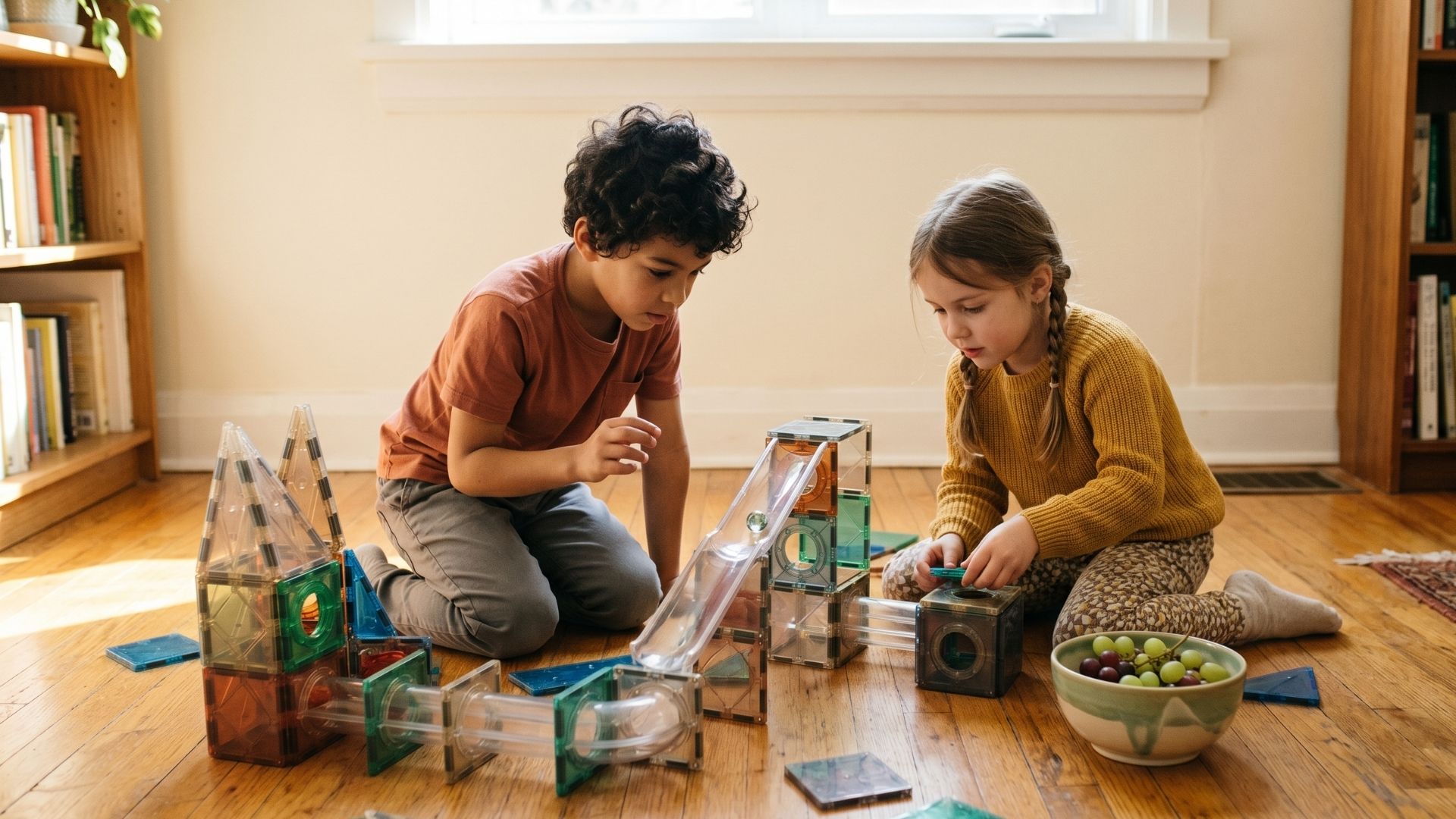
School-age playdates are the easiest playdates of the cluster. By age six, kids can run their own play with minimal adult input. Two-hour playdates are realistic; outdoor preference is real; the board-games-and-LEGO era is in full swing. The parent's job shrinks to logistics, snacks, and the occasional referee call. Here are the 12 activities that consistently work for ages 6 to 9, with what to expect from the playdate format and when to step back.
The school-age shift: playdates without parent direction
Around age six, something useful happens. Kids start to run their own play. Two 7-year-olds in a room will, within five minutes, agree on what to do, set themselves up, and disappear into it for an hour or more. They do not need an adult to suggest activities, organise the materials, or mediate the early conflict. They have learned the social mechanics.
This changes the parent's role completely. At age 3, you were the activity director. At age 7, you are the snack provider, the logistics manager, and the occasional emergency referee. The play is theirs.
What does not change: you still need to set up the space, have materials available, and know roughly where they are. School-age kids run their own playdates inside the structure you have built; they do not invent the structure. Your job is the structure.
If you are still working out the broader playdate logistics, our complete guide to playdates covers the bigger picture. This piece is the school-age-specific layer.
The 12 activities that absorb 6-to-9-year-olds
Sorted by setting (mostly indoor, with outdoor options) and by attention span (most of these absorb 45-90 minutes).
Indoor (8 ideas).
- LEGO building. The single most reliable school-age activity. Two kids, a baseplate each, a shared bin of bricks, a challenge prompt ("build the tallest tower", "build a vehicle for a stuffed animal", "build a town"). 60-90 minutes of focus.
- Magna-Tiles or magnetic tiles. Engineering, ramp-building, marble runs.
- Board games and card games. Uno, Spot It, Sushi Go, Catan Junior, Codenames Junior, Settlers of Catan (older end of the range), Ticket to Ride. One game lasts 30-45 minutes.
- Pretend play (still works at this age, just more elaborate). Spy missions, restaurant, vet clinic, post office. The setups are similar to preschool but the kids run them with longer arcs.
- Art project of the day. Pick one: collage, painting on big paper, friendship bracelets, salt-dough sculpting, sketching together. School-age kids can sustain art for 45-60 minutes.
- Building forts and reading inside them. A pile of cushions, blankets draped over chairs, a stack of books, two flashlights. They build, then read inside.
- Cooking or baking together. Decorating cupcakes, making pizza from scratch, assembling fruit kebabs. Adult-supervised but kid-led.
- Reading aloud or sustained-silent-reading time. Two kids, two books, a soft place to sit. Looks calm; is one of the best activities for kids who are getting fluent at reading.
Outdoor (4 ideas).
- Park playdate with the playground equipment. Climbing, swinging, kicking a ball around. School-age kids can keep themselves entertained on equipment for 60-90 minutes.
- Bike ride or scooter session with parents along. A 30-45 minute loop in a safe area.
- Sport in the garden or local field. Football, basketball, frisbee, badminton. Two kids, one ball or set, a flat surface.
- Nature scavenger hunt. A printable list of things to find (a smooth stone, a leaf with five points, a bird feather). 45 minutes in any park or wooded area.
Pick two to three for a 2-hour playdate. Cycle through; each absorbs 45-60 minutes at this age.
Board games and card games that actually work
School-age is the start of the great board game years. The right game is a 30-45 minute activity for two kids that produces both fun and friendship; the wrong game is a meltdown.
What works at ages 6 to 7.
Short, simple, mostly luck-based. Uno, Spot It, Memory, Snakes and Ladders, Hoot Owl Hoot (collaborative), Race to the Treasure (collaborative), Sushi Go.
What works at ages 8 to 9.
Strategy emerges. Catan Junior, Codenames Junior, Ticket to Ride, Settlers of Catan, Splendor, Azul, Sushi Go Party, Trekking the National Parks Junior. Skill matters more; some kids start to care about winning vs. losing.
Collaborative vs. competitive.
For a first playdate, collaborative games (where the kids work together against the game) are safer. Competitive games are fine for kids who already know each other and have shown they handle losing. If a kid is in the rough patch where every loss ends in tears, stick to collaborative for a few months while emotional regulation catches up.
Avoid: long games (anything over 60 minutes), highly verbal games (Pictionary works only with kids who can write fast), games with lots of small pieces (lost in the carpet within 5 minutes).
Outside vs. inside (the energy ratio)
School-age kids do better with at least 30 minutes of outdoor time per playdate, even when the main activities are indoor. The split that works: 30-40 minutes outside, 60-90 minutes inside.
Why: school-age kids have built up a lot of physical energy from sitting at a desk all day. Indoor play absorbs them mentally but does not burn the body. A short outdoor block (running around, biking, climbing on park equipment, kicking a ball) before settling inside means the second half of the playdate is calmer, more focused, and less prone to wrestling on the couch.
If your playdate is purely indoor (rain, weather, no park nearby), build in physical movement halfway through. Floor-is-lava on the cushions. A 10-minute dance-freeze. A round of indoor obstacle course. A trip up and down the stairs five times. Even a small movement break resets the energy.
For more on burning physical energy when stuck inside, see our guide to indoor activities for high-energy kids.
The friend-of-the-week phenomenon
School-age kids cycle through best friends in ways that look concerning to adults but are developmentally normal. This week's playdate request is for Sam; next week it is for Maya; the week after that, Sam is back. Do not over-interpret.
Two principles for handling the cycling.
- Follow the kid's lead, but do not change too fast. If they want a Sam playdate this week, set it up. If they ask for Maya next week, also fine. Do not call Sam's parent to apologise that your kid has "moved on"; you will be friends again in three weeks.
- Encourage repeat playdates with the kids who are emerging as the closer ones. Look across the patterns of three months: which kid does your kid talk about repeatedly, even when they have not seen them recently? That is the developing friendship. Prioritise scheduling those.
The cycling settles down by age 9 or 10 for most kids; before that, expect rotation. The deeper friendships are the ones that survive the rotation. For more on the friendship-building side specifically, see our playdates that build friendships piece.
When tech and screens come up
By age six or seven, screens become part of the playdate negotiation. "Can we play on the iPad?" "Can we watch a show?" "Can I show her my Roblox?" Pre-decide your answer before the playdate.
Three workable family policies:
- No screens during playdates. Stated upfront on arrival. Most kids accept this without much fuss; novelty of the friend usually beats the iPad.
- Screens for the last 15-20 minutes only. Used as the wind-down. Useful for calming the energy before pickup. Not useful as the main activity (defeats the purpose of the playdate).
- Co-viewing only. They can watch a show together, but no individual headphone-and-tablet setup that fragments the playdate.
If the visiting kid is from a family with very different screen rules, a quick text to the parent at scheduling: "Heads up, we keep screens off during playdates here. Same okay with you?" Most parents are appreciative. For more on navigating different parenting rules, our guide to when other parents have different rules covers it.
Tech-related activities that DO work at this age and do not feel screen-centric: looking at a single specific YouTube tutorial together (for a craft, a magic trick, a science experiment), playing a single coop video game on a TV (Mario Party, Stardew Valley, Overcooked), watching one funny clip and then doing something else. Active and shared beats passive and solo.
The 2-hour playdate: how it goes, what to expect
Two hours is the typical length for a school-age playdate. Here is roughly how it shapes up.
First 15-20 minutes.
Re-acquaintance and warm-up. They might pick up a familiar activity (the LEGO bin, the trampoline, the swing), or one will lead the other to whatever they are excited about that week. Snack on arrival is fine; some families do, some skip until later.
Minutes 20 to 80.
Peak. The board game gets played, the fort gets built, the spy mission unfolds. This is the deep absorption window. Stay nearby, do not interrupt, monitor for conflict only.
Minute 80 snack break.
Mid-playdate snack. 10 minutes at the table. Refuels them for the next hour.
Minutes 90 to 110.
Second activity, often messier or louder. The art project, the pretend play, the outdoor run-around. By this point, the kids are warm and relaxed enough to commit to something more involved.
Minutes 110 to 120.
Wind-down. Quieter activity (reading, a single round of cards, putting things away). 5-minute warning before pickup so the transition is smooth, not abrupt.
If pickup is at 4pm, you tell the visiting kid at 3:55: "Five-minute warning, finish what you are doing." Most school-age kids handle the transition fine if warned. Without the warning, you get the meltdown at the door.
When to step back as a parent (and when not to)
The hardest skill in school-age playdate hosting is knowing when to intervene and when to let them work it out. Three rules of thumb.
- Step back from minor disputes. Six-to-nine-year-olds need to practice resolving small conflicts. "That is not fair, you cheated" is a conversation they should have with each other, not with you. Listen from the next room; intervene only if it escalates to tears, hitting, or one kid retreating to their parent.
- Step in for safety, fairness, and physical conflict. Anything that looks like real anger (raised voices, tears, hitting), anything dangerous (climbing on something they should not be climbing), or anything where one kid is consistently being excluded over time. Brief, calm, factual.
- Step in for transitions. End-of-activity, snack-time, pickup. The kids cannot self-coordinate transitions reliably yet; the parent's job is the timekeeper and the gentle nudger.
What to skip: hovering, narrating, suggesting activities every 10 minutes, asking "is everyone having fun?" School-age kids will tell you if they are not having fun. Trust the silence.
Frequently asked questions
How many activities should I plan for a 2-hour playdate?
Two main activities and one wind-down. Do not over-plan; school-age kids will follow their own thread, and a busy parent-led activity schedule shuts that down. Have backup activities mentally available in case one falls flat.
What if the kids fight the whole time?
Watch first. Some level of disagreement at this age is normal play; constant fighting is a sign the chemistry is off. If you have given it 30 minutes and they cannot get into a flow, suggest a parent-led shared activity (board game with you facilitating, or a movement break together). If it does not improve, end the playdate gracefully early; not every pairing works.
Should I provide elaborate snacks for a school-age playdate?
No. School-age kids prefer simple. A platter of cut fruit, crackers, cheese, and a couple of small treats is plenty. Avoid the fancy charcuterie spread; it goes uneaten. If they get hungry mid-playdate, they will tell you; have backup snacks ready.
Drop-off or stay-and-play at this age?
Drop-off works for most kids by age 6 or 7. The first drop-off with a new family takes a brief in-person handoff (5-10 minutes of parent chat at the door). After the first time, drop-off becomes the norm. Some parents stay through age 8 or 9 for social reasons; both formats work.
What if my kid wants to invite a kid I do not know well?
Set up a low-stakes first playdate. Park or playground meet (90 minutes), drop-off optional. Use the time to get a sense of the kid and the parent. After the first one, you will know whether to keep building or to keep it occasional.
How do I handle a playdate at the visiting kid's house when it is your kid's first time?
Drop-off is fine for most school-age kids if you have met the parent. Brief logistics check at the door ("What time should I come back? Phone number? Any allergies on her side I should know about for next time?"). Send your kid in with a phone-not-included list of "what we do" if they have specific needs (no peanut butter, must wear shoes inside, etc.). Trust the host parent's setup; this is their house, their rules.