
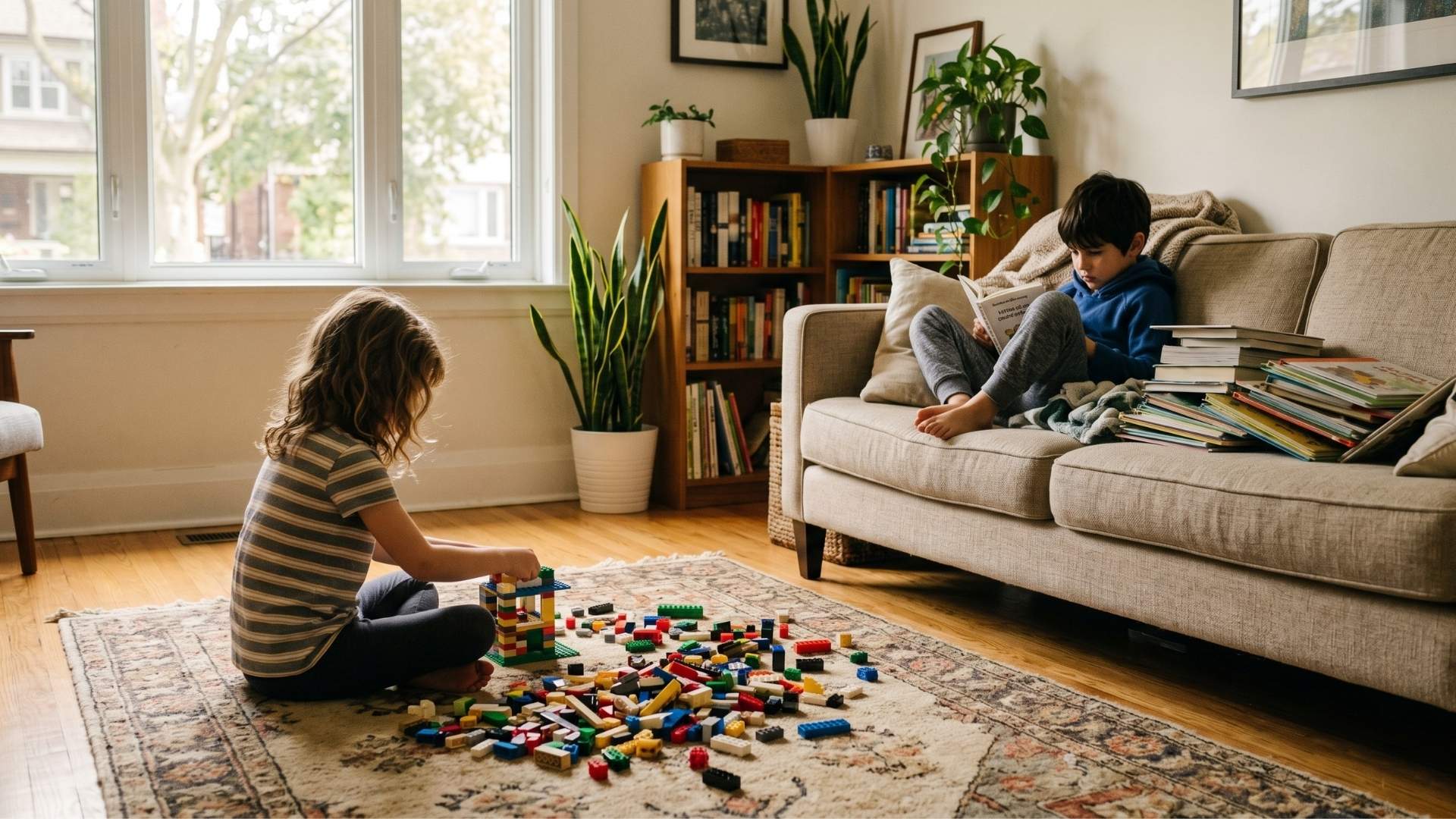
Some playdate pairings just do not work. The kids play in different corners, the energy never warms up, and you spend the whole 90 minutes managing minor friction. The good news: it is usually not personal, it is rarely permanent, and the right move is almost never to push through. Here is how to tell early, the moves to try before giving up, and how to end a not-working playdate gracefully without burning the parent friendship.
The 30-minute test (early signals it is not clicking)
Most playdates that are going to work show signs by the 30-minute mark. The kids have settled in, found at least one shared activity, and are at least near each other. Most playdates that are not going to work also show by 30 minutes; the signals are different but equally clear if you know what you are looking for.
Signs it is clicking by minute 30:
- They are in the same general area.
- They have spoken to each other at least a few times.
- There has been at least one shared moment (a laugh, a high-five, a moment of "look at this").
- Neither kid is asking when the playdate ends.
- The activity has shifted at least once and they shifted together.
Signs it is not clicking by minute 30:
- They are in different parts of the room or house, doing parallel activities with no overlap.
- Conversation between them is one-sided (one kid is monologuing; the other is barely responding).
- Constant low-grade conflict (snippy comments, refusing to share, taking each other's things).
- One or both kids retreating to a parent every few minutes.
- One kid is clearly directing and the other is clearly tolerating, not engaging.
If you see three or more not-clicking signs at the 30-minute mark, intervene actively. The next sections cover what to try. If you are still building out the broader playdate playbook, our complete guide to playdates covers the bigger picture.
The 4 reasons kids do not click
Diagnose before you intervene. The reason will tell you what to try.
- Personality mismatch. One kid is loud and bouncy; the other is quiet and bookish. One wants to lead every game; the other will not be led. Common in pairings the parents arranged but the kids did not choose.
- Age or developmental gap. A 4-year-old and a 7-year-old often do not click during a playdate; the developmental difference is too big. Same logic for a kid who is socially advanced for their age paired with a kid who is more typical.
- Bad day. Either kid woke up off, slept poorly, had a fight at school, is hungry, or is fighting a virus. The chemistry is not actually missing; today is the wrong day.
- Real interpersonal friction. Specific to this pairing. They have actively annoyed each other in past interactions; one feels excluded by the other; there is a history of a hurtful comment or moment that has not been repaired.
How to figure out which one. Watch the body language and listen for the specific complaints. "He is too loud" is personality. "She wants to play baby games" is age gap. "She is just being weird today" is bad day. "She said my drawing was ugly" is real friction.
Each one has different fixes. Personality mismatch usually does not improve much; just space out the playdates. Age gap is structural; play a parallel-play card or shorten future playdates. Bad days resolve themselves by next visit. Real friction needs the repair conversation; see PD-29 for the toolkit.
Mid-playdate rescue moves (try these first)
Before giving up on the playdate, try three rescue moves in this order. Many playdates that look stuck at minute 30 turn around with one of these.
Rescue 1: change the activity.
If they are stuck on parallel-play in different rooms, propose a single shared thing. "Want to make cookies?" "Let us go outside and kick a ball." "I am setting up a craft, come over." The new activity gives them a shared focus that the previous setup did not.
Rescue 2: change the venue.
If indoors is dragging, go to the park. If the home playdate is too quiet, walk to the corner shop together. The change of scene resets the social dynamics; many kids who do not click in a living room do click while walking next to each other.
Rescue 3: insert structure.
If unstructured play is not happening, introduce a structured one with you facilitating. A board game with you keeping the rules. A scavenger hunt with you reading the clues. The structure removes the burden of the kids organising the play themselves; many not-clicking pairs are actually fine if the social demand is reduced.
If all three rescues fail, the playdate is genuinely not working today. Move to the graceful end (next section) rather than push through another hour of friction.
When to end the playdate gracefully
Knowing when to wrap up early is a skill. Playdates that grind through 90 minutes of mutual tolerance damage both the kids and the friendship; ending at 60 minutes with a smile preserves both.
Three signals it is time to end early.
- Both kids are asking when the playdate ends. Not just one; both. Both kids have decided.
- Conflict frequency is rising, not falling. By minute 60, you are intervening every 5 minutes. Continuing produces a meltdown.
- Energy is dropping noticeably. The kids are tired or under-fed, and you do not have time to re-fuel and recover within the playdate window.
How to end gracefully without making the kids feel they failed at the playdate.
- Frame it as natural, not as a wrap-up. "I am going to text Maya's mum and see if she is home; we have had a busy morning." Not "This is not working, time to go." Kids do not need to know you are calling it.
- Have a positive last activity. Snack at the table. A quick read of a book together. A short outdoor moment. The last 10 minutes shape the whole memory of the playdate; finish on something easy.
- Send the visiting kid home with a small positive note. "Thanks for coming, see you next time at school." Even if the playdate did not click, the goodbye should land warm.
- Text the other parent the same day with a friendly message that does not over-explain. "Thanks for letting Sam come. Both kids were a bit tired today; let us try again in a couple of weeks." Leaves the door open without committing.
If you ended early because of real conflict (not just a flat day), the post-playdate text might also include a brief acknowledgment if there was something significant: "They had a small dust-up over the LEGO; both fine now, just wanted to flag." Honesty plus brevity. Do not turn it into a paragraph.
The post-playdate conversation with your kid
After a not-clicking playdate, your kid will sometimes ask about it. Sometimes they will not. Either is fine. If they bring it up, three things to keep in mind.
- Listen first, do not lead with your interpretation. "How did you feel about today?" Open question; let them say what they noticed.
- Validate the experience. "It sounded like it was hard to find something you both wanted to do." Naming what you saw without judgment helps the kid sort their own feelings.
- Do not over-criticise the other kid. Even if you saw the other kid being unkind, channel-shifting your kid's mind to "that kid is bad" creates problems with future playdates and reflects badly on you. Stick to behaviour: "It seemed like she really wanted to play her game today; sometimes that does not work."
What not to say. "You should have tried harder." "Maybe next time you can be the one to suggest a game." Most playdate-mismatch dynamics are not the kid's fault; placing the responsibility on them produces shame, not skill.
Your kid will also tell you, often clearly, whether they want to see this kid again. "Can we please not have her over for a while?" is real information. Take it seriously. Refusing future playdates with this kid is not a failure of social development; it is a kid who has correctly read the situation.
When to not schedule a second one
Sometimes the right move after a not-clicking playdate is to not schedule another one. This is not failure; it is reading the data correctly.
Signs that no second playdate is the right call.
- Your kid asks you not to do it again, and the reasons are specific and reasonable.
- The not-clicking pattern is repeated across multiple playdates with the same kid (you have already given it 3 to 4 chances).
- There is a real interpersonal issue (the other kid is consistently mean, controlling, or excluding) that has not improved across visits.
- The playdate is creating ongoing stress at school (the kids are forced together regularly outside of playdates and the friction carries over).
- You yourself notice that you dread arranging the playdates and the kid clearly does too. Both of you have given the right answer on this one.
How to handle it without burning the parent friendship. Most parents will read the slow-down naturally; you do not have to issue a formal rejection.
- Stop initiating playdates yourself.
- If the other parent invites, decline politely and do not propose alternatives. "This week is busy for us, sorry!" can be repeated 4 to 6 times before the other parent gets the message.
- Keep the parent friendship through other channels (school events, casual park overlap, occasional coffee). The kids do not have to be friends for the parents to be.
- If the other parent asks directly why the playdates have stopped, be brief and kind. "Honestly, the kids did not seem to click as much as we hoped, and we wanted to give it some space. They are both lovely, just different paces." That is plenty.
Avoid the long apologetic message that lays out everything that went wrong. It is not necessary, and it usually causes more friction than the silent slow-down.
The parent-friendship-but-kids-don't-click problem
Common situation: you really like the other parent. You hoped the kids would become friends so the friendship had a built-in social schedule. The kids do not click. You feel stuck.
Three workable arrangements when the parents click but the kids do not.
- Adult-only socialising. Coffees, dinners out, weekend brunches without the kids. The friendship runs on its own track. Many adult friendships work this way.
- Group settings where the kids do not have to interact intensely. Big family barbecues, group park meets, museum visits with multiple families. The kids have other kids to interact with; your two are not forced into a one-on-one dynamic.
- Occasional low-stakes kid contact. Birthday parties for the bigger group, a once-a-quarter park meet, school-event overlap. Enough to maintain familiarity without the pressure of a regular playdate.
Avoid the trap of forcing monthly two-kid playdates because you and the other parent are friends. The kids will resent it; the friendship will start to feel more like an obligation than a pleasure for everyone. For more on the parent-friendship side specifically, see our guide to making mom and dad friends through playdates.
When the not-clicking is your kid's pattern (across friends)
Most kids click with some friends and not others; that is normal. A different pattern: your kid does not click with most friends, across multiple pairings, repeatedly. This is worth taking seriously.
Look at the underlying pattern. Is your kid:
- Consistently dominating playdates and failing to share the play? They will need scaffolding around turn-taking and listening; talk to the teacher and consider a quick read of conflict-resolution resources.
- Consistently overwhelmed in social situations? May be temperamentally introverted (see PD-26) or showing signs of social anxiety; if intense, talk to the pediatrician.
- Missing some social cues that other kids are picking up? Worth a closer look; this can sometimes be a sign of autism spectrum or social communication differences. Not a verdict, just a flag worth investigating.
- Going through a developmental stage where they are figuring out where they fit? Common in late primary years (8 to 11). The kids' social maps are reorganising; expect a year of mismatched playdates as they sort themselves into new groups.
If you are not sure whether the pattern is normal-for-age or worth a closer look, talk to your kid's teacher. They see the social patterns at school and can help you read whether your kid is doing fine in their day-to-day social life. The Child Mind Institute on tween friendships is a good general resource for the school-age and tween years.
Frequently asked questions
Should I tell the other parent that the kids did not click?
Briefly, if asked; not at length, unprompted. Most parents read the situation themselves; if they reach out for another playdate and you decline, they will get the message within two or three declines. A short honest line is fine if directly asked: "They did not seem to click as much as we hoped." Avoid the long autopsy; it makes everyone uncomfortable.
What if the kids click sometimes but not consistently?
Normal. Most kid friendships have on-and-off chemistry depending on mood, age, and what is going on for each. If the playdates work most of the time, keep going; do not over-interpret a bad day. If they consistently miss more than they hit, space the playdates further apart and let the friendship naturally settle into whatever it is going to be.
Is it okay to keep trying with a kid mine does not click with?
Two or three attempts, yes; ten attempts, no. Some friendships need a few visits to find their footing. But after three or four playdates with no improvement, the chemistry is not coming. Continuing to try teaches your kid that you do not respect their social preferences and that they have to perform friendship even when it is not there.
What if my kid clicks with the friend but the friend clearly does not click with mine?
Painful but worth honoring. If the other kid is visibly tolerating rather than enjoying your kid, the friendship is not real. Continue to invite for a while if it makes your kid happy; do not be surprised when the friendship does not deepen. Help your kid build other connections in parallel; do not put all the social investment into a one-sided friendship.
Are there ages when kids click less reliably?
Yes. Ages 4 to 5 (preschool to kindergarten): friendships are very temporary and pairings shift weekly. Ages 8 to 10: kids are reorganising into more stable peer groups, lots of shifting alliances. Ages 11 to 13: gender, identity, and interest groupings are forming; old friends sometimes drift apart. Persistent not-clicking during these windows is often a phase, not a permanent pattern.
How do I help my kid get better at clicking?
Friendship skills do develop. Coach lightly: notice when other kids share interests, talk about what makes a friend feel valued, role-play tricky social moments at home. Avoid heavy-handed coaching; kids learn social skills mostly through experience, not lectures. Make sure your kid has regular, low-stakes social practice (school, a regular activity, repeated play with one or two friendly kids) and trust the process.