
Most kids do well with one to two playdates per week. Toddlers and preschoolers thrive on parallel-play time and can do two short ones; school-age kids in the four-to-eight range usually want one to two longer hangouts; tweens often only want one a week and lots of solo time. The real number is whatever leaves your kid happy, rested, and asking for the next one.
What is the right number of playdates per week?
There is no perfect number. The right frequency is the one that fits your kid's social battery, your family's schedule, and the rhythm of their school week. For most kids, that lands somewhere between one and three peer hangouts a week, including playdates, after-school play in the yard, scheduled activities with a social component, and birthday parties.
What matters more than the number is the quality and the energy at the end. A kid who comes home from a playdate happy, talking about it, and asking for another one had the right amount. A kid who comes home shut down, exhausted, or weepy had too much. The American Academy of Pediatrics on the power of play makes the case that unstructured play with peers is essential to healthy development, but they are equally clear that downtime and family time are part of the same picture.
If you are working out the broader picture, our complete guide to playdates covers when to start and how to set them up. This piece is the frequency-and-by-age question.
Playdate frequency by age
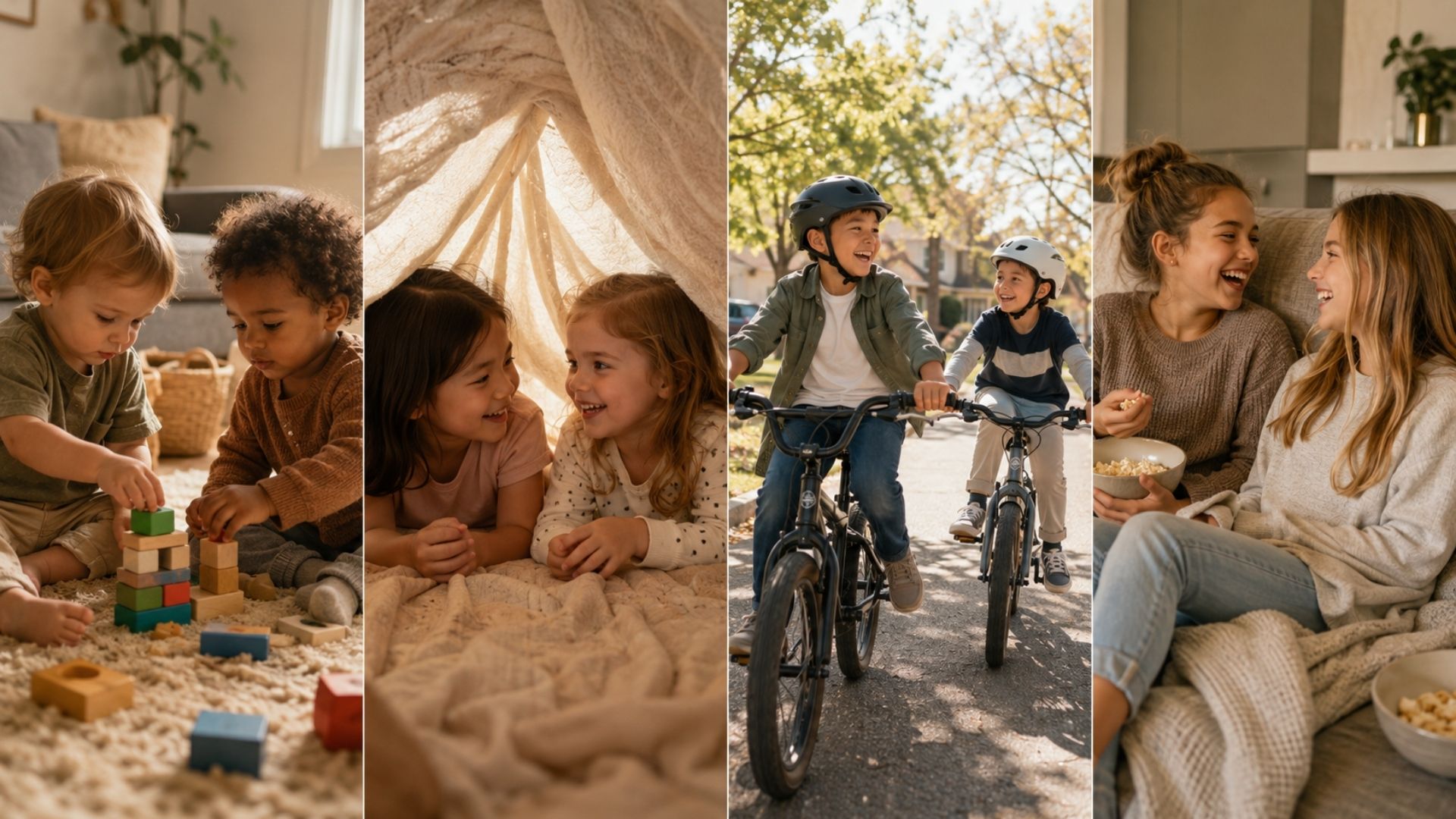
What follows are rough guidelines, not rules. Read your kid first.
Toddlers (ages 1 to 3)
Sweet spot: one to two short playdates a week, 60 to 90 minutes each. Anything more than two is a lot for kids who are still figuring out parallel play and are wiped out by an hour of social input. The AAP's HealthyChildren page on social development at age 2 explains that two-year-olds often play side by side without much back-and-forth, and suggests keeping groups to two or three children at first. Group meet-ups are fun for parents, but most toddlers do better with one familiar friend at a time.
Preschoolers (ages 3 to 5)
Sweet spot: two to three a week, 90 to 150 minutes each. This is the age where pretend play takes off and kids start having actual friendships. They want playdates, and they benefit from them. If your preschooler is in daycare or preschool full-time, scale back to one or two on the weekends; their social tank is already full from the week. Raising Children Network's guide to preschooler friendships is a useful read on what to expect at this stage.
School-age (ages 6 to 9)
Sweet spot: one to two longer playdates a week, two to three hours each. School-age kids get plenty of social input from their school day, so weekends become the playdate window. Some kids want to maximize this and would do four playdates a weekend if you let them. Others want one and then a long Saturday at home with a book. Both are fine. Watch the kid, not the calendar.
Tweens (ages 10 to 12)
Sweet spot: one a week, often longer or more open-ended. Tweens prefer fewer, longer hangouts, and they want lots of solo time. They will tell you what they want. Listen. The biggest shift at this age is that the kid runs the schedule, not the parent.
Why frequency matters less than you think
Parents tend to track playdates the way they track milestones, like a metric to optimize. Two playdates a week, three playdates a week, more is better.
It is not. The point of playdates is not the count; it is the relationships and the unstructured peer time that build social skills. One steady weekly playdate with the same friend over six months will do more for your kid's social development than 20 random playdates with different kids that do not turn into friendships.
What actually matters: a small number of repeat friendships, real free play that is not directed by adults, and enough downtime in between that the playdate stays fun. Bombing a kid with daily playdates often produces a kid who hates playdates by month two.
What if my kid is asking for more playdates than I can manage?
First, this is good news. Your kid is socially motivated and has friends to ask after. Welcome problem to have.
Practical answers: tell them honestly that you can do one or two a week, and let them choose which ones. Stack short playdates back-to-back at one location ("both your friends can come to the park at 3pm") to scale your effort. Push some playdates to drop-off if your kid is ready, which lowers the cost on you. And use neutral spaces (parks, libraries, museums) more than houses; they require less prep, less cleanup, and parents can mostly tag along without committing to a hosting role.
If hosting feels like the bottleneck, our piece on playdate ideas outside the home has options that take 10 minutes of prep instead of 90.
What if my kid is asking for fewer playdates than I expected?
Also fine. Some kids are more introverted, more content with sibling play, or just going through a phase where home is what they want. None of those are problems to solve.
What to watch for: is your kid choosing fewer playdates because they are happy and saturated socially (great), or because they are anxious about social situations and avoiding (worth attention)? The signal is in their mood and their wider behavior. A kid who happily declines playdates and then plays contentedly at home is fine. A kid who declines playdates and seems lonely or sad is sending a different signal.
If anxiety seems to be in the mix, the Child Mind Institute's quick guide to social anxiety disorder is a useful starting place to read about what is typical and what is worth talking to a clinician about. Our piece on playdates for shy and slow-to-warm-up kids also has practical scripts for kids who find peer play taxing.
Should only children have more playdates than kids with siblings?
Slightly more, but not dramatically. The research on only children does not support the old idea that they are at a social deficit, but they do benefit from regular peer time the way kids with siblings get from each other automatically.
A practical rule: aim for the upper end of the range for your kid's age. Where a kid with siblings might do one playdate a week at age six, an only child often thrives with two. Where a sibling kid might do two preschool playdates a week, an only child might do three. The added playdates serve the same function as a sibling, which is unstructured peer time at home.
What also helps for only children: a steady core of two or three friends who feel like cousins, repeat playdates with the same families, and the occasional weekend sleepover once your kid is ready. Our piece on only-child playdate strategies has the longer version, with notes on managing parent burnout when you are the de facto sibling.
What if my kid is in daycare or preschool full-time?
Their social tank is already pretty full from the week. Scale back the weekend playdates rather than piling on more. One playdate per weekend is plenty for most full-time daycare or preschool kids; some want zero on tough weeks and that is also fine.
Watch for the Sunday-night meltdown. If your kid is consistently melting down on Sunday evenings, the weekend may be too packed. Pull back, especially on Saturday afternoon, and protect a slow Sunday morning. Quiet time at home is part of the social diet too.
The flip side: a daycare kid still benefits from one or two regular weekend friendships outside the daycare network. Daycare friendships are real, but they are also slightly more transactional (you see them every weekday and play whatever the teacher set up). A weekend friendship that is chosen, repeated, and home-based has a different quality and helps kids build the muscle of choosing friends.
What about during school holidays?
Holidays change the math. Kids who normally see 25 peers a day at school suddenly see one or two siblings or no one. Most kids need more playdates during long breaks, not fewer.
A useful target for week-long or longer breaks: aim for at least one social hangout every 48 hours. It does not have to be a formal playdate. A morning at the park with a friend's family, an afternoon at the pool with a few neighbors, a coffee shop hangout while siblings draw together. The point is regular peer contact.
On rainy holiday days when no one wants to leave the house, our list of rainy day playdate ideas has options that work.
Signs you have hit the right frequency for your kid
Three quick checks.
- Your kid comes home from playdates happy, talking about them, and asking when the next one is. Not every time; nobody bats a thousand. Most of the time.
- Your kid is not melting down on the days after playdates. Some recovery is normal, especially for younger kids and introverts. Big shutdowns are a sign of too much.
- You are not dreading the next playdate. If hosting or chauffeuring is making you resentful, you are doing too many. Cut one this week.
If all three are pointing the right way, you have it dialed in. Keep doing what you are doing.
Frequently asked questions
Is one playdate a week enough?
For most school-age kids, yes. One regular weekly playdate with a steady friend is plenty for healthy social development, especially when your kid is also seeing peers at school, after-school activities, or sports. If your kid is asking for more, adding one short second one is fine. If your kid seems content, one is enough.
Should I schedule playdates for my baby or one-year-old?
Not really. Babies and young toddlers benefit from being around other small kids, but it is for the parents as much as the babies. "Playgroups" of one or two kids and their parents are great social time for adults and gentle exposure for kids. Do not stress about hitting a frequency target; this age is about the parents finding their people.
What if my kid only wants to see the same friend over and over?
Lean in. A close repeat friendship is more developmentally valuable than variety at this age. Kids learn social skills better with one stable peer they trust than from rotating through different ones. By age seven or eight, many kids start naturally widening their friendship circle on their own.
How many playdates per week is too many?
It depends on your kid, but the rough red line is when playdates start to feel like work, when your kid starts melting down on playdate days, or when you stop being able to recover the house between them. For most families, more than three playdates in a week with a school-age kid is a lot; more than two with a preschooler is a lot.
Do shy kids need more or fewer playdates?
Fewer in number, more in repetition. A shy kid does not benefit from being thrown into lots of new social situations, but they benefit enormously from one or two trusted friends seen regularly. The safety of a familiar face is what builds confidence; novelty often backfires.
Should playdate frequency change in the summer?
Yes, usually upward. Without school as the daily social outlet, kids often need more peer time, not less. Aim for at least one social hangout every two days during long breaks, even informal ones (park meetups, pool days, a friend over for an hour while you make dinner). Watch your kid for signs of overload and pull back if needed.