
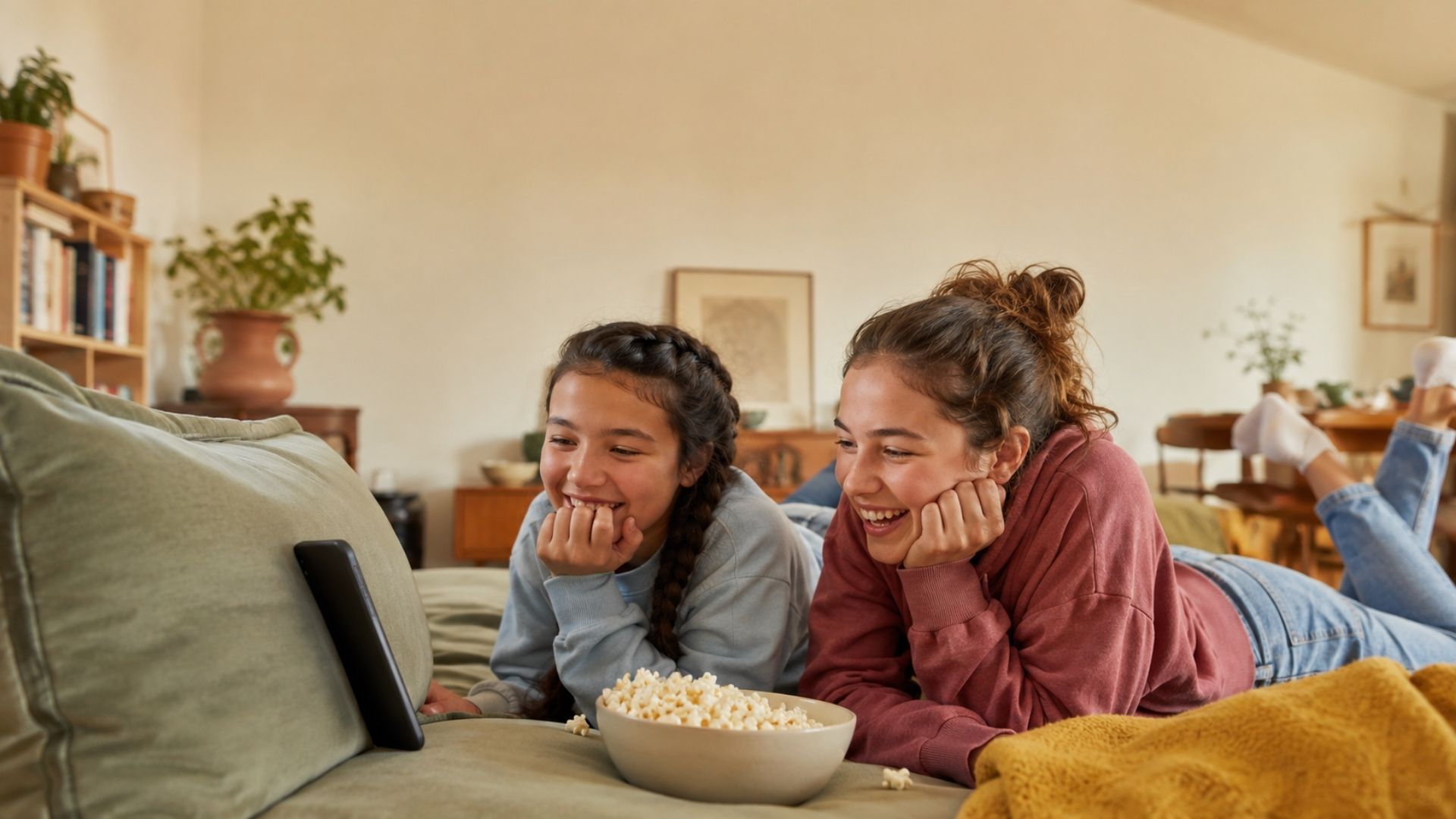
By age 10, the word "playdate" starts to feel babyish to the kid you are setting it up for. It is now a hangout. The activities matter less than the friend; the parent role shrinks to driver, snack provider, and quiet presence in the next room. Two tweens will spend three hours together and the highlights will be: snacks, half a movie they did not finish, a long talk about something you will never know about, and a phone they were both looking at. Here is how to host a tween hangout that genuinely works.
When playdates become "hangouts"
Around age 10, most kids stop calling them playdates. The word feels childish; "hangout" is the upgrade. The format changes too. Tweens are less interested in structured activities, more interested in unstructured time with a specific friend. Two tweens on a couch with snacks and a low-stakes activity in the background can be genuinely happy for three hours.
What is going on developmentally: identity formation has started, peer-orientation is rising fast, and the friend's opinion is starting to weigh more than the parent's. The hangout is one of the first places this plays out. The kids are practicing the kind of low-stakes conversational connection that defines adult friendship; activities are the wallpaper, not the point.
Your job as the host parent is to provide the wallpaper (food, comfortable space, a low-effort activity option) and then disappear. Tweens do not want to be programmed; they want to be left alone, with the option to ask for things.
If you are still working out the broader playdate logistics for any age, our complete guide to playdates covers the bigger picture. This piece is the tween-specific layer.
What tweens actually do together (and what they are avoiding)
If you observe a tween hangout from the next room, here is roughly what is happening. The activity is the cover; the conversation is the substance.
- Talking. About school, about other kids, about a YouTuber, about the embarrassing thing that happened at lunch on Tuesday. This is the main event; everything else is around it.
- Looking at phones together. Reading TikToks aloud, watching YouTube clips, scrolling memes, sometimes a quick game.
- Snacking. Often constantly. Tweens eat in small frequent bursts.
- A low-stakes activity in parallel: drawing while talking, building LEGO while watching something, baking while gossiping. The activity supports the conversation; it is not the focus.
- Wandering. Around the house, around the garden, to the kitchen, back to the room. Tween hangouts have a roving quality that younger-kid playdates do not.
What they are explicitly avoiding: parent-led activities, structured games for two, anything that feels organized. Suggesting a board game can land for some pairs; suggesting an art project usually does not. Read the room; if they want to be left to their own devices (literal and figurative), let them.
The 10 activities that still genuinely work
Sorted by what the kid will actually accept. None of these are parent-led; all of them are options that tweens will reach for if available.
- Baking together. Cookies, cupcakes, brownies, pizza. The recipe gives them a structure; the conversation happens around the bowl.
- A movie or show on the couch. Pick something at their level (not yours). They will half-watch and half-talk; that is the format.
- Going somewhere. The mall, a coffee shop, a movie theater, a park, a swimming pool. Tweens love being out of the house with a friend.
- Crafts they choose. Friendship bracelets (still very alive at this age), candle-making kits, jewelry-making, painting. Adult-level craft kits work well.
- Cooperative video games (one console, one TV). Mario Party, Mario Kart, Stardew Valley, Overcooked. Two-player local-coop is a hangout-level activity, not a screen-zombie activity.
- Gaming clubs they are both into (Roblox, Minecraft, Fortnite). They will play in the same room or each on their own device; either is fine for tween hangouts as long as it is not isolating.
- Going for a walk or bike ride. Not framed as exercise; framed as "let us go to the corner shop." Tweens love a low-stakes errand format.
- Slime making, candle making, soap making, kit-based science experiments. Done at the kitchen table over an hour.
- Sketching, journaling, or writing together. Looks calm; absorbing for the right kids.
- Cooking a real meal together. Pizza from scratch, pasta with sauce, a stir-fry. Adult-level kitchen access, real knife use, end product they eat together.
Pick one as the headline; have two backup ideas if the first does not stick. Do not insist; tweens can spend three hours sitting on a couch talking and that is also a successful hangout.
Just one friend at home: games and ideas for two
Two kids at home with an afternoon to fill is the most common tween hangout. Beyond the list above, these work well for a pair, including younger 9- and 10-year-olds:
- Two-player card games: Speed (also called Spit), Rummy, Crazy Eights, or a deck of Uno.
- Two-player board games: chess, checkers, Connect 4, Battleship, or Mastermind.
- A 20-minute build-off with LEGO, cardboard and tape, or a marble run, then each judges the other's creation.
- A stop-motion film or short video on one phone, starring LEGO figures or toys.
- A scavenger hunt or home escape room that one kid writes for the other, then they swap.
- A blanket fort with snacks and a speaker. Tweens still love one, even if they will not say so.
- Learning one new skill together from a video: card tricks, juggling, origami, or a dance.
Tech, screens, and the "we are just gonna game" trap
Screens are the central feature of tween social life. Pretending otherwise will push the hangout off your home and onto your kid's phone, which is not better.
Three workable screen frameworks for tween hangouts.
- Co-screen, not solo-screen. They can watch the same thing, play the same game on the same console, or look at one phone together. They cannot each be on their own device with headphones; that is parallel-internet, not a hangout.
- Time-boxed. "You can game for the first 90 minutes, then we are doing pizza together, then maybe more screens after." Frames screens as part of the hangout, not the hangout itself.
- Phones away during specific moments. Meals, the activity moment (baking, going for a walk), pickup. Otherwise: present but used reasonably.
Where parents commonly get this wrong: the no-screens-ever rule, which leads tweens to schedule their hangouts elsewhere. The right framework is "screens are part of how you spend time together; let us make sure it is together, not parallel." The Common Sense Media research on tweens, teens and screens is useful background on how tweens use screens today.
If the visiting kid is from a family with very different screen rules, text the parent: "How does X feel about screens during hangouts? Want me to keep them off, or is some shared screen time fine?" Most parents are direct about their rules; you adjust to whatever they say.
Food: tweens eat constantly
Tweens are growing. They are hungry. A 3-hour hangout will involve at least two snack windows and possibly a meal.
Stock more than you think you need:
- A large bowl of crisps, popcorn, or pretzels (the no-effort snack).
- Sliced fruit and vegetables (the always-acceptable backup).
- Bread and toppings (a tween can build their own snack from a fridge stocked with bread, cheese, ham, hummus, peanut butter).
- A treat: cookies, brownies, ice cream, a tray of mini-muffins.
- Drinks: water, lemonade, fizzy drinks if your family does them. Skip juice (tweens find it babyish in many cases); skip coffee (a tween is not getting coffee from your kitchen, sorry).
If the hangout spans a meal, plan a real meal. Tweens are old enough to genuinely enjoy a meal you cook, especially one they helped with. Pizza night, taco night, pasta with garlic bread. The shared meal is often the highlight of a hangout for the kid.
For the broader snack patterns, our guide to playdate snacks covers the menu. Tweens lean toward the same snacks but in larger volumes.
Drop-off vs. parent-present (when each works)
Tween hangouts are mostly drop-off. The visiting kid is dropped off, the host parent is in the house but in another room, the visiting parent comes back at pickup time.
Drop-off works when:
You have met the visiting parent before, or at minimum had a phone-call-or-text conversation. Both kids are 10+. The hangout is at a known place (home, not a venue). You are home and available, even if not actively present.
Parent-present makes sense when:
It is the first hangout with this family. The visiting kid is on the younger end (10) or has anxiety about new spaces. The hangout is at a venue (museum, mall, swimming pool) where adult supervision is needed. Either kid is in a tough patch personally and might appreciate a parent nearby.
How to be present without hovering. Be in another room of the house. Drop in for a snack delivery, ask one question, leave. Do not sit in the room they are in unless they invite you. The wrong kind of presence (hovering, narrating, asking constant questions) is worse than absence.
Cross-gender hangouts at this age
Cross-gender friendships are common at age 10 and become a topic of awkwardness for parents around 11 and 12. Some practical reality.
Most cross-gender tween friendships at this age are not romantic; they are genuine friendships. The kids are aware of the social commentary ("is that your boyfriend?") and find it annoying. Treat the friendship the same way you would a same-gender one: meet the friend, have a hangout, do not make it weird.
Some additional considerations for cross-gender hangouts at 11+ specifically. A first cross-gender hangout often works better in a public-ish setting (going for a milkshake, bike ride to the park, board game in the living room with the door open) than in a closed bedroom. This is not about distrust; it is about reducing the social awkwardness for both kids. Closed-bedroom hangouts at 11+ start a phase of negotiation that is easier to put off until 13+ for most families.
If your kid is the one being teased about a cross-gender friendship, name it briefly with them: "It is annoying when other kids assume you are dating. Friendship can be friendship." Then drop it; the more parents lean in, the weirder it gets.
When to worry vs. when to let it be
Most tween hangouts are exactly what they look like: low-key time with a friend. Occasionally something more concerning surfaces; here is the rough sorting.
Let it be.
They are quiet for an hour and you cannot tell what they are doing. They want to close the door of the bedroom (within reason). They are watching something you would not have picked. They are gossiping about other kids. They are talking about a YouTuber you have never heard of. They are spending a hangout almost entirely on screens together. Some of these can be discussed later; none require immediate intervention.
Worth a closer look.
Persistent secretiveness across multiple hangouts. Your kid seems unhappy or anxious after every hangout with this specific friend. There is a pattern of one kid clearly dominating the other (always picking the activity, always being mean about your kid in subtle ways, always positioning your kid as the follower). The visiting kid has been caught lying about content (saying it is a school project when it is something else, asking your kid to keep things from you). The hangout-content-online crosses lines (sexual content, hateful content, anything illegal).
If concerning patterns appear, a calm one-on-one conversation with your kid is the move (not a confrontation, not a friendship ban without explanation). Understood's guide to helping middle-schoolers connect with other kids is a useful read for the broader frame. For the specific question of when to stop scheduling further hangouts with a friend who is not a good influence, our guide to playdate red flags covers the harder calls.
Frequently asked questions
How long should a tween hangout last?
Two to four hours is normal. Some tweens will happily spend 5 or 6 hours together if you let them; others run out of social bandwidth at the 2-hour mark. Watch your kid (not the visiting kid; the visiting kid will be polite). If your kid wants to wrap up at 90 minutes, wrap up; if they want a 5-hour all-day, build it in. Lengths that work less well: under 90 minutes (barely warms up); over 6 hours without a break (both kids burn out).
Should I plan activities or just let them figure it out?
Have one or two activity options available (baking, board game, craft kit) but do not insist. Tween hangouts run on conversation; activities are wallpaper. If you push activities, the kids will accommodate you and the conversation that was the actual point will not happen. Provide; do not direct.
What if my tween wants to invite a friend I do not know?
First hangout is shorter (90 minutes), at your house, with a brief in-person hello with the visiting parent at drop-off. Use the time to get a sense of both. If the friendship looks good after one or two hangouts, it can move to the normal 2-3 hour drop-off rhythm.
Sleepovers vs. hangouts?
Sleepovers are a separate question with their own dynamics. A first sleepover with any new friend is a step that should follow at least three or four good day-hangouts. For the full sleepover playbook by age, see our sleepover guide.
Is it okay for them to be on screens the whole time?
If the screens are shared (one screen, both kids engaged with what is on it, talking and laughing through it), yes. If the screens are isolating (each kid on their own device, headphones in, no shared experience), no; you have a parallel-internet session, not a hangout. Steer toward the former; intervene gently if it slides into the latter.
How do I handle the kid who is not eating my food?
Ask once, do not push. Some tweens are picky, some are anxious about eating in others' homes, some have eaten right before they arrived. Have backup options (fruit, crackers, plain bread) and let them serve themselves. Do not interpret as a judgment of your cooking; it almost never is.