
Preschoolers are where playdates start to get really good. Around age three, kids shift from playing alongside each other to actually playing with each other. Pretend play takes off. They start asking for specific friends by name. The right activity, set up well, will absorb two preschoolers for 45 to 60 minutes of focused play. Here are 20 activities that consistently work, what makes them work, and what to skip at this age.
The preschool playdate sweet spot (cooperation finally arrives)
Around the third birthday, something shifts. The parallel play of toddlerhood gives way to genuine cooperative play. Two preschoolers will agree on a story ("we are going on a treasure hunt"), assign roles ("you be the pirate, I will be the captain"), and sustain the game together for 30+ minutes.
This is the sweet spot of childhood social play. The kids are old enough to share an idea but young enough that the idea does not need to be elaborate. A cardboard box becomes a spaceship for two without anyone needing to negotiate the design.
Your job as the parent setting up the playdate is to provide raw materials that support pretend play (props, costumes, open-ended toys), then to step back. The NAEYC research on play-based learning is consistent on this: preschool play does its developmental work when adults are present-but-not-directing.
If you are still working on the broader playdate logistics, our complete guide to playdates covers the bigger picture. This piece is the preschool-specific layer.
The 20 activities that work for preschoolers
Sorted into the four buckets that absorb preschoolers most reliably: pretend play, art and craft, building and engineering, and movement.
Pretend play setups (5 ideas).
- Restaurant. A small table, paper menus drawn together, play food or snacks, order pads, a calculator. They take orders from each other and any nearby grown-up.
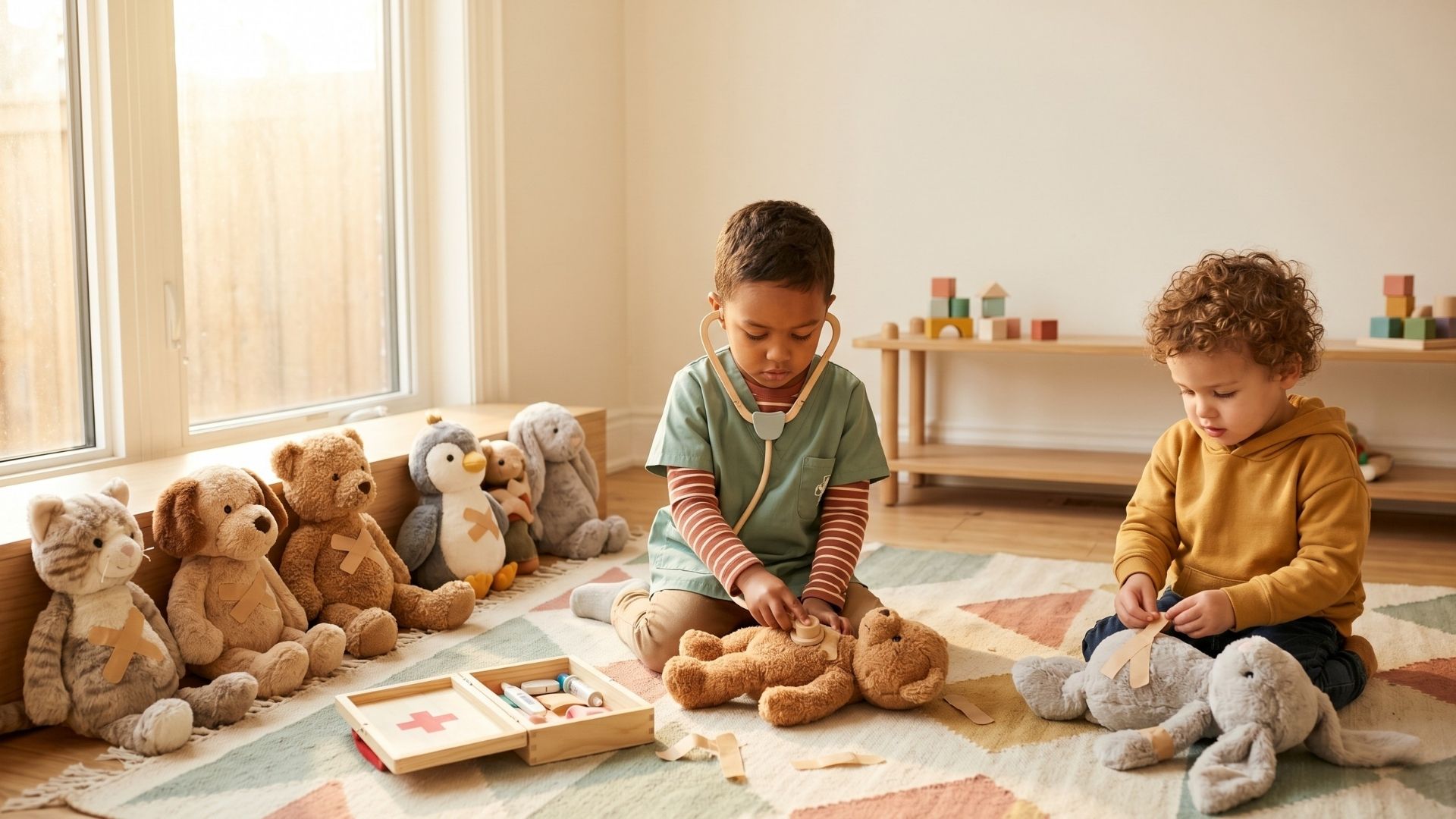
- Vet clinic. Stuffed animals lined up as patients, a doctor kit, paper for charts, masking tape for casts.
- Spy mission. A list of small "missions" written on slips of paper (find something blue, draw a map of the kitchen, deliver a secret message). Sneaky voices for an hour.
- Post office. Envelopes, stamps drawn with markers, a postbox made from a shoebox. They write letters, deliver, write back.
- Theatre or puppet show. Couch cushions or a sheet for a stage, stuffed animals or paper-bag puppets as characters, a 5-minute show for whoever can be assembled as audience.
Art and craft (5 low-mess ones).
- Paper-bag puppets. Brown paper bags, markers, glue sticks, scraps of construction paper. Each kid makes a puppet, then a 30-second show.
- Watercolour postcards. Watercolour paper cut postcard-size, washable watercolours, brushes. Each kid makes a card per family member.
- Sticker mosaics. A single sheet of paper, a pile of small stickers, and a prompt (a cat, a garden, your name in stickers). Zero mess.
- Salt-dough ornaments. 1 cup salt + 1 cup flour + 1/2 cup water, knead, roll, cut with cookie cutters, bake at 200F. Active part is 30 minutes; bakes for hours.
- Air-dry clay sculpting. A small block per kid on a placemat. They sculpt for 30-45 minutes; you let it dry on a tray for two days.
Building and engineering (5 ideas).
- Magna-Tiles ramps and marble runs. Two preschoolers can build a ramp system for 45+ minutes.
- Cardboard box engineering. Save a big cardboard box. Markers, scissors, tape. It becomes a spaceship, fort, or castle.
- Block tower challenges. "Tallest tower in three minutes." "Build a copy of mine from memory." Three rounds, full activity.
- Marble runs (ready-made sets). Endless variations.
- Engineering with kitchen supplies: paper cups, paper plates, masking tape, popsicle sticks. Build a bridge that holds a stuffed animal.
Movement (5 ideas).
- Floor is lava. Couch cushions on the floor as islands; the kids hop between them.
- Indoor obstacle course. Crawl under the chair, jump over a pillow, balance along masking tape, do five jumping jacks, run back. Time them.
- Animal yoga. Cat stretch, frog jumps, bear crawls. A yoga-cards deck makes it 20 minutes.
- Dance party with freeze. Music, dance, pause every 20 seconds, freeze.
- Balloon volleyball. A balloon, a yarn or couch as the net.
Pick three to four for a 90-minute playdate. Cycle through; preschoolers absorb in each activity for 25 to 45 minutes.
The 60-minute attention curve (and why it matters)
A typical preschool playdate runs through three energy phases: settle-in (15-20 minutes), peak (30-40 minutes), wind-down (15-20 minutes). Total length: 75 to 100 minutes.
Settle-in.
Open with something low-stakes. A bin of blocks on the floor. A stack of picture books. A simple craft (sticker mosaic). Do not start with the elaborate pretend setup; the kids need 15 minutes to re-acquaint and warm up.
Peak.
Once they are warm, transition to the absorbing activity. Pretend play setups land best here. The vet clinic, the restaurant, the cardboard-box spaceship. This is when 30 to 40 minutes of focused absorption happens; do not interrupt.
Wind-down.
Snack and a quieter activity. Pull out books, set up a puzzle, put on a quiet song. Do not start anything new and exciting at the 75-minute mark; you are heading toward pickup, and the energy needs to come down.
If the playdate is going well past 100 minutes, you can extend, but watch for the quality drop. Past 90 minutes, conflict frequency rises noticeably.
Pretend play setups: the magic of the preschool playdate
The single highest-yield investment for a preschool playdate is a pretend-play setup. Two preschoolers will agree on a story and sustain it for 40+ minutes if the materials are there.
What makes a good pretend setup:
- Concrete props the kids can manipulate (toys, costumes, paper, props). Abstract "imagine you're at the beach" works less well than "here is a small bowl, a sponge, and a toy crab; you are at the beach".
- An open prompt, not a script. "You are running a restaurant" gives them ownership; "the customer wants pizza, here is what they say" turns it into a parent-led roleplay, which lands less well.
- Two of any popular prop. One doctor kit means a tug-of-war; two doctor kits means parallel-then-cooperative play.
- A defined area. Pretend play happens better in a contained space (the rug, the corner of the room) than spread across the whole house.
Once the setup is there, retreat. Sit nearby, half-listen, do not direct. Most preschoolers will glance at you for confirmation when they invent a wild plot twist; nod, smile, say "that sounds amazing," go back to whatever you are doing. Hovering kills pretend play.
Sharing, turn-taking, and the conflict curve
Preschoolers can share, with structure. They cannot share without it. The playdate is going to involve turn-taking conflicts; the question is how you handle them.
Three structures that work.
- The visible timer. Set a timer on your phone with the screen showing. "Maya gets the truck for two minutes, then it is Sam's turn for two minutes." The timer is the authority; you are the bystander.
- The two-of-everything rule. Where possible, set up two of any popular thing (two dolls in the family, two markers, two play swords). Cuts conflict in half.
- The both-can-use-it framing. Some toys are not turn-take-able; they are use-together-able. "You can both sit at the kitchen and cook side by side." Reframes parallel use as collaboration.
When a conflict happens, intervene quickly and calmly. "I can see you both want this. Let us set the timer." Do not let it escalate to tears; preschoolers' emotional regulation is still developing and a full meltdown takes 20+ minutes to come back from.
Snack and break planning
Preschoolers run on snacks. Plan two snack windows into a 90-minute playdate.
Snack 1: 30-40 minutes in.
Mid-playdate. The first absorbing activity is winding down; the kids need fuel for the next one. Easy options: cucumber slices, cheese cubes, crackers, fruit. Sit at the table for 10 minutes; this is the natural reset between activities.
Snack 2: 80 minutes in.
End of playdate, just before parent pickup. A small treat (cookie, mini-cupcake, fruit popsicle) marks the conclusion. Kids who get a clear endpoint snack tend to have smoother transitions out of the playdate.
For the snack list itself, our guide to playdate snacks covers the 30 best options across allergies and prep effort. For allergy considerations, see playdates and food allergies.
Drinks: water, water, water. Skip juice; the sugar-rush-then-crash adds 20 minutes of chaos to the second half of the playdate.
When preschoolers click vs. when they do not
Not every preschool pairing works. Watch for the signs across the first 30 minutes; if the chemistry is off, adjust.
Signs they click.
They glance at each other often. They negotiate (briefly) about the pretend story. They laugh at the same things. One of them suggests an activity, the other says yes. They share without prompting at least once. They ask for the other kid by name in the days after.
Signs they do not.
They play in completely separate spots after 30 minutes. Conflict every 5 minutes. One kid is constantly trying to direct the other ("no, you have to play the patient"). One kid retreats, the other follows demanding engagement. They ask repeatedly when the playdate ends.
If they do not click after one or two playdates, that is information, not failure. Preschoolers have personalities; some pair well with quiet kids, some with bouncy kids. Try one more playdate in a different setting (the park instead of home) to confirm; if it still does not flow, gracefully space the playdates further apart and let it fade.
Activities and items to skip at this age
A few common parent-imagined preschool activities are not actually a great fit.
- Long board games (Monopoly, Risk, anything 60+ minutes). Preschool attention does not stretch that far; pick games under 20 minutes (Memory, Snail's Pace Race, Spot It, Uno).
- Highly structured craft kits. Pre-cut, follow-the-instructions craft kits look great in the box but lose preschoolers fast; they do not have the fine motor skill or sustained focus for 30-step instructions.
- Anything competitive that produces a single winner. Preschoolers do not handle losing well yet. Skip the win-loss games; pick collaborative versions (Hoot Owl Hoot, Race to the Treasure).
- Parent-led group games (Simon Says, freeze tag) for groups of two. These work for parties of 6+; for a two-kid playdate, they are over in 5 minutes.
- Anything requiring reading. Preschoolers cannot read; activities that depend on it (board games with text-heavy cards, scavenger hunts with written clues) do not work. Use pictures or have an adult read.
- Movies. Tempting as a quick win; you have just lost the playdate. Save the movie for a one-on-one quiet evening.
When in doubt: shorter, more open-ended, more pretend-friendly. The activities that work best for preschoolers are the ones with the lowest instruction count.
Frequently asked questions
How many activities should I plan for a 90-minute preschool playdate?
Three to four. One settle-in activity (15-20 minutes), one peak activity (30-40 minutes), one wind-down (15-20 minutes), with a snack window between each. Do not over-plan; if the kids are absorbed in the peak activity, let it run.
What if my preschooler refuses to share with the visiting kid?
Start with the timer. Acknowledge the feeling first ("I can see you really love that toy"), then introduce the structure ("two minutes each, the timer will tell us when to swap"). Most preschoolers accept the timer within a few uses. If it keeps being a problem, do more two-of-everything setups.
Should I provide costumes for pretend play?
If you have them, yes; if not, no. A few simple dress-up items (a doctor coat, a fire helmet, a couple of capes or dresses) significantly extend pretend-play absorption. But preschoolers can pretend with no costume at all; the prompt and the props matter more than the dress-up.
What is the right number of kids for a preschool playdate?
Two is best, three works, four starts to fragment. Three preschoolers often produce a 2+1 dynamic where one kid feels excluded; supervise and rotate the activities to keep all three engaged. Four is a small party, not a playdate; needs more structure and a longer timeframe.
What about a preschooler who is shy or slow to warm up?
Build in a longer settle-in window (30 minutes instead of 15). Start with side-by-side activities (drawing on a shared piece of paper, building separately from a shared bin) before any cooperative pretend play. The shy kid may need 20 to 40 minutes before feeling comfortable enough to engage; if you push for engagement earlier, they will retreat.
Can I leave the room during a preschool playdate?
Briefly, yes; for the kitchen, the bathroom, to grab a forgotten snack. For longer than 5 minutes, stay within earshot. Preschoolers can play independently, but they need an adult present for safety, conflict mediation, and the social-modelling part of the playdate. Drop-off playdates start to work around age 5 to 6, not before.